Time is a stern teacher of nations. It reshapes alliances, reorders priorities, and reminds states that geography becomes destiny only when political wisdom knows how to use it. Across the Indo-Pacific and the wider Muslim world, countries are again testing whether shared interests can be converted into collective strength.
Sixty-two years ago, Pakistan, Iran, and Turkey confronted a similar question. In July 1964, the three regional members of the Central Treaty Organization established the Regional Cooperation for Development (RCD) through the Istanbul Agreement. Unlike CENTO, the RCD was not a military alliance. Its purpose was economic, technical, and socio-economic cooperation—turning geographical proximity into commercial opportunity and political understanding into practical development.
The RCD pursued joint ventures in industry, trade, transport, and culture, and facilitated travel and postal exchanges. One of its most enduring physical legacies in Pakistan was the RCD Highway, now known as the N-25, which remains a vital artery linking Sindh and Balochistan. But the RCD became a lesson in the gap between aspiration and achievement. Financial constraints, protectionist policies, administrative weaknesses, and divergent national priorities slowed implementation. The organization never acquired the institutional depth needed for genuine economic integration.
Political upheaval in Iran brought its formal end in 1979. Yet the idea survived. In 1985, Pakistan, Iran, and Turkey revived it through the Economic Cooperation Organization, later expanded to include Central Asian states and Afghanistan. The RCD's history contains a paradox: its institutional record was modest, but its strategic vision was ahead of its time.
From development to deterrence
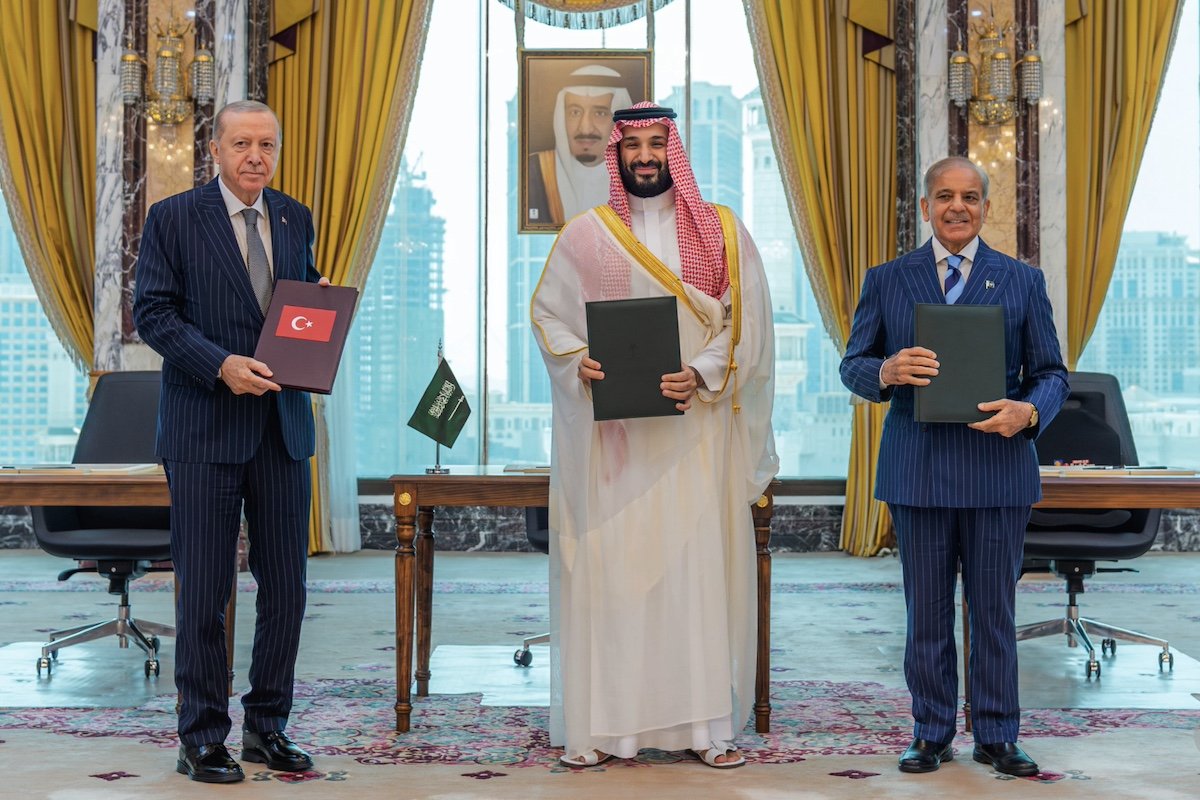
Today, the region is witnessing another attempt to convert shared interests into collective strength—this time principally through security. On August 7, 2026, Pakistan, Saudi Arabia, and Turkey signed the Makkah Joint Defense Agreement, declaring that an armed attack against one would be regarded as an attack against all. Signed in Makkah amid extraordinary regional uncertainty, it aims to strengthen collective deterrence and defense cooperation. The governments have emphasized that the arrangement is defensive and not directed against any particular country.
The agreement did not emerge from a vacuum. Pakistan and Saudi Arabia had already signed their Strategic Mutual Defense Agreement in September 2025. The Makkah pact therefore widens an existing security relationship. Turkey brings one of the region's most capable armed forces and a sophisticated defense industry. Saudi Arabia contributes economic weight, strategic geography, and an ambitious defense-localization program. Pakistan offers decades of military experience, defense-industrial capacity, and the Muslim world's only established nuclear deterrent. Together, they combine military capability, economic strength, and technological capacity.
If wisely institutionalized, their cooperation could move beyond symbolism. Joint exercises, intelligence sharing, counterterrorism, maritime security, cyber defense, defense production, and technological research could gradually create a functioning security architecture. That distinction is crucial. The history of RCD teaches that agreements perish when institutions remain weak. The Makkah agreement will face the same test; its future depends not on the grandeur of its declaration but on the seriousness of its implementation.
For Pakistan, the arrangement carries particular significance. Islamabad gains a stronger regional security partnership with two states of considerable diplomatic, economic, and military influence. Saudi Arabia remains a vital economic partner; Turkey has become a trusted defense and technological partner. The combination offers greater strategic depth in a fragmented international system. Yet Pakistan must approach the opportunity with confidence and prudence. A defense agreement should never substitute for economic strength. Sustainable national power rests on economic resilience, technological advancement, political stability, and institutional capacity. Pakistan should therefore convert the relationship into industrial partnerships, technology transfer, investment, energy cooperation, and increased trade.
There is also a danger of allowing outsiders to define the agreement. Some interpret it as a sectarian bloc directed against Iran. Others see an anti-Western arrangement or speculate about hidden nuclear dimensions. India and Israel seem particularly troubled by the trilateral understanding. Such conclusions are premature. The signatories have rejected claims of a sectarian or nuclear alliance and described the pact as defensive. Nor is it a rejection of the West. Each country maintains important Western relations. The pattern is better understood as strategic diversification: regional powers seeking the capacity to protect their interests without depending on a single external guarantor.
That is the most important change since the days of RCD. In 1964, cooperation was imagined through the language of development—roads, trade, industry, and culture. In 2026, the vocabulary has shifted to deterrence, maritime security, terrorism, technological warfare, energy security, and strategic autonomy. Beneath the changing language lies the same idea: regional states must turn common interests into common strength. If current arrangements translate into permanent mechanisms, joint capabilities, and sustained political will, the Makkah agreement could become a cornerstone of a more autonomous regional security architecture. As our analysis of the pact's strategic nature notes, it is a hedge, not a revolution. Pakistan must seize the moment without losing sight of wider responsibilities. Its relationships with Saudi Arabia, Turkey, and Iran need not be mutually exclusive. History shows that paper agreements cannot erase historical realities; only robust institutions can. The lesson of RCD is clear: without institutional depth, even the most visionary pacts remain hollow.