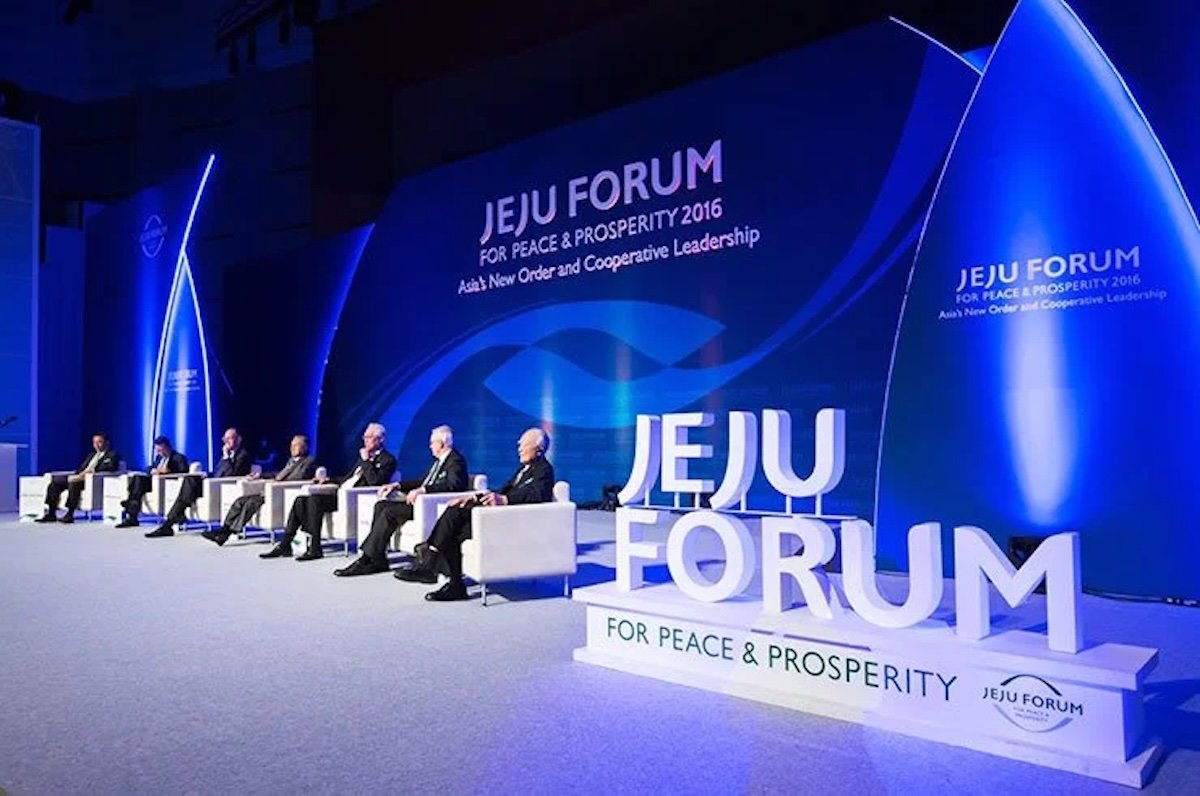
As South Korea prepares to host the Jeju Forum for Peace and Prosperity from June 24 to 26, policymakers across Asia face a pressing question: what is the future of peace on the Korean Peninsula? The forum arrives at a moment of profound transformation, driven by intensifying geopolitical competition, North Korea's accelerating military capabilities, shifting alliance dynamics, and mounting economic and demographic pressures within South Korea itself. These forces are fundamentally reshaping the foundations that have underpinned regional stability for decades.
Pyongyang's Strategic Shift
On June 13, 2026, North Korea issued one of its most definitive statements on inter-Korean relations in recent years. In a declaration titled "South Korea Remains an Unchanging Enemy State That Has Internalized Hostility and Confrontation," Pyongyang explicitly rejected the possibility of peaceful coexistence and reaffirmed its position that South Korea is a permanent hostile state. This is not routine political rhetoric. The statement directly challenges the premises of previous peace initiatives by dismissing concepts such as reconciliation, peaceful coexistence, and eventual reunification.
For decades, despite recurring crises and military confrontations, both Koreas officially maintained that reunification remained a long-term objective. That framework is now rapidly eroding. North Korea increasingly views South Korea not as a partner for eventual reunification but as a separate and hostile state. The language used in the June statement leaves little room for future reconciliation efforts and suggests that Pyongyang now approaches inter-Korean relations primarily through a military and security lens.
Growing Confidence in Pyongyang
This shift reflects North Korea's growing confidence in its strategic position. Deepening military cooperation with Russia, continued advances in nuclear and missile capabilities, growing diplomatic relevance amid intensifying geopolitical competition, and greater confidence in its ability to withstand sanctions have all strengthened Pyongyang's sense of leverage. As a result, the North Korean leadership appears to see little strategic benefit in engagement with Seoul.
Particularly concerning is North Korea's accelerating expansion of its nuclear arsenal. Recent statements by Kim Jong-un and North Korean state media indicate a determination to continuously increase both the quantity and sophistication of the country's nuclear weapons. Combined with advances in ballistic missile technology, tactical nuclear systems, and strategic delivery platforms, North Korea's growing nuclear capabilities represent one of the most serious security challenges facing Northeast Asia. The continued expansion of its nuclear arsenal not only undermines prospects for denuclearization but also increases the risks of miscalculation, arms competition, and strategic instability throughout the region.
For South Korea, these developments pose a dual challenge. Domestically, President Yoon Suk Yeol's administration faces growing economic headwinds, demographic decline, and political polarization. Internationally, Seoul must navigate an increasingly complex alliance with Washington while managing relations with Beijing and Tokyo. The Washington's Memorandum Habit highlights how paper agreements alone cannot resolve deep-seated historical tensions, a lesson that resonates on the Korean Peninsula.
The Jeju Forum provides a platform for discussing these challenges, but the gap between diplomatic dialogue and on-the-ground realities is widening. As North Korea solidifies its hostile posture and expands its military capabilities, the prospects for a negotiated peace appear increasingly remote. The region's middle powers, including Australia and members of ASEAN, must consider how to safeguard their interests in an environment where the risk of miscalculation is rising.
Ultimately, the future of peace on the Korean Peninsula depends not only on the actions of Pyongyang and Seoul but also on the broader geopolitical dynamics that shape their choices. The US-Iran Peace Deal Shakes China's Energy Calculus illustrates how major power agreements can ripple across Asia, affecting energy security and strategic alignments. Similarly, any shift in the Korean Peninsula's security architecture will have far-reaching implications for the entire Indo-Pacific region.