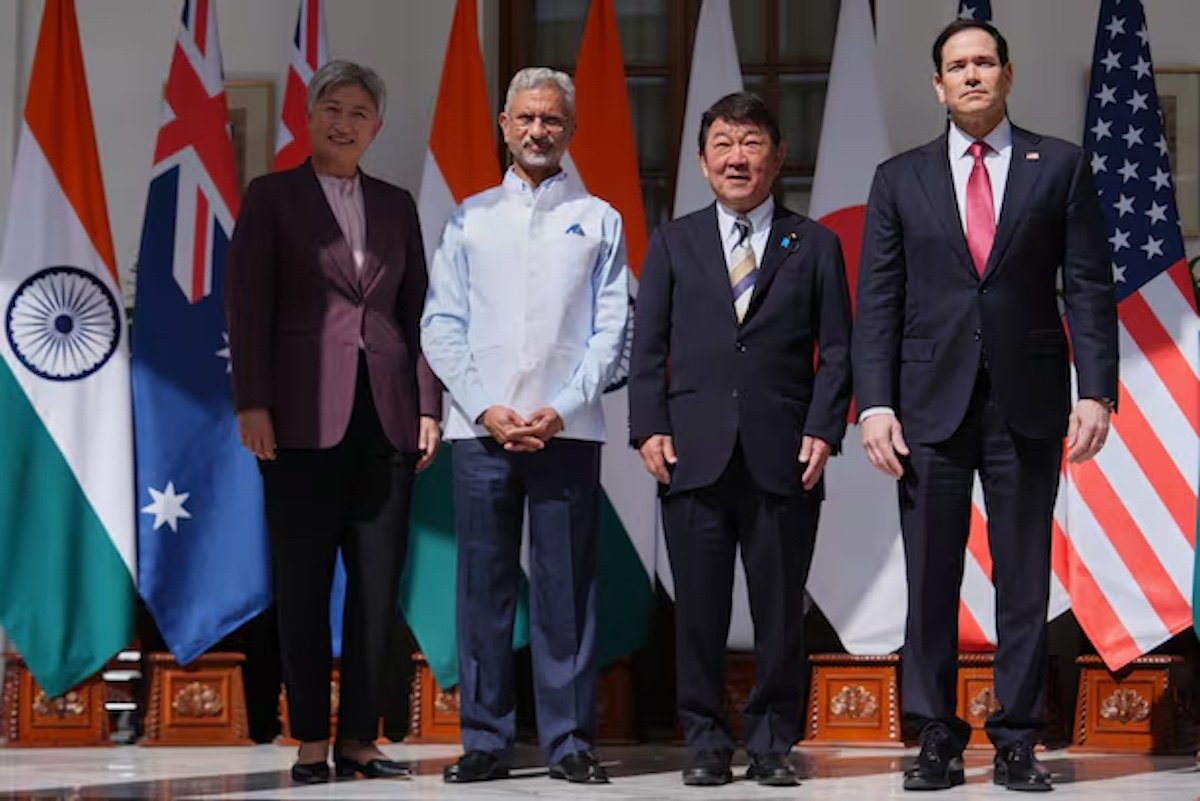
While the Shangri-La Dialogue in Singapore grabbed headlines with its speeches on military competition, the most consequential development for the Indo-Pacific last week may have been the decisions announced days earlier at the Quad foreign ministers’ meeting in New Delhi. There, India, Japan, Australia, and the United States unveiled a slate of initiatives focused on infrastructure, maritime surveillance, and critical minerals—signaling a strategic pivot that extends well beyond traditional defense.
The Quad’s emphasis on a port project in Fiji, alongside maritime domain awareness programs, reflects a broader recognition that strategic competition in the Indo-Pacific is increasingly about the arteries of trade and connectivity. As the region’s economic geography shifts, ports, undersea cables, and logistics hubs are no longer seen merely as commercial assets but as components of national resilience and economic security.
From Military Balances to Economic Geography
According to UNCTAD, roughly 80% of global trade by volume moves by sea. Much of Asia’s growth depends on maritime routes stretching from the Persian Gulf through the Indian Ocean, the Malacca Strait, and the South China Sea into the Pacific. The South China Sea alone carries about one-third of global maritime trade, worth over US$3 trillion annually, along with more than 30% of global crude oil and nearly 40% of liquefied natural gas shipments.
As trade and supply chains concentrate around a relatively small number of chokepoints, infrastructure has acquired heightened strategic significance. The Quad’s new agenda reflects this reality, moving beyond the military deterrence that dominated the Shangri-La Dialogue to address the underlying infrastructure that sustains regional economies.
China’s expanding economic footprint has accelerated this shift. Beijing is the largest trading partner for most East and Southeast Asian economies, and Chinese firms have developed commercial interests in ports, logistics facilities, and telecommunications networks across strategically important maritime regions through the Belt and Road Initiative. For countries like Australia, Japan, and India, the concern is less about any single project than the cumulative effect of Chinese influence over the connectivity networks that underpin regional prosperity.
The Pacific Islands: A New Strategic Frontier
The Pacific Islands have moved from the margins to the center of this strategic calculus. Chinese diplomatic engagement and infrastructure investment have expanded across Kiribati, the Solomon Islands, Papua New Guinea, Vanuatu, and elsewhere. The 2022 security agreement between China and the Solomon Islands reinforced concerns that economic engagement could gradually facilitate broader strategic access.
Geography explains much of the region’s importance. Although Pacific Island states have relatively small populations, they collectively control vast Exclusive Economic Zones spanning millions of square kilometers of ocean. These maritime spaces sit astride routes linking Asia, Oceania, and the Americas, and they increasingly form part of the wider communications and logistics architecture of the Indo-Pacific.
The Pacific is also vital to global digital connectivity. More than 95% of international data traffic travels through submarine cables, and several major cable systems linking North America, Asia, and Oceania pass through or near Pacific Island territories. As economic activity becomes increasingly dependent on digital infrastructure, concerns about connectivity and security now extend well beyond ports and shipping routes.
This explains the significance of the Quad’s decision to support infrastructure development in Fiji. By combining port investment with maritime surveillance and domain awareness programs, the Quad is seeking to strengthen connectivity and improve visibility across a region critical to trade, communications, and strategic access. The initiative echoes similar efforts elsewhere, such as India-Vietnam BrahMos Deal Strengthens Indo-Pacific Deterrence Against China, which underscores the growing importance of maritime partnerships.
Chokepoints and the Great Nicobar Project
Similar considerations are shaping strategic thinking across the Indo-Pacific. India’s Great Nicobar project, located near the western approaches to the Malacca Strait and adjacent to the Six Degree Channel, occupies a position close to one of the world’s most important maritime corridors. About 75% to 80% of China’s oil imports transit the Strait of Malacca, while the wider maritime system connecting the Indian Ocean, the South China Sea, and the Pacific is central to the trade and energy security of major Asian economies, including China, Japan, South Korea, and India.
Great Nicobar is significant because it strengthens India’s position within this wider maritime geography. Enhanced logistics infrastructure, port facilities, and surveillance capabilities would improve India’s ability to monitor and respond to developments in a region where economic and strategic interests converge. This aligns with broader trends, such as Japan-Australia Frigate Deal Cements New Defense Axis in Indo-Pacific, which highlights the growing emphasis on maritime security cooperation.
The Quad’s new agenda—ports, cables, and minerals—represents a recognition that the Indo-Pacific’s future will be shaped as much by the resilience of its infrastructure as by the balance of military power. As the region’s economic geography continues to evolve, the ability to secure and control the networks that sustain trade, energy, and digital connectivity will become an increasingly central dimension of strategic competition.