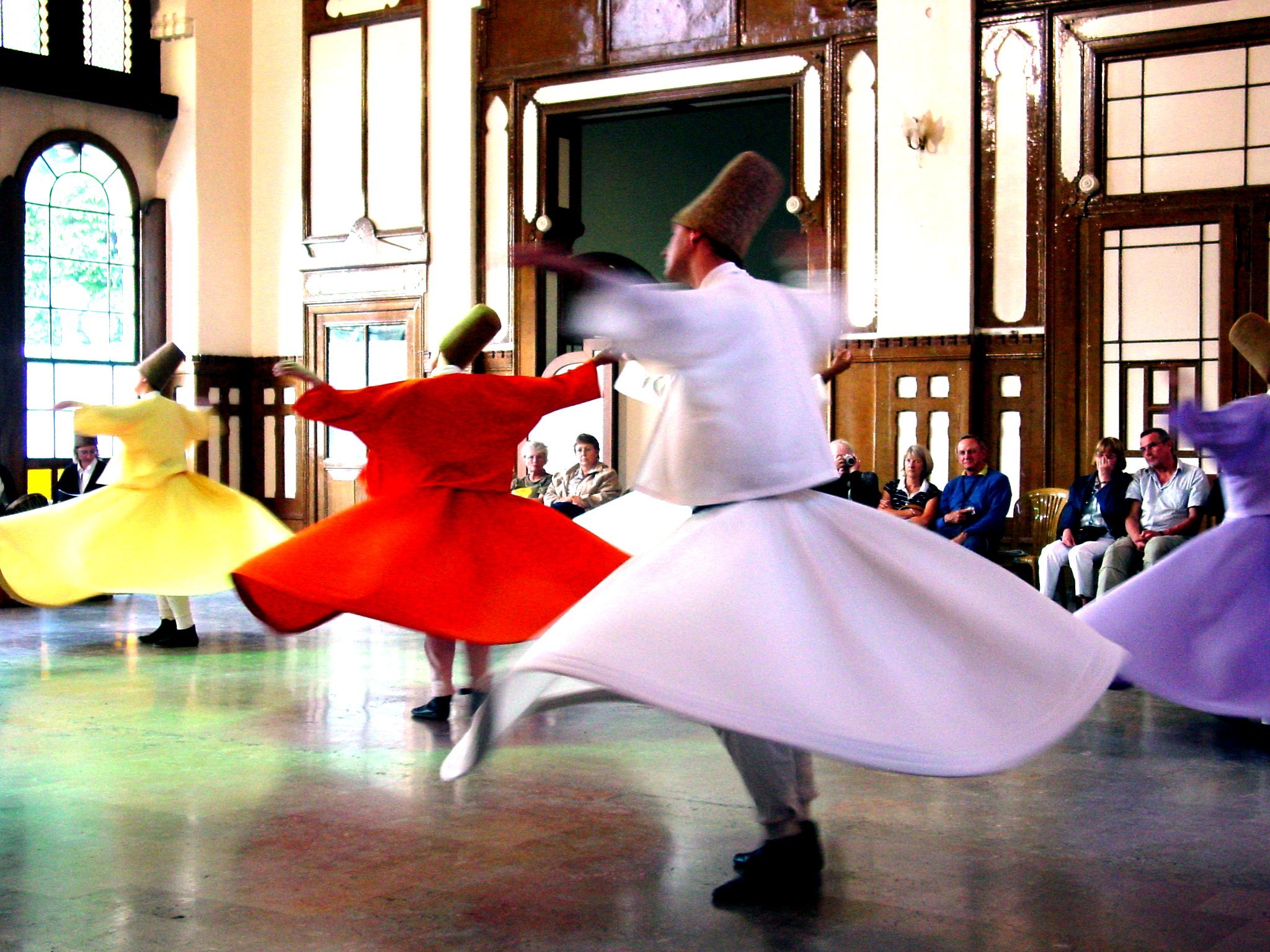
Every December, thousands of pilgrims converge on Konya, Turkey, to commemorate the death of Jalal al-Din Rumi, the 13th-century poet and Sufi mystic. His followers call the night Shab-e 'Arūs, or "wedding night," marking the moment they believe he was united with the divine. The ceremony, known as Sema, features white-robed dervishes spinning in ritual worship—a practice that has become a global symbol of Turkish culture.
Yet thousands of miles away, in the United States, Rumi's words appear on wedding programs, yoga studio walls, and social media feeds. He is one of the best-selling poets in America, but many of his readers may not realize how deeply his poetry is rooted in Islam. As a scholar of Sufism, I see a stark divide between the Rumi revered in Konya—a Muslim legal scholar and preacher—and the spiritual sage quoted on Instagram. The popular English translations that made him famous often strip away the religious depth that gives his work its power.
Who was Rumi?
Born in 1207 in Balkh, in present-day Afghanistan, Rumi's family fled westward as Mongol armies swept across Central Asia, eventually settling in Konya, then part of the Seljuk Sultanate. Like his father, Baha al-Din Walad, Rumi trained in Islamic law and theology, becoming a respected teacher. His life changed in 1244 when he met Shams of Tabriz, a wandering Sufi teacher whose intense companionship upended Rumi's scholarly existence. After Shams disappeared, Rumi channeled his longing into thousands of lyric poems, later collected as the Divan-e Shams. Most are ghazals—short love poems with a single repeating rhyme, often composed during gatherings of music and dance.
Rumi's masterpiece, however, came later and took a different form: the masnavi, a Persian poetic form built from rhyming couplets. Because each couplet can have its own rhyme, the form allows for almost endless narrative, making it ideal for long spiritual epics. Rumi's Masnavi-ye Ma'navi, or Spiritual Couplets, dictated to his disciple Husam al-Din Chelebi from around 1258 until his death, runs to some 25,000 couplets across six books. It opens with the lament of a reed flute separated from its reed bed—a classic Sufi metaphor for the soul's longing to return to its divine source.
The Masnavi is less a single story than a vast, winding conversation, weaving animal fables, bawdy tales, Quranic stories, and reflections on the sayings of the Prophet Muhammad. Rumi himself described it as "the roots of the roots of the roots of religion" and "the explainer of the Quran." Later admirers went further, calling it "the Quran in the Persian tongue," a phrase traditionally attributed to the 15th-century poet Jami. For centuries, Muslims from the Balkans to South Asia have gathered in circles to read and study the Masnavi line by line.
Lost in translation
Translating poetry always involves trade-offs between sound and sense, but with Rumi the stakes are especially high because his meaning is so intertwined with Islamic theology. Faithful translations exist—such as those by Reynold Nicholson in the early 20th century—but they are not the versions most Americans read. The most popular are by the American poet Coleman Barks, who, beginning in the 1970s, reworked earlier scholarly translations into free-verse American English. Barks did not read Persian, and his versions often omit or soften the religious references, presenting Rumi as a universal mystic rather than a devout Muslim.
The result is a Rumi who fits comfortably into American spiritual consumerism, but at the cost of his historical and religious identity. For those who encounter Rumi only through Barks, the poet becomes a source of inspirational quotes, divorced from the Quranic verses and Sufi practices that shaped his worldview. This gap matters not only for literary accuracy but for cultural understanding: it obscures the Islamic heritage of one of the world's most beloved poets, and it flattens the rich diversity of Muslim intellectual and artistic traditions.
As Rumi's popularity continues to grow in the West, readers might do well to seek out translations that preserve his faith, or at least to recognize that the Instagram sage is a modern creation. The real Rumi—the scholar, preacher, and mystic who whirled in Konya—remains a figure of profound religious devotion, and his poetry is inseparable from that devotion. Understanding that connection is essential to appreciating the full depth of his work.