When US Secretary of War Pete Hegseth addressed the Shangri-La Dialogue in Singapore, his message was unmistakable: the era of America subsidizing the defense of wealthy allies is finished. Hegseth outlined a doctrine of “pragmatic idealism,” demanding partners rather than protectorates. For decades, the post-Cold War order assumed the US security umbrella was permanent. That assumption is now collapsing, replaced by a transactional blueprint that forces major Asian powers—especially Japan—to rapidly reassess their strategic foundations.
For Tokyo, Hegseth’s declaration landed with particular force. The automatic assurance that once underpinned the US-Japan alliance has evaporated. As we explored in our analysis of Asia's security realignment beyond the US shield, the Shangri-La Dialogue has evolved into a laboratory for geopolitical adaptation. Medium and major powers are discovering that traditional alliances no longer guarantee stability. National resilience must now be engineered through self-reliance, enhanced capabilities, and carefully cultivated regional partnerships.
Japan's Strategic Realignment
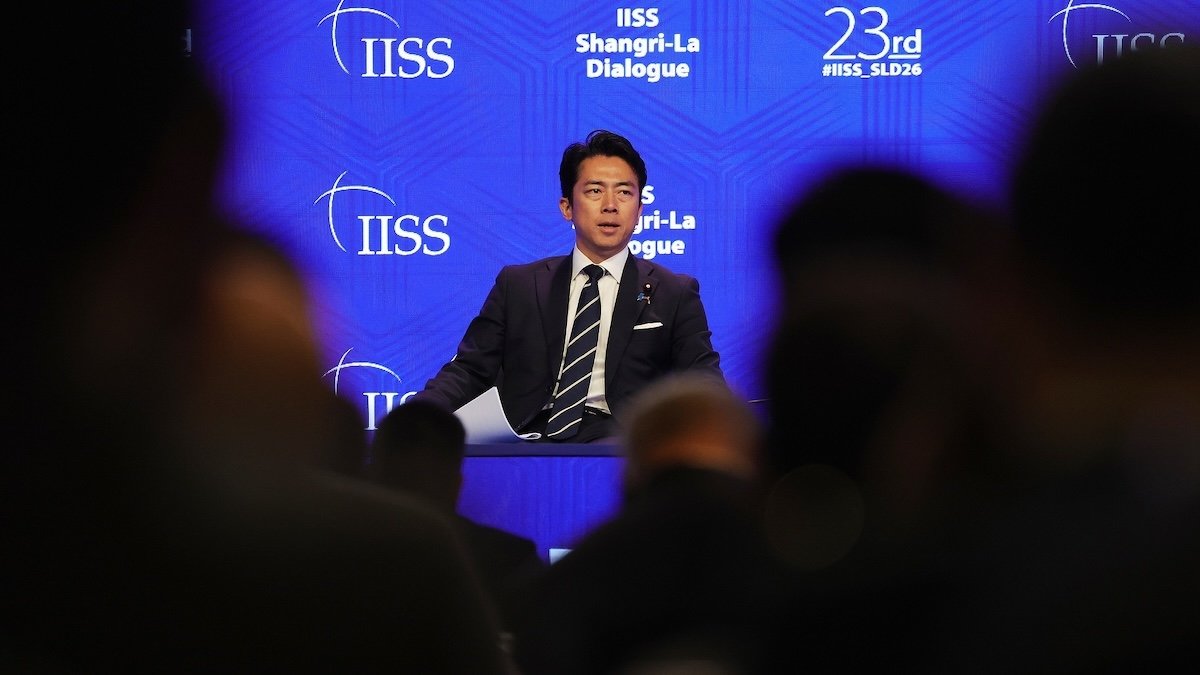
This shift is not a retreat into isolationism but a structural fragmentation of global security into localized, parallel arrangements. For Japan, it is a generational realignment. Japanese Defense Minister Shinjiro Koizumi used the Singapore summit to deliver a sophisticated defense of Tokyo’s evolving posture. Rather than defensive rhetoric, Koizumi emphasized that Japan’s door to dialogue remains open, even as it advances concrete defense enhancements.
Tokyo is moving forward with tangible initiatives: expanding defense technology co-production, revising arms export guidelines to enable greater collaboration, and strengthening maritime partnerships across Southeast Asia—notably with the Philippines, Australia, and South Korea. These steps build on Japan’s recent decisions to raise defense spending toward 2% of GDP and invest heavily in next-generation capabilities such as missiles, cyber defenses, and joint production arrangements. This represents a major evolution from Japan’s post-war pacifist constraints.
No longer waiting for external clarity, Tokyo is quietly building its own minilateral defense networks. These efforts include deeper integration with like-minded nations through frameworks emphasizing interoperability, intelligence sharing, and joint exercises—all while maintaining a commitment to international law and a free and open Indo-Pacific. Yet the strategy is carefully calibrated. Japanese leadership has repeatedly emphasized that the door to dialogue remains open with all parties, including China. This approach rejects hostile framing in favor of practical diplomatic channels.
Broader Regional Trends
This balanced posture mirrors a broader regional trend: Asian powers are seeking to stabilize their environments through bilateral diplomacy, economic pragmatism, and incremental security cooperation rather than ideological crusades. As noted in our coverage of Shangri-La 2026: US Dominance, China's Retreat, India's Awakening, the Indo-Pacific remains the primary engine of global economic growth, and the unfolding dynamics expose three structural transformations.
First, middle and major powers are entering an era of calculated strategic autonomy, where nations like Japan must balance historical constraints with competitive imperatives. Second, the traditional security architecture is being replaced by a model of “businesslike cooperation” where burden-sharing is mandatory, compelling allies to demonstrate tangible contributions. Third, regional powers are taking the driver’s seat in managing their own neighborhoods, reducing reliance on external arbiters while preserving essential diplomatic channels.
Washington, meanwhile, faces a deeper dilemma than merely demanding allies pay their way. The current administration’s posture risks shifting from long-term systemic stability to short-term crisis management if not carefully managed. By prioritizing transactional outcomes over unconditional structural commitments, Washington is altering the psychological baseline of global deterrence. Governments from Seoul to Manila, and particularly in Tokyo, are quietly recognizing an uncomfortable truth: military dominance without absolute predictability forces every state to become an independent strategic actor.
These trends are already filtering into Japan’s domestic debates on constitutional reinterpretation, defense spending, and long-term strategic identity. For years, Western analysts assumed Japan would remain a passive consumer of Western defense guarantees. Instead, Tokyo is actively adapting to American transactionalism with sophistication and determination. The Shangri-La shockwave has made one thing clear: the era of automatic assurance is dead, and Asia’s security architecture will never be the same.