Just over a week after South Korea's local elections on June 1, the political conversation has taken an unexpected turn. A public opinion survey released on June 10 showed the conservative People Power Party (PPP) at 41.6% support, narrowly ahead of the Democratic Party's 40.4% — despite the latter winning most major races. The shift suggests public attention is moving from electoral outcomes to the controversy over how the vote was administered.
Reports of ballot shortages at polling stations across the country have transformed what initially seemed like isolated incidents into a broader institutional challenge. On June 5, the National Election Commission (NEC) reported shortages at 50 locations; three days later, it revised the figure upward to 91. The changing numbers have fueled public skepticism and raised questions about election administration.
According to the Chosun Ilbo, election authorities in Seoul's Songpa District prepared ballots for only 51% of registered voters, while Ongjin County in Incheon prepared enough to cover 100% of eligible voters. The report noted that local election offices exercised substantial discretion because no nationally standardized printing guideline had been clearly established. Courts have ordered the preservation of election materials while investigators examine how such disparities occurred.
Whether the explanation is administrative incompetence, procedural failure, or something more serious, many citizens are asking how such a breakdown could occur in one of Asia's most technologically advanced democracies. For deeper context on the systemic issues, see our earlier analysis: Ballot Shortages and Delays Undermine Trust in South Korea's Election System.
The Youth Take to the Streets
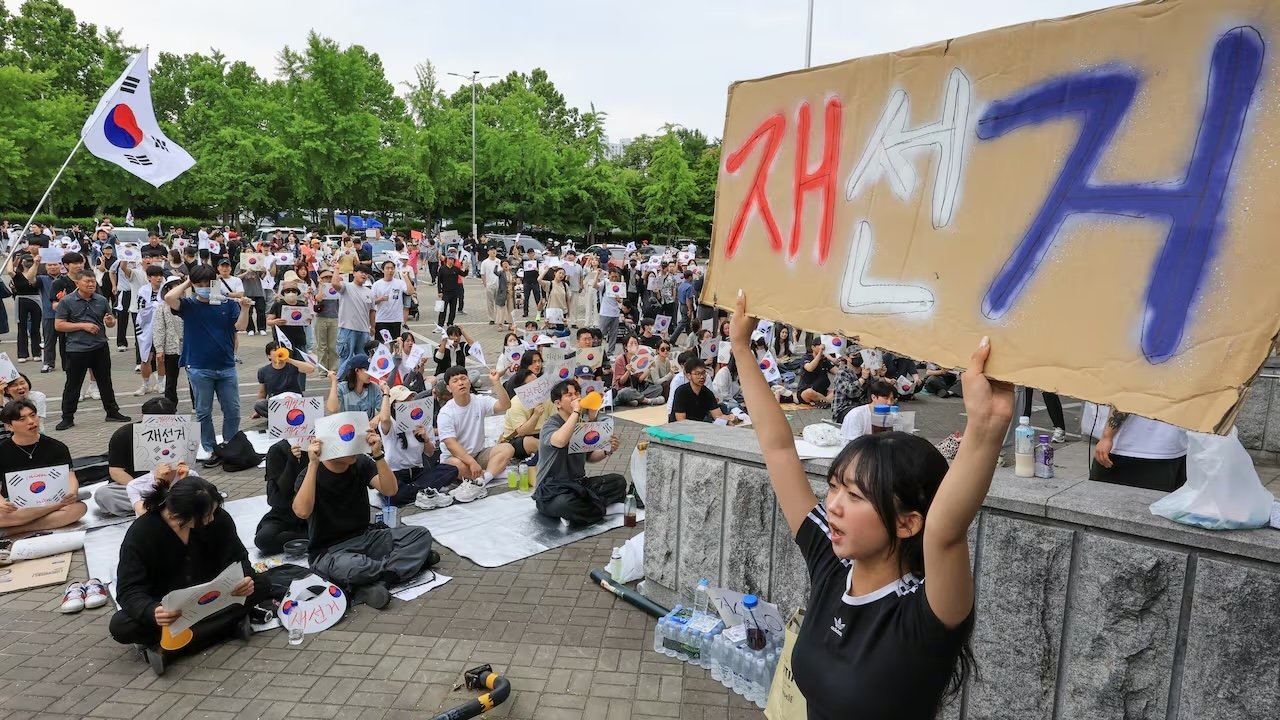
The most striking development may be who is asking those questions. Since election day, crowds of up to thirty thousand demonstrators have gathered daily near Jamsil Sports Complex, close to one of the most heavily publicized polling locations affected by shortages. Multiple reports indicate that voters in their twenties and thirties constitute a substantial portion of the crowds.
For longtime observers of South Korean politics, this is unusual. Large-scale street mobilization has not traditionally been associated with conservative causes or concerns about election administration. Yet many participants appear motivated less by ideology than by concerns about electoral transparency and institutional accountability.
One longtime conservative rally participant in her 40s described being surprised by the unusually young crowd and by students voluntarily cleaning protest sites after demonstrations. She later donated to the movement, saying the concerns voiced by young participants felt personal because her own daughter had recently entered university. Whatever the ultimate cause of the ballot shortages, the controversy has clearly energized a demographic that many political parties have struggled to engage.
Beyond the Conservative Base
The issue is also spreading beyond traditional conservative constituencies. The student government of Chonnam National University recently joined a nationwide declaration criticizing the ballot shortage controversy. That development is notable because the university is in the Jeolla region, long one of the Democratic Party's strongest political bases. Participation from institutions traditionally associated with progressive politics suggests the controversy is expanding beyond conservative circles and becoming a broader debate about confidence in electoral institutions.
Some younger participants have described the movement as a "second democratization movement," reflecting growing frustration with institutional accountability. The language may be dramatic, but it points to a growing perception among some younger voters that institutional accountability, rather than partisan loyalty, is becoming the defining issue. This sentiment echoes broader regional concerns about democratic resilience, as seen in South Korea's strategic autonomy push amid great-power competition.
Whether the ballot shortages ultimately prove to be the result of administrative incompetence, procedural failures, or deeper institutional weaknesses, the political effects are already visible. A generation of younger South Koreans that has often appeared disengaged from traditional politics is now demanding greater transparency from public institutions. That may become the most significant legacy of the controversy.