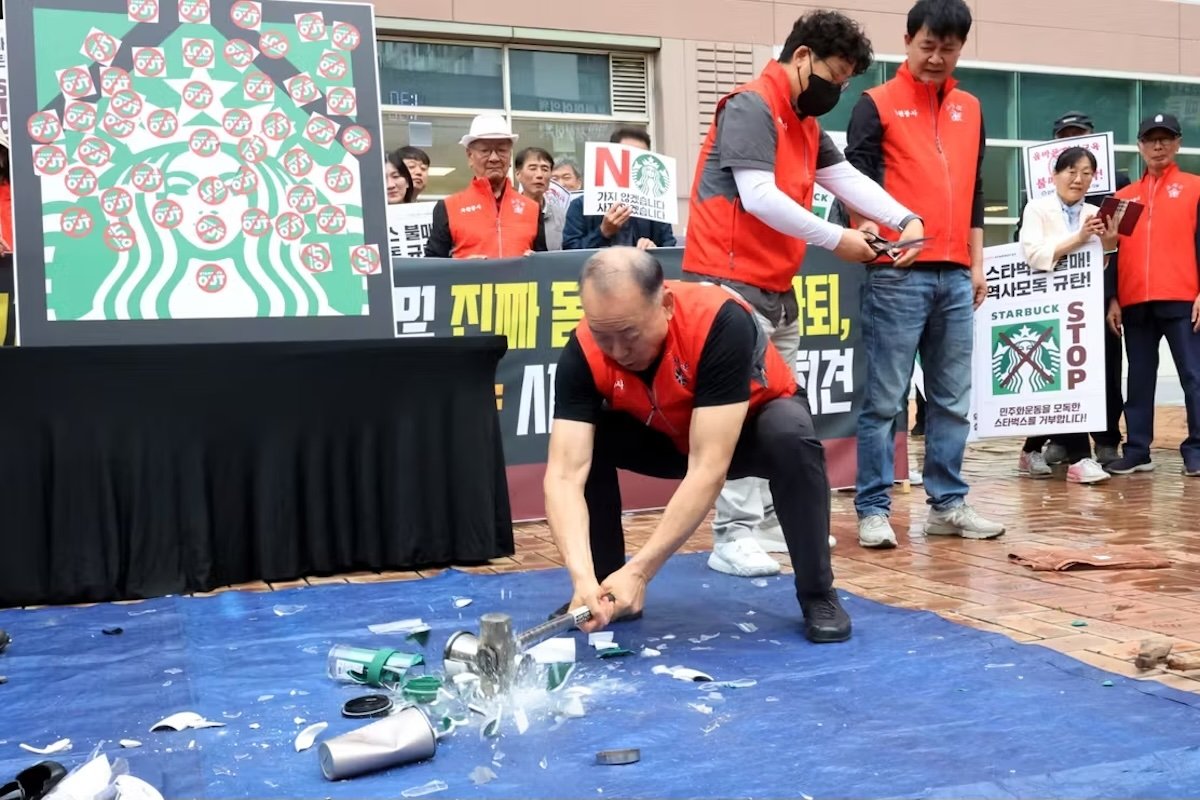
What began as a marketing misstep at Starbucks Korea has escalated into a criminal investigation that tests the boundaries of democratic memory in South Korea. Police are now probing Shinsegae Group chairman Chung Yong-jin and former Starbucks Korea CEO Sohn Jeong-hyun after complaints alleged insult, defamation, and violations related to the May 18 democratization movement. The complaints accuse them of insulting Gwangju citizens, victims, and bereaved families through the so-called “Tank Day” promotion, which featured a military-themed drink on the anniversary of the 1980 pro-democracy uprising.
The Seoul Metropolitan Police Agency has assigned the case and questioned complainants, moving with unusual speed. This is where liberal alarm should begin, as the distinction between intentional mockery and negligent coincidence becomes blurred under the weight of collective outrage.
When Memory Becomes a Prosecutorial Weapon
South Korea’s criminal defamation and insult laws already provide powerful tools for punishing speech. Under criminal defamation, even empirically true statements can expose speakers to liability if they damage others’ reputations and are not judged to have been made for the public interest. Separately, criminal insult law punishes contemptuous public expression even when it does not allege a falsity as fact. When these expansive legal tools are tied to sacred public memory, the danger grows. Memory becomes not only a moral inheritance but a prosecutorial weapon. The question shifts from “Was this stupid and insensitive?” to “Who can be criminally punished for failing to honor the memory in the required way?”
The arbitrary use of criminalized memory becomes clearer when one compares another Starbucks Korea marketing misadventure regarding a different historically sacred date. On March 26, 2010, the South Korean naval corvette Cheonan sank, killing 46 sailors. Yet Starbucks Korea on March 26, 2026, launched Dear20, a program for Starbucks Rewards members in their twenties. If one applies the punitive symbolic logic, a promotion aimed at customers in their twenties on the anniversary of Cheonan might be called offensive because many of the dead sailors were young men. Yet activists did not launch a campaign to punish Starbucks in the name of honoring the victims of March 26, and the police did not start a criminal inquiry.
In South Korea, the enforcement of criminal defamation and insult laws often depends less on consistent principle than on which memory is politically activated, which faction controls the state and media, and which target is socially safe to punish. This pattern is broader than Starbucks and Gwangju. A number of professors have been punished for lectures and scholarship allegedly defaming former comfort women for the Japanese military. After making remarks that some women probably volunteered to become comfort women, a Sunchon National University professor, surnamed Song, was fired and received a six-month prison sentence.
Park Yu-ha, a Sejong University professor and author of Comfort Women of the Empire, was sued, fined 90 million won in civil damages, and criminally prosecuted for defaming former comfort women. Although South Korea’s Supreme Court ultimately rejected criminal punishment by treating the disputed passages as academic argument or opinion, Park endured nearly eight years of reputational, financial, and institutional costs, from indictment in 2015 to the Supreme Court ruling in 2023.
Most recently, the American streamer known as Johnny Somali provoked public outrage for repeatedly disrupting public spaces and for kissing and hugging a comfort woman statue. He was sentenced to six months in prison after convictions that included obstruction of business and fabricated sexually explicit content. A liberal argument against excessive punishment should not minimize real offenses, especially sexual-image crimes. But even contemptible defendants retain rights because rights are not rewards for sympathetic behavior. Criminal law should punish specific proven acts, not satisfy public anger. Deportation, fines, restitution, and targeted penalties often serve justice better than symbolic imprisonment designed to reassure the public that the state has defended national honor.
South Korea’s democratic achievement is real: It overthrew military rule, built competitive elections, and developed a vibrant civil society. Yet its public culture still carries an illiberal, meongseokmari-style temptation to treat collective denunciation as civic virtue. This temptation is not confined to one side. Conservatives have their own versions around anti-communism, national security, and LGBT issues. The danger grows when any ruling party confuses communal punishment with justice.
Writers, academics, and public intellectuals should reject double standards. It is easy to criticize illiberalism when caused by right-wing governments, here or abroad. It is harder, but more necessary, to criticize illiberalism when one’s own preferred camp uses moral memory to discipline companies, citizens, celebrities, or dissidents. The test of liberal principle is not whether one defends virtuous persons from crude mobs. The test is whether one defends due process, proportionality, and viewpoint freedom when the target itself is crude and unpopular.
The true meaning of Gwangju is that state power becomes most dangerous when it convinces itself that it is justice and therefore stands above ordinary rules. The lesson of May 18 is not permanent suspicion against insufficiently reverent citizens, companies, celebrities, or consumers. It is a warning against arbitrary power, even when that power claims to speak in the name of justice. For more on the broader implications of this case, see South Korea's Starbucks Furor Revives an Illiberal Habit of Collective Punishment and Starbucks 'Tank Day' Gaffe Exposes South Korea's Pre-Election Fault Lines.