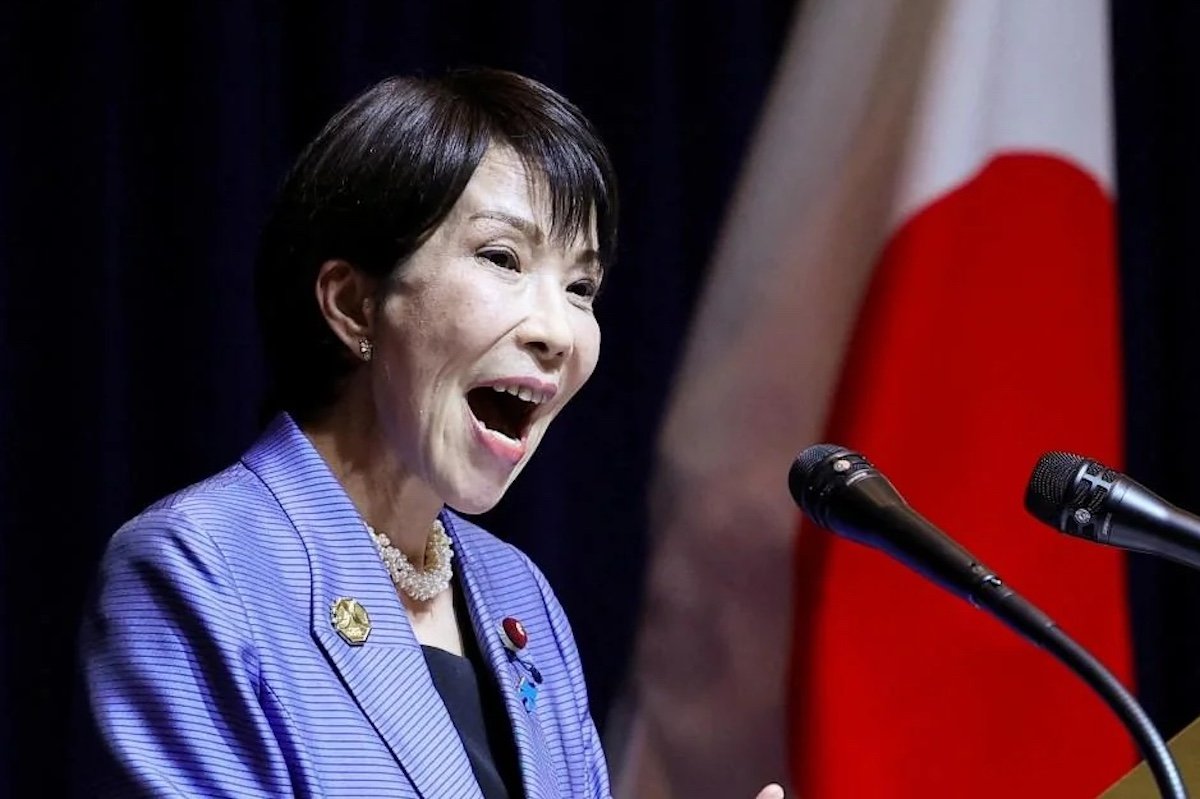
Japanese Prime Minister Sanae Takaichi is undertaking a two-nation tour of Vietnam and Australia from May 1 to 5, with energy security, critical minerals, and China's maritime activities topping the agenda. The most consequential element may be a foreign policy address she is expected to deliver in Hanoi, setting out a revised version of Japan's Indo-Pacific strategy.
Takaichi has moved quickly since taking office in October 2025. She attended the ASEAN summit in Malaysia and APEC in South Korea within weeks, hosted U.S. President Donald Trump in Tokyo, and launched shuttle diplomacy with South Korean President Lee Jae-myung in January. A landslide election victory in February gave her the strongest domestic mandate of any Japanese prime minister since World War II.
The diplomatic tempo has not let up. Japan and the Philippines signed an Acquisition and Cross-Servicing Agreement in January, deepening a security relationship that now includes a 125% increase in Japan's Official Security Assistance funding. In March, Canadian Prime Minister Mark Carney visited Tokyo, and the two sides signed a Comprehensive Strategic Partnership covering defense, energy, critical minerals, and technology. India welcomed Japan's recent decision to lift its longstanding ban on lethal arms exports, with both sides already coordinating the transfer of Japanese equipment used on Mogami-class vessels.
Tokyo is deepening its engagement with AUKUS Pillar II, maintaining the Quad, advancing trilateral defense cooperation through the US-Japan-Australia TSD and the US-Japan-Philippines framework, and co-developing a next-generation fighter with the UK and Italy under GCAP. The lifting of the lethal arms export ban on 21 April provides the industrial foundation for this architecture, clearing the way for exports of fighter jets, missiles, and warships to 17 partner countries. Without it, deals like the $6.5 billion Mogami-class frigate agreement with Australia would not have been possible.
Energy Security and the Hormuz Challenge
The sharpest test of Takaichi's diplomacy came in March, when she traveled to Washington for a summit with Trump held against the backdrop of the Iran conflict. The United States had been pressing its allies to help secure the Strait of Hormuz. Takaichi navigated the meeting by offering political support without making concrete naval commitments, citing constitutional constraints under Article 9. She left Washington with alliance cohesion intact but with Japan's energy vulnerabilities laid bare.
The Vietnam and Australia visits follow directly from that experience. If the Trump summit was about managing an ally whose demands Japan cannot fully meet, Hanoi and Canberra are about deepening partnerships in which the interests are more clearly mutual and the vulnerabilities are shared. Japan relies on Australia for approximately 40% of its LNG and around 60% of its coal, but the dependency runs in both directions: Japan is one of Australia's largest and most stable energy customers. A recent East Asia Forum analysis described the two countries as existentially important to each other's economic security. The Hormuz disruption threatens both Japan's supply and Australia's market access.
Takaichi is expected to seek Australian Prime Minister Anthony Albanese's cooperation on stable energy flows and safe navigation through the Strait of Hormuz. Australian Foreign Minister Penny Wong traveled to Tokyo ahead of the visit to discuss trade and energy security. Takaichi is also reportedly bringing fuel assurances backed by Japan's more than 200 days of strategic fuel stocks, a signal aimed at calming Australian consumers — and an illustration of the mutuality, with Japan offering its reserves to stabilize a market that keeps its own industry running.
Vietnam presents a different dimension of the same problem. Hanoi has asked Japan for assistance securing oil supplies, and Takaichi is expected to explore how Tokyo can cooperate during her summit with Prime Minister Le Minh Hung. For more on the domestic pressure Takaichi faces, see Japanese Parties Push PM Takaichi for Stronger Action on Hormuz Energy Crisis.
Critical Minerals and the China Factor
Japan's long-term investment in diversifying its critical minerals supply away from Chinese dominance is now a central feature of its relationships with both Australia and Vietnam. The Japan–Australia minerals partnership is the most mature example. Japan's decade-long backing of Lynas Rare Earths, beginning in 2012, has helped build the largest rare earth producer outside China, but it has also helped build an Australian industry that would not exist at its current scale without Japan's patient capital. Lynas now supplies 7,200 metric tonnes annually of neodymium and praseodymium under a contract extending to 2038, with a minimum price guarantee. Australia's Iluka processing facility, backed by $1.65 billion in government investment, adds further depth.
Vietnam's role is longer-standing but more uneven. JOGMEC established a rare earth research and technology transfer center in Vietnam in 2012, but a Toyota Tsusho and Sojitz joint venture on the Dong Pao deposits was abandoned in 2013. Vietnam holds some of the world's largest rare earth reserves, yet its production and refining capacity remain limited. Closing that gap is one of the things Takaichi's visit may seek to address.
The most significant deliverable from the Vietnam stop may be a foreign policy address in which Takaichi is expected to announce a revised version of Japan's "Free and Open Indo-Pacific" strategy, the framework Shinzo Abe proposed a decade ago. The updated version is expected to focus on three pillars: strengthening economic foundations, pursuing growth through shared challenges, and deepening security cooperation. The tilt toward economic security reflects the shift in the strategic environment since Abe first outlined the concept. For context on Japan's evolving defense posture, see Japan's Defense Shift: Preparation, Not Pacifism, Drives New Arms Export Rules.
Takaichi's broader vision for Japan's place in Asia is one of proactive engagement, leveraging economic and security partnerships to build resilience against shared challenges. The Vietnam and Australia visits are not isolated diplomatic gestures but part of a coherent strategy to remake Japan's role in the region — one that balances alliance management with deeper ties to like-minded partners. As the global order shifts, Tokyo is positioning itself as a linchpin of stability in the Indo-Pacific, with energy and minerals at the core of its new approach. For more on the implications of the Japan-Australia frigate deal, see Japan-Australia Frigate Deal Signals Shift in Pacific Security Amid China's Naval Rise.