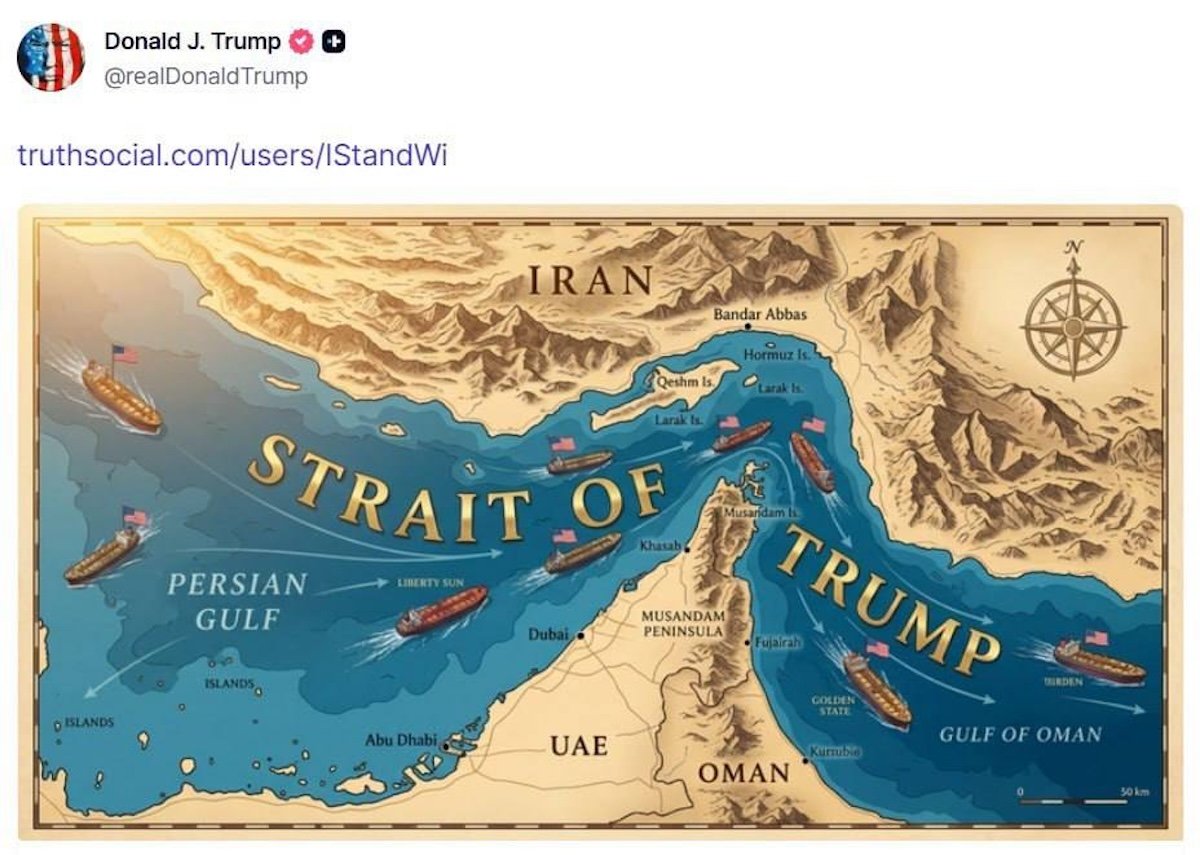
President Donald Trump has escalated his rhetoric over the Strait of Hormuz by posting a map on his Truth Social platform that labels the strategic waterway as “US territory.” The post, made on Tuesday, came just days after he threatened to declare the strait part of the United States, and it drew an immediate response from Tehran.
Iran’s deputy foreign minister, Kazem Gharibabadi, took to X (formerly Twitter) to dismiss the claim. “Just as Trump correctly wrote the name of the Persian Gulf, his illusion about the Strait of Hormuz will soon be corrected – or we will correct the delusions of this delusional individual,” he wrote in Arabic, attaching a screenshot of Trump’s map. The map shows the strait, which lies south of Iran and connects the Persian Gulf with the Gulf of Oman.
A vital artery under pressure
The Strait of Hormuz is one of the world’s most critical maritime chokepoints, through which roughly a fifth of global oil supplies pass. Since the United States and Israel began a bombing campaign against Iran on February 28, Tehran has restricted traffic through the strait, a move that has sent fuel prices climbing worldwide. In the United States, the average price for a gallon of gasoline recently hit a record high for mid-August, adding to domestic economic strain.
Despite the economic toll at home and a plunging approval rating, Trump has shown no sign of backing down. In a speech on Long Island last Friday, he declared, “I’ll never apologize, I did the right thing,” and reiterated his threat over the strait. Critics across the United States and abroad have condemned the president as a “completely unhinged lunatic” and a “sadistic violent menace to the world,” with some calling for his impeachment.
The 60-day ceasefire that had been in place expired on Monday, with no progress reported on talks to end the war. Trump has justified the campaign as necessary to prevent Iran from developing nuclear weapons, but his own intelligence agencies have assessed that Tehran was not actively pursuing such a program. Notably, Trump withdrew the United States from the Obama-era Iran nuclear deal during his first term.
On the ground, Iranian military officials remain defiant. Major General Mostafa Izadi, deputy commander-in-chief of the Islamic Revolutionary Guard Corps, said on Tuesday that “the enemy failed to destroy Iran’s defensive capabilities and nuclear industries,” according to Palestine Chronicle. Iranian Parliament Speaker Mohammad Bagher Ghalibaf warned that the strait will remain closed until the US blockade and oil embargo are lifted, and that any party continuing “aggression or threats” would face a “more severe defeat.”
The standoff has broader implications for the Indo-Pacific, where energy security and freedom of navigation are paramount. Japan and South Korea, both heavily reliant on Middle Eastern oil, are watching the situation closely. Any prolonged disruption at Hormuz would ripple through Asian economies, potentially forcing Tokyo and Seoul to accelerate their own energy diversification efforts. Washington may need to accept a toll at the strait if it hopes to avoid a wider conflict.
Trump’s aggressive posture has also raised concerns among US allies in Asia. Japan has remained notably silent on Trump’s Middle East policies, a stance that reflects its delicate balancing act between Washington and its own energy needs. Meanwhile, experts argue that Trump’s Iran war is already lost, leaving Washington without leverage in the region.
As the crisis deepens, the international community watches to see whether Trump’s map post is mere bluster or a prelude to further escalation. For now, Iran shows no sign of yielding, and the strait remains a flashpoint with global consequences.