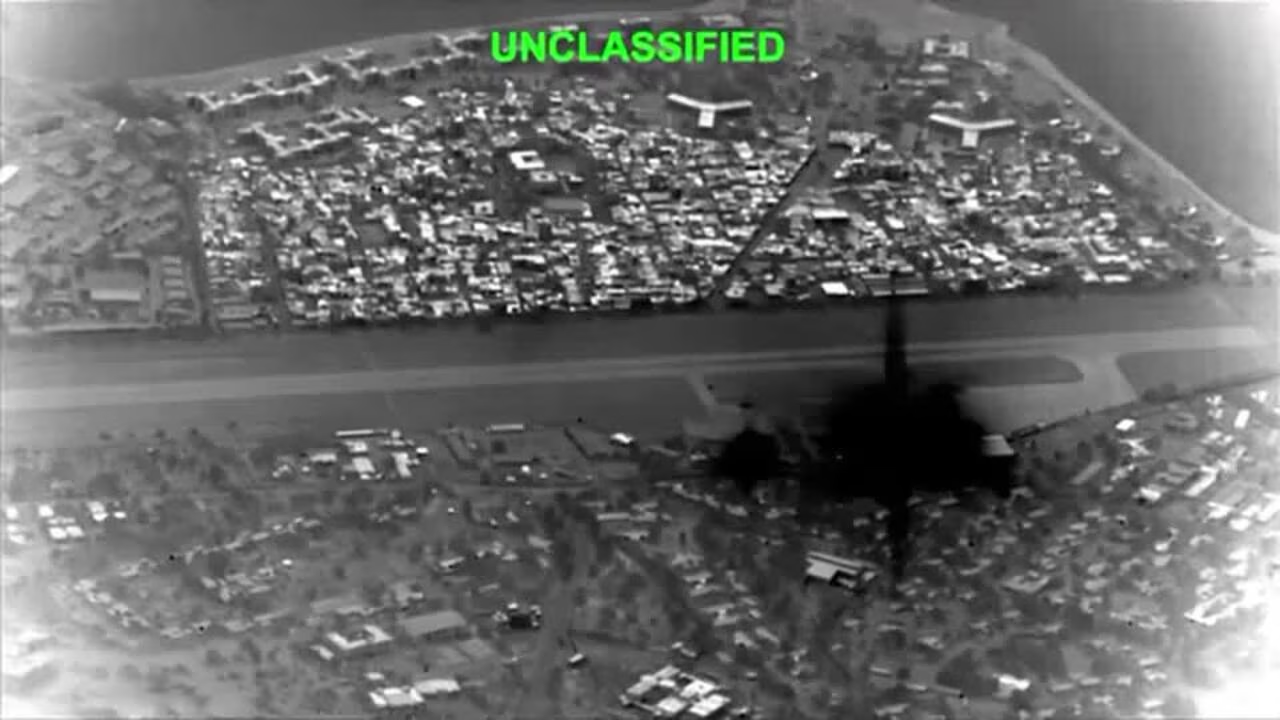
President Donald Trump has escalated his military campaign against Iran by suggesting the United States will soon seize Kharg Island, the offshore terminal that handles approximately 90% of Iran's crude oil exports. In a series of posts on Truth Social and interviews on Thursday, Trump framed the potential operation as a bid to assume "total control" of Iran's oil and gas markets, drawing explicit parallels to U.S. actions in Venezuela.
"The United States will be hitting Iran VERY HARD TONIGHT," Trump wrote, following days of airstrikes that have targeted military infrastructure and, according to local reports, damaged two reservoirs, leaving around 20,000 people without drinking water. "At some point in the not too distant future, we will be taking Kharg Island, and other oil infrastructure points, and assume total control of their Oil and Gas Markets, much like we have with Venezuela."
The threat is not new. The Trump administration reportedly had plans to invade the island as far back as March, but those were shelved over fears of heavy American casualties, especially given Iran's preparations, including anti-personnel and armor mines. Trump acknowledged the plan's unpopularity in a Fox News interview, saying, "I don't know that America has the stomach for it, to be honest with you. You'd make a fortune."
Military and Political Risks
Senior CNN political correspondent Aaron Blake noted that "it's widely assumed that taking and keeping Kharg Island would require ground troops." A May survey from the Institute for Global Affairs found that only 18% of Americans supported such an operation, with even a majority of Republicans opposing boots on the ground. The House of Representatives recently passed a war powers resolution aimed at curbing Trump's ability to wage war against Iran without congressional approval, with four Republicans joining every Democrat.
Brett Erickson, managing principal of Obsidian Risk Advisors and a sanctions and geopolitical-risk expert, called the idea "grim and stupid." He pointed out that Iran's exports from Kharg Island have plummeted during the conflict, with only one vessel loaded in the past five weeks. "The island is a fixed position," Erickson said. "It would constantly come under fire from drones and missile barrages. We would likely, in the absolute best case, lose hundreds of lives. Worst case? Well into the thousands. Would it change anything about the war? No."
House Speaker Mike Johnson (R-La.) appeared to downplay the threat, telling reporters he believed Trump was "communicating directly with our adversaries over there" and advised against putting "too much stock in the details of that right now." However, Senator Lindsey Graham (R-S.C.), a key advocate for the U.S.-Israeli war against Iran, praised Trump's suggestion, comparing a potential Kharg Island operation favorably to the World War II Battle of Iwo Jima, which cost 26,000 American casualties.
Congressional and Public Opposition
Representative Ted Lieu (D-Calif.) argued that invading the island without congressional approval "would be brazenly unconstitutional." He warned, "American troops would die during the invasion. And then every day Iran would try to kill more American troops on Kharg Island." Lieu called on the Senate to pass the House's war powers resolution, which was approved last week.
The broader context of Trump's threats includes ongoing airstrikes that have damaged civilian infrastructure and raised concerns about regional stability. The US-Iran airstrikes risk derailing fragile ceasefires as conflicts deepen across the Middle East. Meanwhile, Trump's approach to resource control mirrors his administration's policies elsewhere, such as in Venezuela, where he has claimed success in securing oil flows to U.S. refineries. Critics, however, note that the Venezuelan operation has not been without controversy, and the parallel raises questions about the legality and ethics of using military force to seize natural resources.
As the debate unfolds, the US House vote to curb Trump's Iran war powers signals a growing Republican rift over the scope of presidential authority. For now, Trump's rhetoric suggests he is willing to push ahead despite public and congressional opposition, but the practical obstacles—including Iranian defenses, the risk of heavy casualties, and the island's diminished export value—remain daunting.