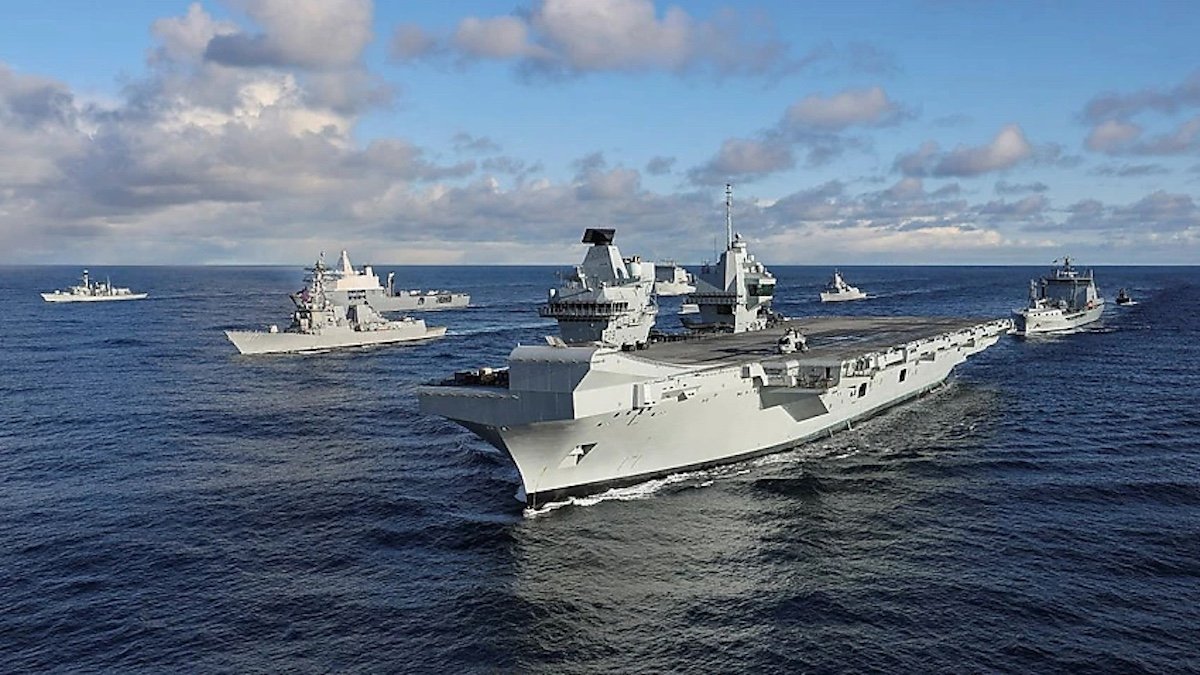
General Sir Gwyn Jenkins, head of the British Royal Navy, has announced that the 10-nation Joint Expeditionary Taskforce—comprising the UK, Norway, Sweden, Denmark, Finland, Iceland, Estonia, Latvia, Lithuania, and the Netherlands—has agreed to create what he called “a family of allied fleets.” Officially named the Northern Navies Initiative (NNI), the effort is explicitly designed to contain Russia in the Arctic and Baltic seas. This marks an evolution of the UK’s Arctic-Baltic policy, which was first outlined last summer.
Strategic Geography: From Greenland to Estonia
Estonia, located at the eastern edge of the Baltic Sea near St. Petersburg, has been identified as the eastern lynchpin of this strategy, while Greenland—still part of Denmark—now serves as its western anchor. The inclusion of Greenland, Iceland, and the UK allows the NNI to monitor the so-called GIUK gap, the maritime corridor between Greenland, Iceland, and the UK that serves as Russia’s primary Arctic gateway to the Atlantic. Denmark also controls the Baltic Straits, giving the NNI the potential to impose a partial blockade on Russia.
However, any blockade would constitute an act of war, and Russia would likely respond with kinetic self-defense if its warnings are ignored. The United States, which has imperfectly blockaded Iran and is preparing to potentially blockade China in the Strait of Malacca through its new military partnership with Indonesia, may approve of the UK-led NNI’s preparations. Yet the risks are significant: a blockade could trigger a direct NATO-Russia confrontation at sea, adding a dangerous new dimension to the ongoing New Cold War.
Poland’s Conspicuous Absence
One notable gap in the Joint Expeditionary Taskforce is Poland, which has not joined despite the taskforce’s formation in late 2014. This may stem from Poland’s political dynamics: during its recent period of conservative-nationalist rule, Warsaw prioritized the United States as its top partner over Germany, which liberal-globalist factions favor. Even after former dual British citizen Radek Sikorski returned as Polish Foreign Minister in late 2023, Poland has not joined, though critics view Sikorski as a UK agent of influence. Poland’s neglected navy may be a factor, but recent joint drills with Sweden and technical cooperation with the UK suggest future membership is possible.
Russia’s Countermeasures and Alternative Routes
Russia has already begun deterring the NNI by escorting its “shadow fleet” in the Gulf of Finland, a policy that could be scaled up to include more ships across the Baltic and Arctic. Meanwhile, Russia retains alternative maritime routes: its Black Sea ports, the North-South Transport Corridor through Iran, a potential complementary corridor through Afghanistan and Pakistan, and Vladivostok. These options mean that any US-backed, UK-led blockade would be manageable for Moscow—provided free passage between St. Petersburg and Kaliningrad remains uninterrupted. Nevertheless, Russia is unlikely to accept such a blockade without pushback.
The growing risk of a hot NATO-Russian war at sea, rather than on NATO’s Eastern Flank in Central and Eastern Europe, underscores the escalating tensions of the New Cold War. For Asian observers, this development has indirect but important implications: it could affect energy routes from Russia to Japan and South Korea, and it may influence Japan’s delicate balancing act between energy ties with Russia and defense support for Ukraine. The NNI also highlights how Arctic security is becoming a global concern, with potential spillover effects for Indo-Pacific maritime strategies.