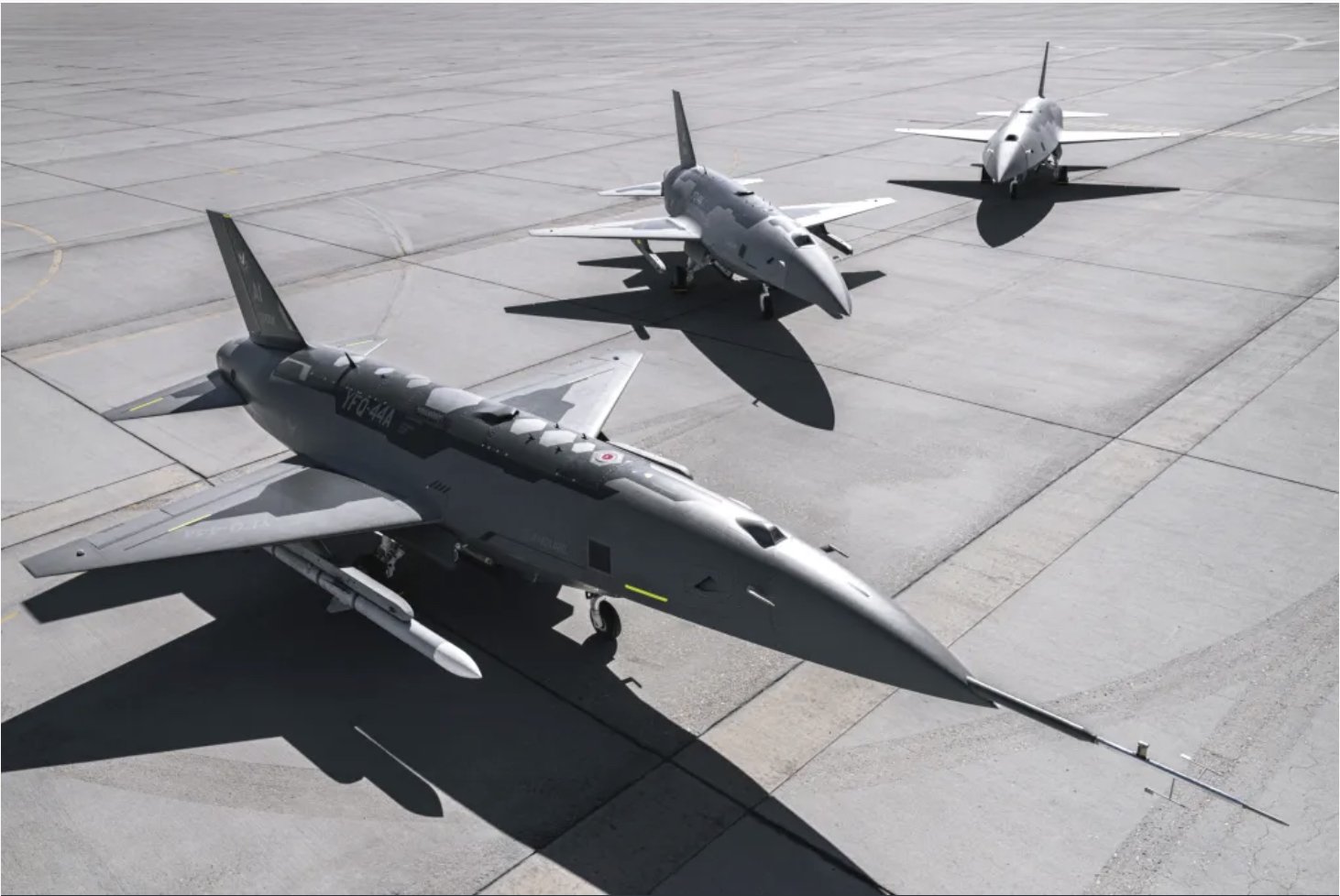
The United States Air Force is placing a strategic bet that robotic wingmen, not additional manned fighters, will determine who controls the skies over the western Pacific. Facing its oldest and smallest combat fleet in history, the service has awarded contracts to General Atomics Aeronautical Systems and Anduril Industries for their respective FQ-42 Dark Merlin and FQ-44 Fury drones under the Collaborative Combat Aircraft (CCA) Increment 1 program.
Simultaneously, the Air Force selected Anduril, RTX's Collins Aerospace, and Shield AI to develop the mission autonomy software for these uncrewed aircraft. Under a system-of-systems approach that separates hardware from software, the service aims to field more than 150 semi-autonomous wingmen by the end of the decade. The fiscal 2027 budget request includes nearly US$1 billion for initial production, with a unit cost target of under $30 million—roughly one-third the price of an F-35A.
Why the Urgency?
The CCA program reflects a widening airpower imbalance between the United States and China. According to a February 2024 report by Mark Gunzinger and Lawrence Stutzriem for the Mitchell Institute for Aerospace Studies, the US Air Force is grappling with its oldest, smallest, and least ready combat fleet in history. The Heritage Foundation's 2026 Assessment of US Military Power notes that active-duty combat-coded fighters have dwindled to just 800 aircraft, far short of the 1,200 baseline needed to fight two major regional conflicts simultaneously.
In contrast, the China Aerospace Studies Institute (CASI) reported in May 2026 that the People's Liberation Army Air Force (PLAAF) fields over 3,150 aircraft, including approximately 2,400 dedicated combat aircraft. The PLAAF is rapidly modernizing, with 15 brigades equipped with advanced fifth-generation J-20 stealth variants and 22 brigades flying fourth-and-a-half-generation J-10C and J-16 fighters. Only four legacy brigades still operate older third-generation J-7 and J-8 aircraft.
Gunzinger and Stutzriem argue that CCAs can serve as disruptive force multipliers, suppressing hostile air defenses, absorbing enemy fire, and enabling resilient, runway-independent forward operations. However, the program faces significant hurdles. Gregory Allen and Isaac Goldston of the Center for Strategic and International Studies (CSIS) warned in August 2024 that fielding a meaningful number of CCAs may not occur until September 2029—too late to deter a possible Chinese invasion of Taiwan before that date. They also noted that the per-unit cost has ballooned from an initial $3 million to $25–$30 million, raising concerns that the Air Force is "gold-plating" the program and undermining its core purpose of providing affordable mass.
In a modeled mid-2030s conflict scenario, Travis Sharp of the Center for Strategic and Budgetary Assessments (CSBA) described how the US Air Force would deploy 500 CCAs from dispersed bases in Japan and the Philippines. Operating unrefueled within a 1,300-kilometer radius, these drones would perform combat air patrols around Tainan Airport in southwest Taiwan, using "rapid return" profiles for air-to-air missile strikes or "stay-on-station" profiles for persistent sensing and electronic warfare.
Yet China's massive missile buildup challenges the assumption that forward bases are sanctuaries. Analyses by the Stimson Center and Hudson Institute warn that in a Taiwan conflict, most US aircraft losses would occur on the ground. This vulnerability underscores the high stakes of the CCA program, which aims to provide survivable, distributed combat power in the face of China's growing anti-access and area-denial capabilities.
For more on China's military modernization, see China's Missile Swarm Strategy Targets US Carrier Groups from 3,000 km. The Pentagon's evolving focus on the Indo-Pacific is explored in Why Dropping 'Indo-Pacific' Sharpens the Pentagon's China Focus.