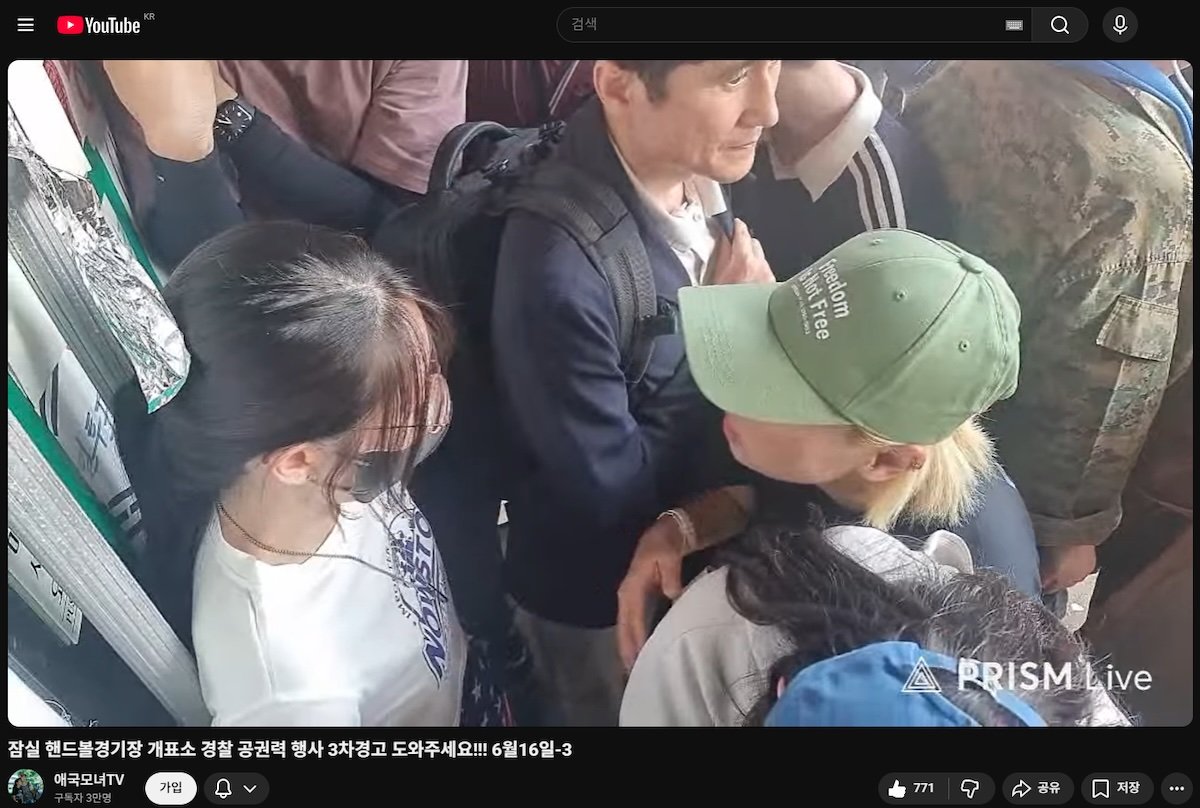
On June 16, outside Seoul's Olympic Park Handball Gymnasium, a scene unfolded that captured the attention of a nation. For days, the venue had been at the center of a dispute over South Korea's June 3 local elections, with activists demanding access to stored election materials they believed could answer unresolved questions. Earlier that day, police and representatives from the People Power Party (PPP) had agreed to a supervised entry, complete with live cameras and restrictions on removing documents. As officers prepared to move in, a young woman stepped forward and stood alone in front of the entrance.
The standoff lasted nearly two hours. Rally participants urged her to step aside. Politicians negotiated. Police waited. She refused, shaking her head silently, and eventually turned her back to the crowd, holding the door shut with her own body. In the end, police withdrew, and the effort was abandoned. The image of a lone citizen, unaffiliated with any party or movement, halting a coordinated operation resonated far beyond the gymnasium's walls.
A Symbol of Deeper Discontent
This incident is not merely a footnote in election controversy; it reflects a broader transformation in South Korean politics. For decades, left-leaning activists saw themselves as the natural representatives of youth, democracy, and social change. Yet many younger voters today evaluate politics through a different lens—focusing less on ideology and more on who holds power and how it is exercised. The generation that built its identity during the 1980s democracy movement now occupies influential roles in politics, academia, media, and civil society. To many participants, the standoff appeared less as a clash between the state and a fringe movement than as a confrontation between ordinary citizens and an entrenched political elite.
That perception deepened when Seoul police warned that rally participants could potentially “lose everything.” Critics saw the remark not as a routine law-enforcement caution but as evidence of authorities demanding compliance rather than earning trust. For many younger South Koreans, who grew up in a prosperous democracy and view personal freedom as a birthright, such threats feel like an infringement on autonomy.
PPP spokesman Park Min-young captured this sentiment in a recent statement: “Even young women are saying this now. Gender issues have largely become an issue of the past. When they look at conservative governments or conservative politicians, they may not necessarily like them. They may not feel particularly positive about them. But at least when conservatives are in power, people’s lives do not become more difficult. Conservatives are not constantly trying to control or regulate how they live. Housing prices do not suddenly skyrocket. Inflation does not surge because the government is flooding the economy with money. Jobs do not disappear. But when the left comes to power, they engage in all kinds of moral posturing and virtue signaling. Then, after just five years in office, housing prices have doubled, people who refused vaccines cannot even enter cafés, businesses are shut down, and one restrictive measure after another is imposed. People end up thinking, When the left governs, my life becomes more difficult. My quality of life deteriorates. This is something that people in their twenties and thirties increasingly feel regardless of gender.”
This shift has implications beyond elections. Efforts by governments, activist groups, or cultural institutions to shape personal behavior—whether through vaccine mandates, housing policies, or speech regulations—often provoke resistance. The young woman at the gymnasium crystallized a sentiment already present among many younger voters: that public institutions are less protectors of liberty than potential constraints upon it.
As South Korea's political landscape evolves, the consequences may extend far beyond a single afternoon in Seoul. The significance of June 16 was not that a young woman stood in front of a door. It was that so many young Koreans saw themselves standing there with her.
For more on South Korea's shifting political dynamics, see our analysis of Lee Jae-myung's strategic autonomy push and the broader implications of Seoul's selective human rights stance.