The United States Navy is confronting a stark reality: its domestic shipbuilding industry cannot keep pace with China's rapid naval expansion. A new report from the Center for Maritime Strategy (CMS), a nonpartisan think tank founded in 2022 and backed by the Navy League of the United States, argues that the solution lies not just in domestic investment but in leveraging the industrial capabilities of key allies.
The report highlights that decades of deindustrialization, labor shortages, and fragile supply chains have left US shipyards struggling to deliver vessels on time or at scale. In contrast, China's shipbuilding capacity dwarfs that of the US—by a factor of 232, according to a leaked 2023 slide from the US Office of Naval Intelligence. Former US Secretary of the Navy Carlos Del Toro noted in February 2023 that a single Chinese naval shipyard has the capacity of all US naval shipyards combined.
Allied Shipyards as Force Multipliers
The CMS report examines how allies such as South Korea, Italy, Canada, Sweden, and the UK have sustained robust shipbuilding industries. It identifies opportunities for the US to expand cooperation in ship production, repair, and maintenance, drawing on allied best practices in workforce development, technology integration, and supply chain management. South Korea's shipbuilding sector, for instance, has shifted from labor-intensive methods to a technology-driven model with advanced automation, as noted by analysts Carroll and Cook in a May 2025 article for the Center for Strategic and International Studies (CSIS). Japanese shipbuilders similarly emphasize high-quality standards and automation, even for complex naval vessels.
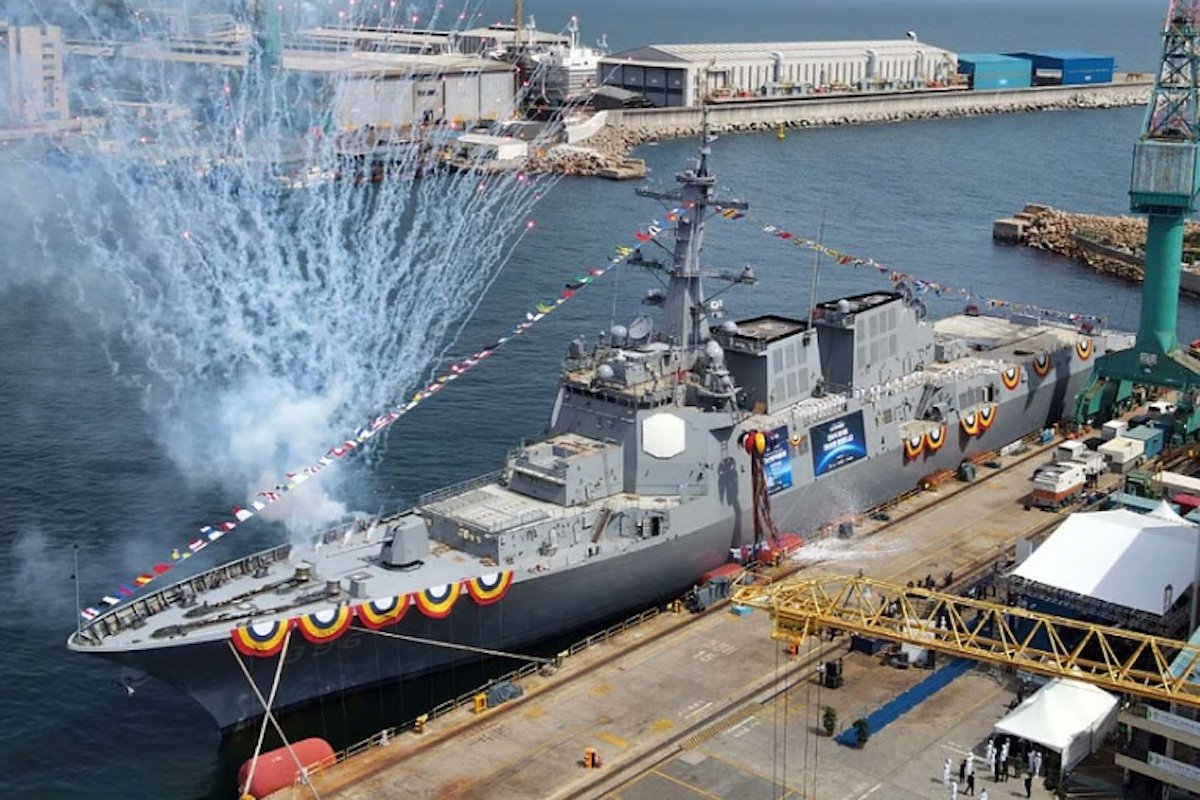
The cost and time advantages are striking. J. James Kim, writing in a December 2025 Stimson Center article, points out that it takes the US nine years and about US$2.5 billion to build an Arleigh Burke Flight III destroyer. In contrast, South Korea's KDX-III Batch II destroyer, ROKS Jeongjo the Great, cost around $565 million and took roughly five years from contract to commissioning. While not a replica, it shares similar weapons systems and features, making it a comparable alternative at nearly one-fifth the price and half the delivery time.
These figures underscore why the US Department of Defense (DoD) has consistently assessed that China possesses the world's largest navy by hull count, with about 355 ships, including over 145 major combatants, and projects growth to 460 by 2030. Meanwhile, a January 2026 Congressional Research Service (CRS) report states that as of October 2025, the US Navy had only 293 ships—well below its 2016 target of 355 and the 2023 goal of 381 manned ships plus 134 unmanned systems.
Sam Tangredi, in a January 2023 Proceedings article, argues that larger fleets almost always win naval wars, particularly among near-peer competitors. His analysis of 28 conflicts found that 25 were won by the side with the larger fleet, even when the smaller force initially held technological advantages—which he says are typically short-lived.
The US Maritime Action Plan of 2026 already emphasizes leveraging allied investment and partnerships to rebuild domestic capacity. It states that “targeted incentives encourage shipbuilders from partner nations to invest directly in America’s maritime industrial base,” while creating “clear pathways for foreign direct investments in US shipyards, suppliers and maritime infrastructure.”
However, outsourcing naval shipbuilding to foreign partners raises concerns about technical compatibility, information security, and the loss of US shipbuilding jobs. It also risks tying a critical defense industrial sector to foreign influence, potentially impacting US strategic autonomy. Yet structural constraints—workforce shortages, fragile supply chains, and limited automation—suggest that foreign shipyards may remain indispensable for addressing near-term fleet shortfalls at acceptable cost and speed.
This dynamic is not limited to shipbuilding. The broader competition with China is reshaping defense and technology supply chains across the Indo-Pacific, as seen in the race to build fusion energy supply chains and the development of next-generation naval aviation capabilities. The US Navy's next-gen fighter competition also tests the future of carrier aviation against China's growing anti-access capabilities.
Ultimately, the CMS report suggests that relying on allies is not merely an option but a necessity. The question is whether the US can manage the risks while reaping the benefits of allied industrial power.



