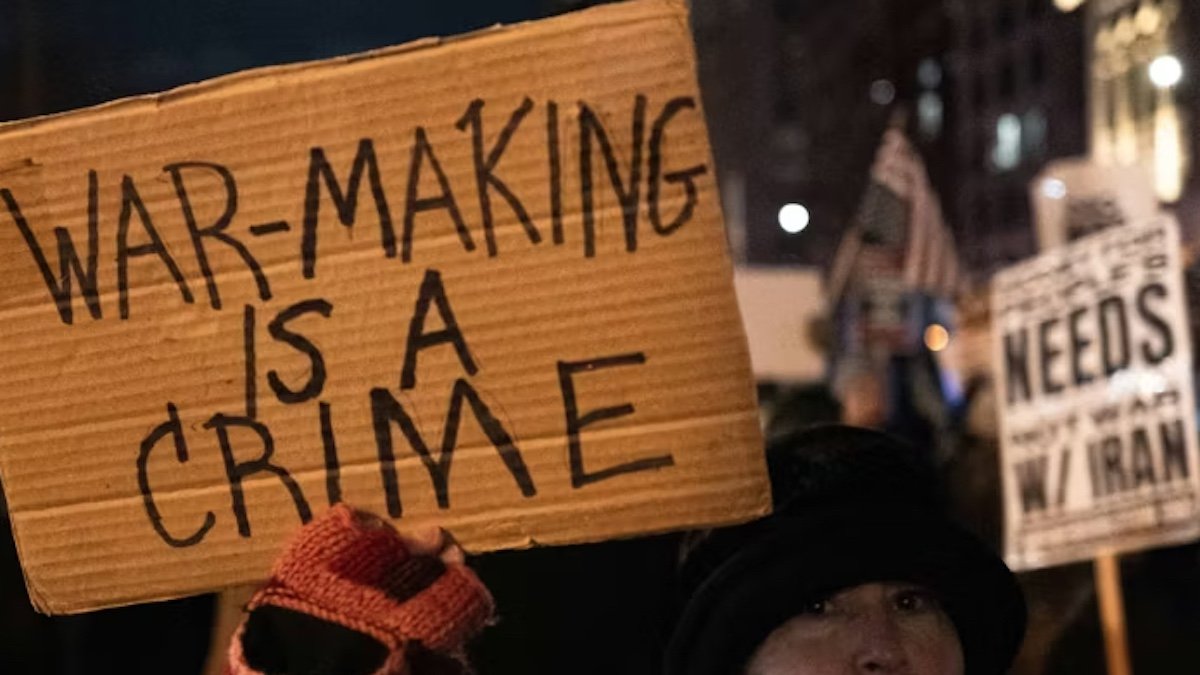
President Donald Trump's military campaign against Iran has opened with a historic political anomaly: for the first time since Gallup began measuring public opinion on war, a majority of Americans oppose a US military action at its outset. Only 34 percent support the strikes, a figure that stands in stark contrast to the initial approval ratings for nearly every major US conflict of the past eight decades.
The political implications are significant, particularly for the Democratic Party as it looks toward the 2028 presidential election. The opportunity, however, comes with two conditions: that the election is free and fair, and that a Democratic candidate can credibly claim to represent a genuine break from the foreign policy consensus that has sustained America's permanent war footing.
A break with historical precedent
Historically, Americans have rallied behind the flag when military action begins. World War II enjoyed 97 percent support after Pearl Harbor. The Afghanistan War began with 92 percent approval, and the first Gulf War with 82 percent. Even the deeply unpopular Vietnam War started with 65 percent support. The only previous exception was Obama's 2011 Libya bombing, which drew 47 percent approval but still had only 37 percent outright opposition.
Trump's Iran war has shattered that pattern. The immediate opposition reflects a public that sees the conflict as reckless and unjustified, particularly after the president threatened that "a whole civilization will die tonight" and claimed victory multiple times while continuing to strike. The sense that the commander-in-chief has betrayed public trust is unprecedented in living memory.
For Democrats, this is a rare opening. The party has struggled to articulate a coherent alternative to the bipartisan interventionism that has defined US policy since the end of the Cold War. The Iran war, however, offers a clear contrast: Trump's unilateralism and disregard for consequences are deeply unpopular, and the public's rejection of his approach could be a powerful electoral issue.
The credibility problem
But not all Democratic candidates are equally positioned to seize this moment. The party's leading figures have their own records on military intervention, particularly regarding Israel's war in Gaza, which has continued under both the Biden and Trump administrations. The question for primary voters will be whether a candidate's opposition to Trump's Iran war is a matter of principle or simply partisan convenience.
Kamala Harris, the most recent Democratic nominee and a potential 2028 contender, faces a difficult test. As vice president, she supported arming Israel throughout its campaign in Gaza, which has killed an estimated 74,000 Palestinians, according to local health authorities. Her record offers little evidence that she would fundamentally alter US foreign policy, and her past support for the war effort may undermine her ability to claim the anti-war mantle.
At the other end of the spectrum is Representative Alexandria Ocasio-Cortez of New York, who has not ruled out a presidential run. She was among the earliest and most vocal critics of Israel's actions in Gaza, calling for a ceasefire within weeks of the October 7, 2023 Hamas attack. Her record suggests a willingness to challenge the foreign policy establishment, but her progressive positions may limit her appeal in a general election.
The broader field includes a range of figures with varying records. Some, like Senator Bernie Sanders of Vermont, have long opposed US interventionism. Others, such as Governor Gavin Newsom of California, have been more cautious, balancing progressive rhetoric with a pragmatic approach to foreign policy.
Asia's stake in the debate
The outcome of this debate will have significant implications for the Indo-Pacific. Trump's foreign policy has already disrupted alliances and emboldened adversaries, from his curtailment of US-South Korea military drills to his overture to North Korea, which has been seen as a test for Seoul and Beijing. A Democratic president who is genuinely committed to reducing America's military footprint could reshape the region's security dynamics, but one who continues the status quo might simply continue the drift.
The Iran war itself has direct consequences for Asia. The threat to annex the Strait of Hormuz and the broader standoff have raised oil prices and threatened global supply chains, affecting economies from Tokyo to New Delhi. South Korea's economy, already strained by Trump's tariff policies, faces additional uncertainty.
For Democrats, the challenge is to translate public anger over the Iran war into a coherent foreign policy vision that addresses both the Middle East and the Indo-Pacific. The party's base is increasingly skeptical of military intervention, but the establishment remains committed to a global role. The 2028 primary will be a test of whether the party can bridge that divide.
The opportunity is real, but so is the risk. If Democrats nominate a candidate who is seen as simply opposing Trump without offering a credible alternative, the moment may pass. If, however, they find a candidate who can articulate a principled anti-war position and back it with a record of consistency, they could reshape American politics for a generation.
As the war in Iran continues and the 2028 campaign begins, the question is not whether Democrats can seize on public anger, but whether they can offer a vision that goes beyond opposition. The answer will determine not only the next president, but the future of America's role in the world.