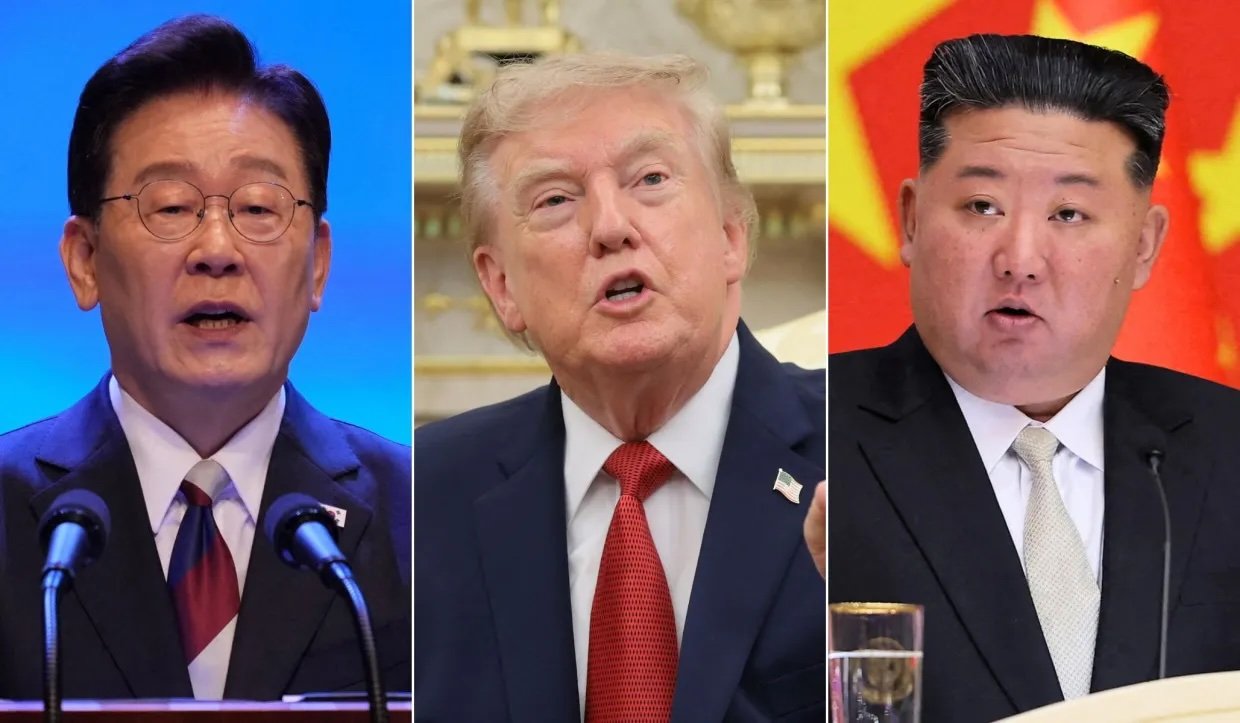
NEW YORK — When South Korean President Lee Jae-myung took office in June 2025, he knew managing the relationship with Donald Trump would be a defining challenge. But few in Seoul anticipated that by 2026, the US president would be openly questioning the value of the alliance and demanding billions in cash payments.
Trump has already made clear his displeasure with Seoul's refusal to support US military action against Iran. In a recent statement, he recounted asking Lee, “Would you like to give us a little hand? We don't need help with Iran, but if you'd like, give us a hand with Iran.” Lee's response — “No thanks” — drew Trump's ire. “We have 39,000 soldiers over there, guarding you from Kim Jong Un, your next-door neighbor, and you're not going to help us on a very easy military operation in Iran. That's strange,” Trump said.
The US president has also moved to curtail joint military exercises with South Korea, a decision that follows a phone call with North Korean leader Kim Jong Un. Trump described the drills as “very insulting” to Kim, whom he called “very well-behaved” during his term. The move has alarmed officials in Seoul and Tokyo, who see it as a signal that Washington's security commitments in Asia are weakening.
Economic pressure mounts
Beyond security, Trump has pressed Seoul for a $350 billion “signing bonus” in exchange for lower tariffs. That sum equals roughly 18% of South Korea's GDP — a burden that Lee warned could push the economy back to the brink of collapse. “Without a currency swap, if we were to withdraw $350 billion in the manner that the US is demanding and to invest this all in cash in the US, South Korea would face a situation as it had in the 1997 financial crisis,” Lee said in September 2025.
Seoul's National Security Adviser Wi Sung-lac has been blunt: “Our position is not a negotiating tactic. It's objectively and realistically not a level we are able to handle. We are not able to pay $350 billion in cash.” The demand would consume 70% of this year's national budget and 80% of its foreign exchange reserves.
The economic strain comes as Trump's trade policies continue to hit Asian exporters. His administration has already imposed tariffs on South Korean goods, and analysts expect more to come. The permanent tariffs are shifting costs onto American consumers, but they also threaten the export-driven economies of the region.
Allies lose faith
The erosion of trust is not limited to Seoul. In Tokyo, Prime Minister Sanae Takaichi has worked to stay in Trump's good graces, but Japan has also faced tariffs and the humiliation of Trump's demands for a $550 billion payment. The US president's overtures to Kim Jong Un have raised concerns in Japan, which has long viewed North Korea's missile program as a direct threat.
Joshua Kurlantzick, an analyst at the Council on Foreign Relations, says the Trump administration's actions suggest “the White House is shifting its priorities away from Asia, by necessity and choice.” He warns that “Asian allies and partners are becoming increasingly concerned that they can no longer depend on US security guarantees, potentially leading them to move closer to China – or simply facilitating an intra-Asia arms race as they scramble to provide for their own defenses.”
Georgetown University's Victor Cha argues that the confusion in US policy reflects a broader disorder in the international system. “For US allies and partners in Asia and Europe, the additional variable creating disorder is the increasing unpredictability of the United States,” he says. “'America First' policies no longer value alliances as intrinsic goods and power assets for the US. Rather, alliances are viewed as expensive obligations and power liabilities that exploit US generosity.”
The Trump administration's North Korea overture is being watched closely in Seoul and Beijing. For China, the US pivot away from Asia is a strategic win, but it also raises the risk of a regional arms race. Meanwhile, North Korea's military buildup continues, and Seoul is weighing its options.
In the short term, Lee's strategy appears to be to stall — to delay any decision on the $350 billion payment while hoping that Trump's attention will shift elsewhere. But with the US president's patience wearing thin, and with the curtailment of military drills emboldening Kim Jong Un, the pressure on Seoul is only likely to grow.
The coming months will test whether the US-South Korea alliance can survive the transactional approach of the Trump administration. For Lee, the stakes could not be higher: his country's economy, its security, and its place in the Indo-Pacific order all hang in the balance.