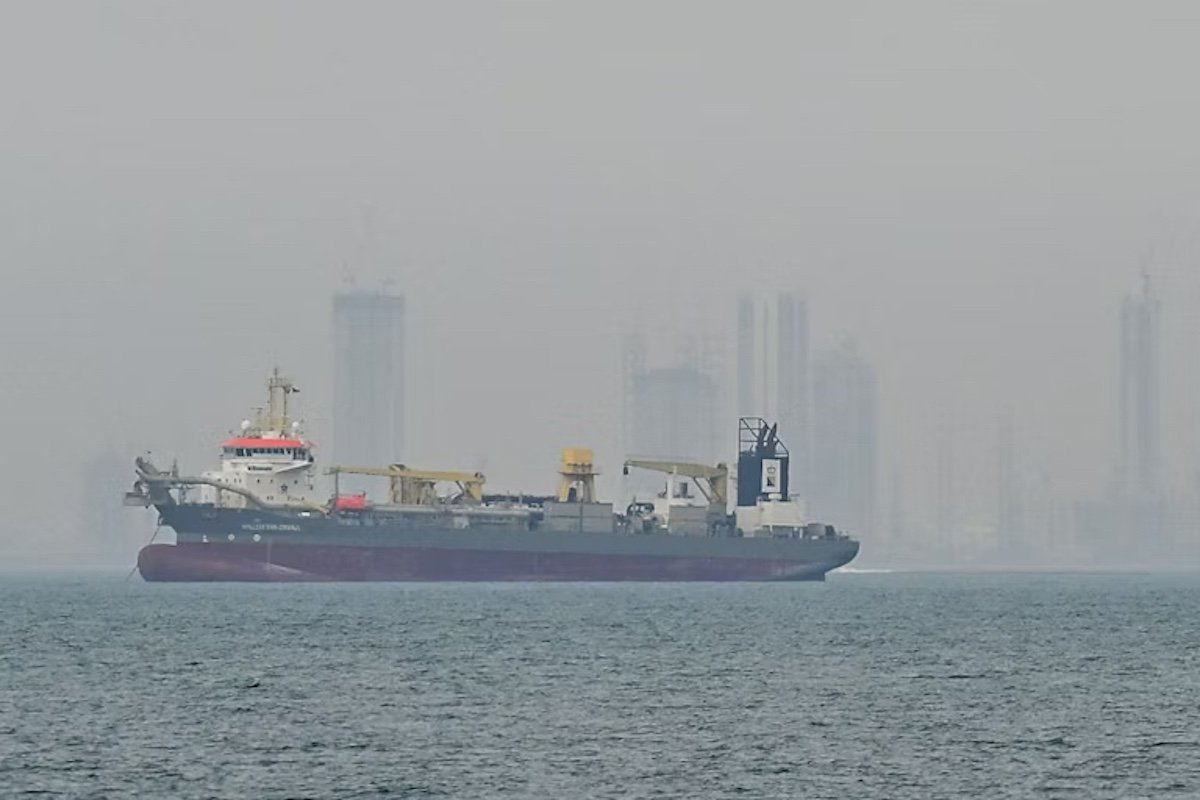
Events in the Middle East during February and March 2026 once again disrupted global maritime trade, underscoring the vulnerability of the interconnected system that relies on secure sea lanes. The armed attacks on Iran and their maritime spillovers, including the closure of the Strait of Hormuz, have sharply highlighted the fragility of this network. While military confrontations drew global attention, a quieter but profound shift was underway: shipping lines and insurers began to view the Cape sea route around southern Africa not as a temporary diversion, but as a permanent alternative.
The closure of the Strait of Hormuz by Tehran, following Israeli and US strikes, caused severe disruptions. Military hostilities and insurance risk suspensions bottlenecked carriers inside and outside the Persian Gulf. This high-risk scenario escalated the importance of the Cape route, especially as the conflict widened. Iran fired missiles toward Cyprus in the eastern Mediterranean, while a US submarine sank an Iranian naval frigate in the Indian Ocean south of Sri Lanka. These events, combined with the ongoing Houthi attacks in the Red Sea, have made the Cape route the default choice for many shipping companies.
According to a maritime security analyst with over 15 years of experience studying events off Africa, the constant rerouting now demands less ad hoc decision-making and a fundamental rethink of how the route is viewed and managed. It is in the interests of shipping companies, crews, and stakeholders to ensure a safe alternative route around Africa that can guarantee a good standard of shipping and delivery of goods. This requires paying close attention to the risks associated with the route and how they can be mitigated.
The Cape Route's Historical Context
Until the Suez Canal opened in 1869, the Cape sea route was the only viable path for maritime traffic between the Atlantic and Indian Oceans. The Suez Canal shortened distances but proved vulnerable to geopolitical disruptions. The Arab-Israeli wars of 1956, 1967, and 1973 caused lengthy shutdowns, with the canal remaining closed for about eight years after the 1967 war, trapping commercial vessels. More recently, the Houthi rebel movement in Yemen began attacking commercial vessels in the southern Red Sea in 2024, forcing a major rerouting. At its height, an estimated 66% of shipping sailed south along the Cape route.
The Ever Given blockage of the Suez Canal in March 2021 demonstrated that non-war risks, such as climatic conditions and human failure, can also disrupt shipping. These incidents have collectively pushed the Cape route from a contingency to a regular feature of global trade.
Risks Along the Cape Route
The Cape route presents a different risk profile. Duration, costs, services, and sea conditions add up to a distinct set of challenges. One risk is the extra loss of containers due to rough seas around the tip of Africa, carrying heavy financial and environmental costs. A second risk relates to limited support along the route, which can add up to 15 days to a journey. South Africa, once a salvage hub, has abandoned those capabilities, leaving ships exposed if they enter an African harbor for unplanned reasons, where they face dysfunctional service delivery and port inefficiencies.
These risks require implementing mitigation plans. The first plan should be extensive cooperation between African governments, their maritime agencies, and shipping companies. This remains the gold standard for building maritime security to contain non-traditional and non-naval threats along the route. International cooperation is needed for modernization and port service delivery, ranging from bunkering services to salvage assistance and search and rescue operations.
Responses do not solely depend on naval interventions. However, naval cooperation and coast guard collaboration remain critical. The shift to the Cape route has implications for Asian economies, particularly those reliant on energy imports from the Middle East. For instance, China, Japan, and South Korea have long depended on the Strait of Hormuz for oil and liquefied natural gas. The closure has forced these nations to seek alternative supply chains, as explored in US-Iran Stalemate in Hormuz Strains Alliances, Reshapes Asian Energy Security. Similarly, the broader geopolitical tensions are reshaping global power dynamics, as detailed in Geographic Leverage: How the Strait of Hormuz Reshapes Global Power Dynamics.
African countries, particularly South Africa with its Atlantic and Indian Ocean ports and service hubs, must become partners in ensuring a sea route of choice amid a shifting and insecure global security landscape. The Cape route's value is no longer just historical; it is a present-day necessity that demands strategic investment and cooperation.