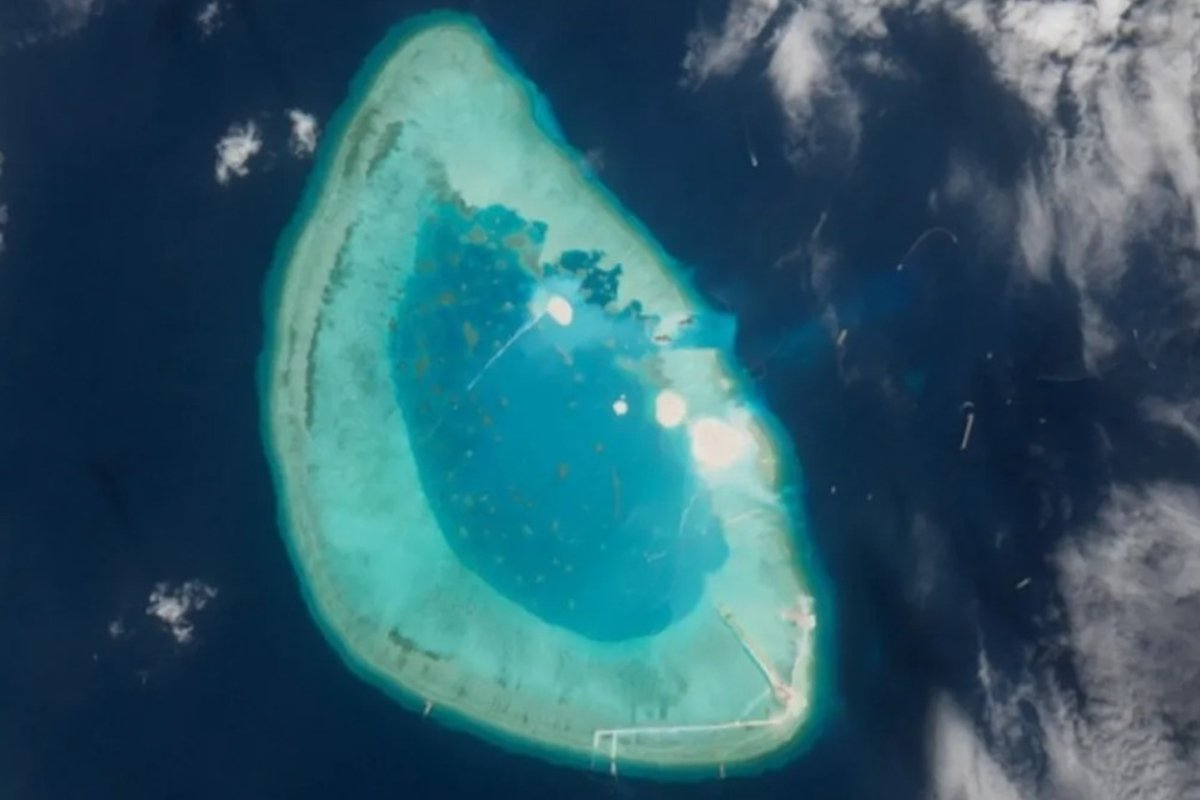
China has resumed land reclamation at Antelope Reef in the disputed South China Sea, satellite imagery reveals, as the ongoing US-Israel-Iran conflict draws significant US military assets to the Middle East. The activity, visible in European Space Agency Sentinel-2 images from January 2026, began in October 2025 and involves dredging at multiple points along the reef's lagoon, expanding land around an existing outpost and port facility.
Located in the western Paracel Islands, roughly 400 kilometers east of Vietnam and 281 kilometers from China's Sanya naval hub on Hainan Island, Antelope Reef sits in a vital trade corridor carrying about one-third of global maritime commerce. The buildup fits China's broader strategy of enhancing surveillance, electronic warfare, and anti-access/area denial (A2/AD) capabilities across dispersed artificial islands, enabling persistent monitoring and complicating adversary operations.
Strategic Implications of US Force Redeployments
The US Naval Institute fleet tracker shows that as of March 30, 2026, the USS Abraham Lincoln carrier strike group (CSG) has been redeployed from the South China Sea to the Middle East, with the USS George Washington CSG underway from its homeport of Yokosuka, Japan, to join it. Additionally, the 31st US Marine Expeditionary Unit (MEU), built around the USS Tripoli, and the 11th MEU, centered on the USS Boxer, have been deployed to the Middle East. This leaves the USS Theodore Roosevelt CSG as the only US carrier force in the Pacific, potentially creating a serious carrier gap that weakens the US ability to respond to multiple hotspots, including the Korean Peninsula, the Taiwan Strait, and the South China Sea.
According to the South China Morning Post, US reconnaissance flights over the South China Sea dropped by 30% in February 2026, with only 72 flights recorded compared to 102 in the previous two months. The South China Sea Strategic Situation Probing Initiative, a Chinese think tank, reported this decline, which coincides with the US focus on the Middle East and efforts to create favorable conditions for a planned meeting between US President Donald Trump and Chinese President Xi Jinping.
China appears to have used this window of opportunity to scale up construction at Antelope Reef. The Asia Maritime Transparency Initiative (AMTI) reported in March 2026 that the reclaimed land at Antelope Reef is roughly 6.11 square kilometers, potentially making it China's largest occupied feature in the Paracel Islands and the entire South China Sea. For comparison, Woody Island in the Paracels, which hosts an air and naval base and Sansha City, covers about 3.44 square kilometers, while Mischief Reef in the Spratly Islands spans 6.16 square kilometers. AMTI notes that the northwestern side of the new landmass at Antelope, extending more than 16,795 meters, has been shaped with a noticeably straight outer edge ideal for an airstrip, potentially supporting a 2,743-meter runway similar to those at Woody Island, Mischief Reef, Subi Reef, and Fiery Cross Reef.
Other claimants are not standing idle. John Pollock and Damien Symon, writing in a March 2026 Chatham House article, note that Vietnam has rapidly expanded reclamation work across all 21 of its controlled features in the Spratly Islands, framing this as a response to China's own island-building. Citing March 2025 data from AMTI, they state that Vietnam has dredged approximately 13.4 square kilometers of coral reef since 2022, while China dredged about 18.8 square kilometers. Small concrete outposts on several of Vietnam's occupied features have been supplemented by large-scale artificial islands with munition storage facilities.
The ongoing US-Israel-Iran conflict is likely motivating China to speed up its island-building, as key US forces in the Pacific are diverted to the Middle East. This shift in focus reflects both force deployments and surveillance activity across the Indo-Pacific. The redeployment of two US MEUs from the Pacific could limit US operational flexibility in the First Island Chain, a region that depends heavily on dispersed marine littoral operations, amphibious mobility, and forward-based aircraft stationed on amphibious assault ships.
China's expansion at Antelope Reef also highlights its aim to deny US forces information and operational options rather than rely solely on defending fixed positions. Although US assessments suggest such outposts are vulnerable to precision strikes, missile shortages, rapid Chinese runway repair capabilities, and expanding electronic warfare capabilities could limit US effectiveness. For a deeper look at how China's military innovations could entangle US forces, see our analysis on China's drone-launched mines. Additionally, the broader context of US-China competition in advanced technologies is explored in our piece on fusion energy supply chains.
As the US faces a potential two-front problem in the Middle East and the Indo-Pacific, China's accelerated island-building at Antelope Reef underscores a strategic calculus: while American attention is consumed by Iran, Beijing is consolidating its maritime claims and reshaping the balance of power in a potential Taiwan-linked conflict. The implications for regional stability are significant, as the South China Sea remains a flashpoint for competing sovereignty claims and great power rivalry.