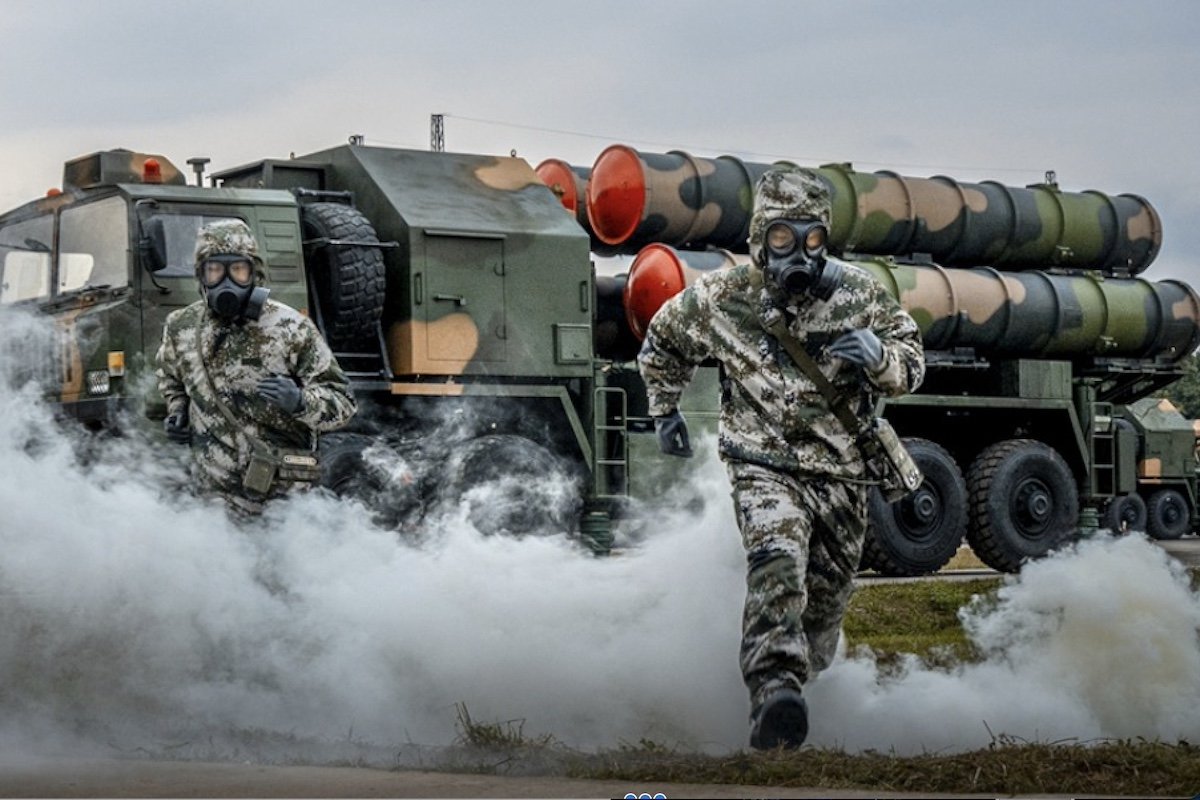
The Chinese military has conducted exercises simulating a response to a nuclear attack, a move analysts interpret as preparation for a potential escalation in any future conflict over Taiwan. The drills, reported by the South China Morning Post, were carried out by the People's Liberation Army's Eastern Theater Command, which holds operational responsibility for the Taiwan Strait and East China Sea.
Simulating a Radiological Battlefield
Held at an unspecified naval base, the exercise involved chemical, biological, radiological, and nuclear (CBRN) defense teams. Using uncrewed helicopters and handheld detectors, personnel practiced rapid identification of radiation spread. Specialized units then conducted screening and full-scale decontamination procedures for personnel and equipment, aiming to improve readiness in complex, contaminated battlefield environments.
The timing of the drills coincides with broader regional anxieties. They followed reported strikes near Iran's Bushehr nuclear facility and subsequent warnings from the International Atomic Energy Agency (IAEA) about radiological risks. Furthermore, the exercise accounts for the presence of several civilian nuclear plants within the command's area, including in Fujian and Zhejiang provinces, which are within range of potential adversaries.
The Logic of Nuclear Escalation in a Taiwan Scenario
Military analysts posit that these drills reflect a specific concern: that the United States might consider using tactical nuclear weapons to counter China's growing conventional military advantage in the Taiwan Strait. This mirrors the Cold War-era "offset" strategy employed by NATO against the Soviet Union.
In a November 2023 Atlantic Council report, analyst Greg Weaver noted that a Chinese amphibious invasion fleet would be "almost uniquely vulnerable" to nuclear attack. Building on this, Matthew Kroenig suggested in a separate September 2023 report that if US conventional forces proved insufficient to halt an invasion, Washington might contemplate limited nuclear first use against offshore targets like PLAN vessels and staging forces. The theory holds that striking maritime assets could signal limited intent while crippling the invasion, potentially constraining wider escalation.
However, this strategy faces sharp criticism. David Kearn, in a March 2024 War on the Rocks article, argues that threatening first use is a short-sighted overreaction. He contends the threat lacks credibility given ambiguous US commitments to Taiwan and limited domestic support for nuclear escalation. Kearn warns such a move would risk catastrophic Chinese retaliation against US bases, alarm allies, undermine non-proliferation efforts, and damage America's global standing. The recent reassessment of security postures by Indo-Pacific nations following conflict in Iran illustrates how regional stability is easily unsettled by distant crises.
Strains on US Extended Deterrence
A second driver of nuclear risk is the perceived weakening of US security guarantees in Asia. Analysts Marigold Black and Iain MacGillivray, writing for the Lowy Institute this month, note that Cold War-era frameworks for US extended nuclear deterrence are under growing strain. A more complex, multipolar nuclear environment—shaped by China's rapid modernization—is challenging old assumptions.
According to Hans Kristensen and others writing in the March 2025 Bulletin of the Atomic Scientists, China's nuclear arsenal is estimated at roughly 600 warheads and is expanding swiftly. With large-scale silo construction and new missile systems, China's stockpile could exceed 1,000 warheads by 2030, making it the fastest-growing nuclear force globally. As Black and MacGillivray point out, fading confidence in whether the US would risk its own cities to defend an ally weakens incentives for those allies to remain non-nuclear, potentially prompting them to consider indigenous arsenals.
Japan's Latent Capability and China's Concern
Nowhere is this dynamic more acute than in Japan, a focal point of Chinese strategic anxiety. Chinese state media and experts have repeatedly highlighted Japan's latent nuclear capability. A December 2025 SCMP report cited Chinese nuclear experts who believe Japan could build nuclear weapons in less than three years, citing its plutonium reserves, uranium enrichment capability, and advanced delivery systems like the Epsilon-S rocket.
Yet significant constraints remain. As scholar Wakana Mukai argued in a June 2025 article, Japan's identity as the only country to have suffered nuclear attack, strong domestic anti-nuclear norms, and its reliance on the US nuclear umbrella powerfully shape its stance. The dilemma for Tokyo and other US allies is balancing assured security against a rising China. This technological competition extends beyond weaponry, as seen in the parallel US-China race to build fusion energy supply chains, which is forcing other nations to choose sides.
The Eastern Theater Command's drills are a visible sign of Beijing's preparation for worst-case scenarios. They underscore how a crisis over Taiwan could rapidly transcend conventional warfare, testing the fragile nuclear deterrence architecture in the Indo-Pacific and forcing regional powers to confront profoundly dangerous choices.