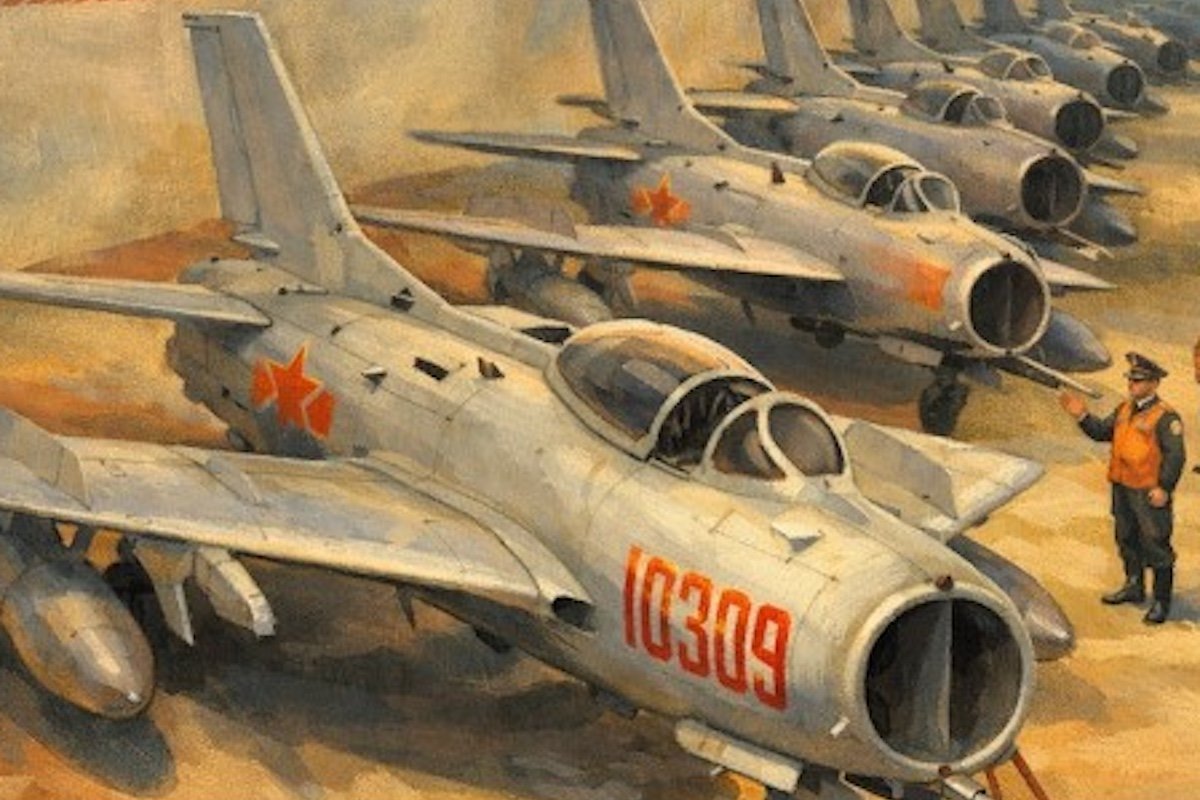
The People's Liberation Army has converted retired J-6 fighter jets into unmanned attack drones and deployed them at six air bases near the Taiwan Strait, according to satellite imagery and open-source intelligence analyzed by the Mitchell Institute for Aerospace Studies. Five of these bases are in Fujian province, with one in Guangdong, positioning the drones for potential use in a conflict over Taiwan.
J. Michael Dahm, a senior fellow at the Mitchell Institute, told Reuters that the PLA has stationed 200 or more of these converted aircraft to support the opening phase of any assault on Taiwan. Rather than operating as traditional remotely piloted vehicles, these drones are intended to function more like cruise missiles, striking Taiwanese, US, or allied targets in large numbers.
Cost Imbalance and Saturation Tactics
The J-6, a Soviet-era design that China produced in large numbers between 1958 and 1986, has a maximum speed of Mach 1.3, a range of 700 kilometers, and a payload capacity of 250 kilograms, according to the South China Morning Post. Taiwan's defense officials and external analysts have noted that the primary goal of these drones is to deplete the island's air defense resources by forcing defenders to expend expensive interceptors against cheap, fast-moving targets.
Kelly Grieco and Hunter Slingbaum of the Stimson Center highlighted the stark cost disparity: a single PAC-3 interceptor costs US$3.7 million, while a Tien Kung-3 interceptor costs US$620,000 per round. In contrast, China built over 4,500 J-6 fighters and 2,400 J-7 fighters, providing a vast reserve of airframes that can be converted at relatively low cost.
Jerome Brahy, writing for Army Recognition, estimated that if China launches 700 to 1,000 J-6 drones in a short period and Taiwan adopts a two-shot interceptor doctrine, the island would need 1,400 to 2,000 missiles to fully engage the threat. With Taiwan currently possessing between 1,200 and 1,800 interceptor missiles, saturation could occur when the number of targets exceeds the air defense system's capacity to detect, track, and intercept. Brahy calculated that with an 80% interception rate, an attack of 1,000 drones could result in 200 successful penetrations, delivering about 50,000 kilograms of payload. He noted that such a wave could be launched at 100 to 250 aircraft per hour over four to eight hours, potentially degrading Taiwan's defenses within a day, as radar systems cannot reliably distinguish between a J-6 drone and a modern fighter like the J-16.
This approach mirrors broader trends in modern warfare, where cheap drones are used to overwhelm expensive air defense systems, a dynamic explored in our coverage of the US military's costly dilemma against Iran's cheap drones.
Limits of Attrition Warfare
However, this strategy has inherent limits. While China has vast stocks of obsolete aircraft, those stocks are finite. Russia's experience in Ukraine offers a cautionary tale. According to the Oryx open-source intelligence site, Russia has lost over 4,300 tanks since its February 2022 invasion, including more than 1,800 T-72s, 1,200 T-80s, and 200 T-90s. As losses mounted, Russia increasingly turned to older models like the T-54/55, T-62, and T-64, many in poor condition. Dylan Malyasov noted in Defense Blog that as of October 2025, Russia had only 137 T-54/55s, 933 T-62s, and 653 T-64s remaining, with none in decent condition. This depletion has forced Russia to rely on attrition warfare, strategic bombing, and small-unit tactics rather than major combined-arms maneuvers.
Taiwan could pursue a similar strategy of resilience, as seen in Iran's ability to absorb an initial US-Israeli salvo of 5,197 munitions across 35 types in the first 96 hours of the US-Israel-Iran war. Following Iran's example, Taiwan could improve its resilience by adopting the Western mission command concept, delegating authority to lower-ranking officers to enable independent action despite decapitation strikes or communications breakdowns.
China's munitions system faces its own challenges, and the conversion of J-6s into drones is part of a broader military buildup that includes other asymmetric capabilities, such as drone-launched mines designed to encircle Taiwan. Taiwan's defense ministry has outlined plans to acquire a new generation of counter-drone systems swiftly, but the cost imbalance remains a critical vulnerability.
The deployment of these converted jets underscores a shift toward mass attrition warfare in any Taiwan contingency, testing not only firepower but also the sustainability of both sides' military resources. As the US Navy explores its own drone swarm strategy in the Indo-Pacific, the PLA's approach highlights the growing role of low-cost, high-volume systems in modern conflict.