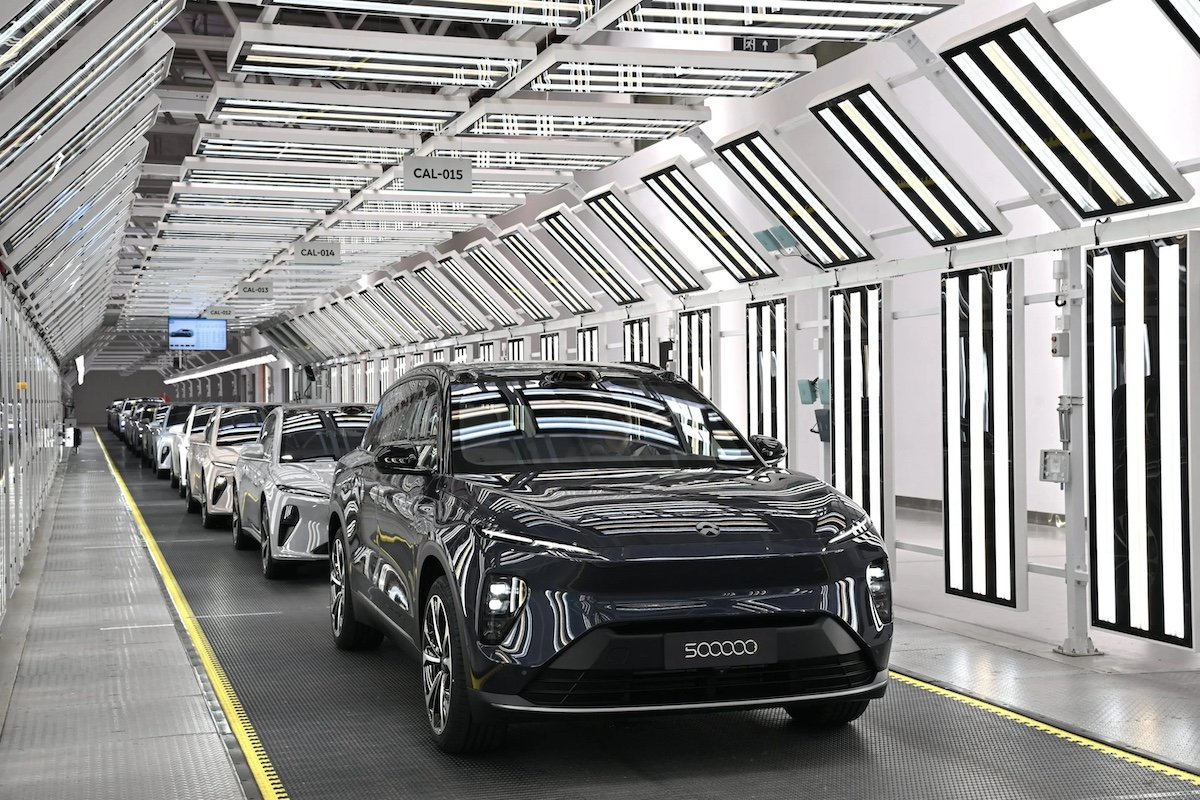
Two years ago, this writer stood on the floor of Auto China 2024 in Beijing and called it an industrial blood-sport, a repeat of Japan's motorcycle wars but with cars. That prediction has proven grimly accurate. The 2026 edition, now spread across the China International Exhibition Center's Sunyi Venue and the newly built Capital International Exhibition and Convention Center next door, occupies three times the floor space—210,000 square meters of new hall. With 1,451 vehicles on display and 181 new launches, the kill-or-be-killed Battle Royale that is China's auto industry has only intensified.
Regulatory Shifts and Export Surge
The Chinese government is phasing out EV purchase tax exemptions: a 50% reduction in 2026 and complete elimination in 2027. This has driven domestic car sales down 20.3% in the first quarter of 2026. But exports have grown 57%, largely making up the shortfall. For companies like BYD, exports carry six times the margins of domestic sales, and the company's 2025 export volume hit 1.05 million vehicles—a 145% increase year-on-year. BYD's 2026 target of 1.5 million units looks achievable, with January-April exports up 60%.
BYD, once the undisputed leader, has stumbled. Its products have been outshone in premium segments by NIO, Xiaomi, XPeng, and Huawei, while Geely, Chery, Changan, and Leapmotor undercut it in mass-market price wars. Regulators have also stepped in, demanding suppliers be paid within 60 days instead of the abusive 140-180 days BYD had imposed, reducing its working capital and slowing its breakneck expansion. Yet counting out BYD would be a mistake. The company invested years ago in export infrastructure, with eight company-owned roll-on-roll-off car transport ships and seven more under construction. Its second-generation Blade Battery, with 1,500kW flash charging, can refill from 10% to 70% in five minutes and from 10% to 97% in ten minutes. BYD has promised 20,000 flash charging stations by year's end, potentially eliminating range anxiety—one of the last pain points for EV owners.
Technology Wars: From Horsepower to NVH
Batteries remain 30-50% of an EV's price, and frontier technologies could be game-changing. CATL's sodium ion technology could halve battery costs, while solid-state batteries—non-flammable, double the range, lighter, and cheaper—remain the Holy Grail. Chinese researchers account for 66% of the world's most cited battery papers; the US is second at 12%. Fast charging is becoming table stakes, with BYD, CATL, and competitors all offering versions.
The horsepower war is also running its course. The average EV in China now has over 270 horsepower, compared to 150 for internal combustion engine cars. Perky acceleration is now expected; 500 horsepower, once the realm of exotic European sports cars, is an upgrade option on mass-market models. Premium Chinese EVs offer ridiculous 1,000-1,500 horsepower—overkill, like interiors with half a dozen touchscreens and karaoke systems. With acceleration "solved," engineers have moved on to more meaningful challenges.
Noise, vibration, and harshness (NVH) have become a new battleground. Li Auto kicked off the NVH arms race with silent interiors and silky smooth operations. Chinese car companies now approach NVH holistically, scrutinizing every part for reduction rather than relying on heavy insulation. Motors are engineered to reduce whine; electrical systems use pulse width modulation to minimize acoustic noise. Chassis are cast in one piece to eliminate vibration-prone rivets and welds. Windows use multi-layer laminated glass sandwiching polyvinyl butyral to reduce outside noise. Hydraulic bushings replace rubber to reduce high-frequency road shock, and interior noise is actively canceled with speakers and microphones. These engineering sorceries now give mass-market Chinese EVs a premium, low-NVH feel.
Advanced suspensions are also becoming ubiquitous, from continuous dampening control to air suspensions to fully active systems. Models from BYD, Geely's Zeekr, and Dongfeng's Voyah now offer CDC as standard or near-standard. The technology wars are not just about speed or luxury; they are about redefining what a car can be, as the Donroe Doctrine reshapes global perceptions of Chinese industrial strategy.
Global Implications
China's auto bloodbath has global consequences. The country's dominance in battery research and production, as highlighted by the tungsten supply chain, gives it leverage in critical materials. Meanwhile, the export surge is reshaping markets from Southeast Asia to Europe. Indonesia, for instance, must tread carefully as it navigates China's bauxite rush, while Singapore's AI neutrality model cracks under US-China pressure. The battle for the future of the car is being fought in Beijing, and the rest of the world is watching.