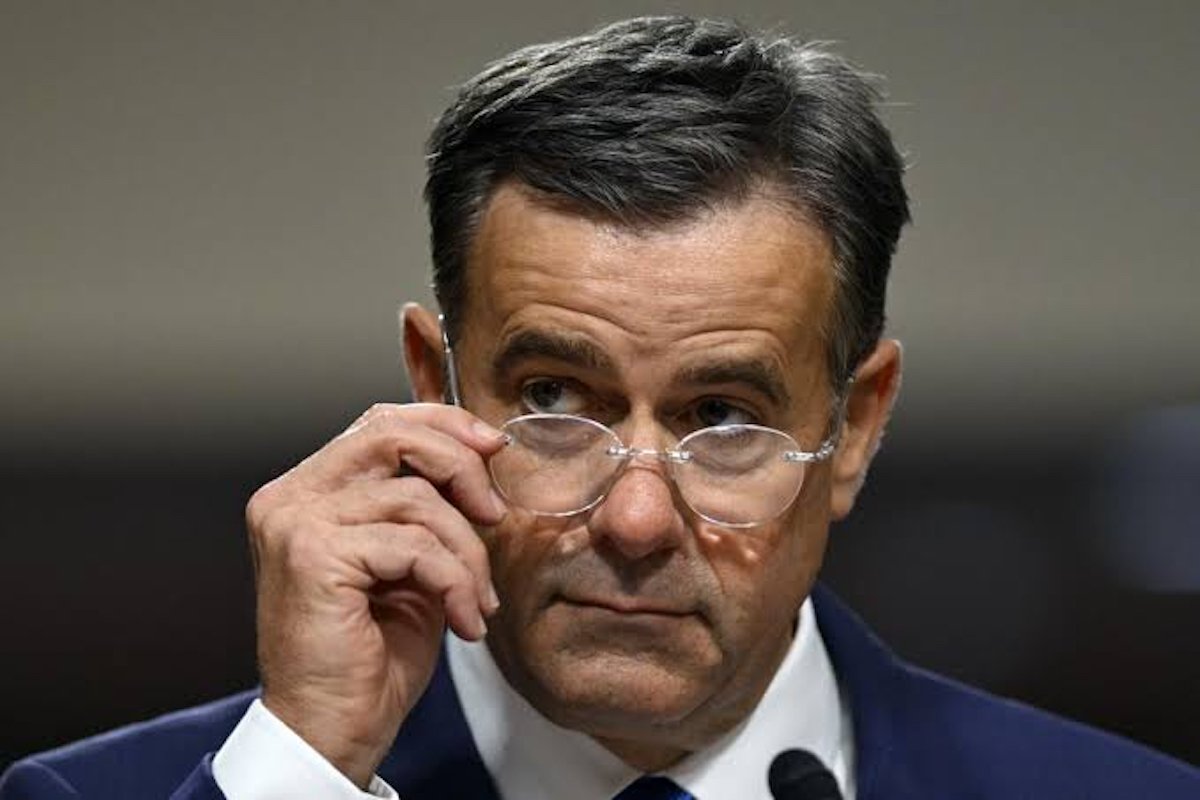
The circumstances surrounding CIA Director John Ratcliffe's recent visit to Moscow remain opaque, but the available details paint a picture of an urgent, high-stakes mission. The unannounced trip, which took place in late August, has fueled speculation about Washington's concerns regarding the stability of the Kyiv government and the trajectory of the war in Ukraine.
Ratcliffe departed from Joint Base Andrews on August 23 aboard a C-17A Globemaster, a transport aircraft typically used for strategic airlift missions. The plane, however, did not fly directly to Moscow. Instead, it landed in Riga, Latvia, roughly 525 miles from the Russian capital, where it remained overnight before proceeding to Moscow's Vnukovo airport. This indirect routing suggests that the visit was not pre-cleared by Russian authorities, and that the CIA director was essentially seeking entry without prior approval.
Upon arrival, Ratcliffe was met by US Embassy vehicles on the tarmac, and his motorcade was observed moving through Moscow. Notably, there was no indication that any Russian official greeted him at the airport. The Kremlin only acknowledged the visit after Ratcliffe had departed, stating that he met with Russian intelligence officials but not with President Vladimir Putin.
A message of warning?
The most plausible explanation for Ratcliffe's urgent trip is that Washington sought to deliver a direct warning to Moscow about the potential collapse of the Ukrainian government. While mainstream Western media often portrays Ukraine's position as tenable, there is growing evidence that Kyiv is struggling to sustain its war effort. The CIA may have intelligence indicating that Ukraine's internal situation is deteriorating more rapidly than publicly acknowledged, and that Russia might be contemplating a decisive military push to replace the current leadership in Kyiv.
Such a scenario would align with Ratcliffe's mission. The CIA director is not typically tasked with routine diplomatic communications; his presence in Moscow suggests a matter of grave national security concern. The fact that the visit was so hastily arranged, without prior clearance, underscores the urgency.
It is also notable that the US reportedly asked Ukrainian President Volodymyr Zelensky to suspend drone strikes over Russian territory for a few days to clear the airspace for Ratcliffe's flight. This request, if accurate, indicates that the US was willing to make significant concessions to ensure the CIA director's safe passage, further highlighting the importance of the mission.
The Russians, for their part, had to be informed of the C-17's approach to avoid any accidental engagement by air defense systems. This coordination, despite the lack of formal approval, suggests that there was at least some level of communication between Washington and Moscow prior to the flight.
Historical parallels
Secret trips by senior US officials to Moscow are rare. The most famous example is Henry Kissinger's visit on October 21, 1973, during the Yom Kippur War. Kissinger was invited by Soviet leadership to help defuse a crisis that threatened to escalate into a superpower confrontation. Today's situation, while different in specifics, carries similar overtones of potential escalation.
Russia has been increasingly vocal about its willingness to retaliate against Western support for Ukraine, particularly the UK's backing of deep strikes on Russian territory. The Kremlin has warned of "inevitable consequences," and there is talk within Russia of a major military mobilization to achieve victory in Ukraine. Such a move could trigger a wider European conflict, a prospect that Washington would find deeply alarming.
However, it is unlikely that Ratcliffe's mission was solely to warn Russia against mobilization. The CIA director's role is more about intelligence sharing and understanding adversary intentions than issuing ultimatums. It is more probable that Ratcliffe carried a message about the unacceptability of any Russian attempt to overthrow the Ukrainian government, and perhaps to gauge Moscow's willingness to negotiate a settlement.
The identity of Ratcliffe's Russian counterpart remains officially undisclosed, but it is widely believed to be Sergey Naryshkin, head of Russia's Foreign Intelligence Service (SVR). Ratcliffe and Naryshkin had previously spoken by phone in March 2025, focusing on crisis resolution. This existing channel may have been the conduit for arranging the meeting.
The fact that Putin did not meet with Ratcliffe, despite being "in the loop" according to Tass, suggests that the Russian president chose to keep his distance, perhaps to avoid legitimizing the visit or to signal displeasure with its purpose. The meeting with Naryshkin, however, indicates that Moscow was willing to engage at a senior intelligence level.
For observers of the Indo-Pacific, this episode carries broader implications. The stability of Ukraine is not just a European concern; it affects global security dynamics, including in Asia. A Russian victory or a chaotic Ukrainian collapse could embolden other authoritarian actors, from Pyongyang to Beijing, and reshape the strategic calculus in the region. As Pyongyang's balancing act between Moscow and Beijing demonstrates, the war in Ukraine has already had ripple effects across the Indo-Pacific.
Moreover, the secretive nature of Ratcliffe's visit highlights the fragility of US-Russia relations and the potential for miscalculation. In an era of heightened great-power competition, such backchannel communications are essential to prevent unintended escalation. The fact that the visit was so hastily arranged, and that the Russians were initially unaware, underscores the volatility of the current moment.
As the situation in Ukraine continues to deteriorate, the international community, including Asian nations, will be watching closely. The outcome of this conflict will shape the global order for years to come, and the CIA director's urgent mission to Moscow may be a harbinger of significant developments on the horizon.