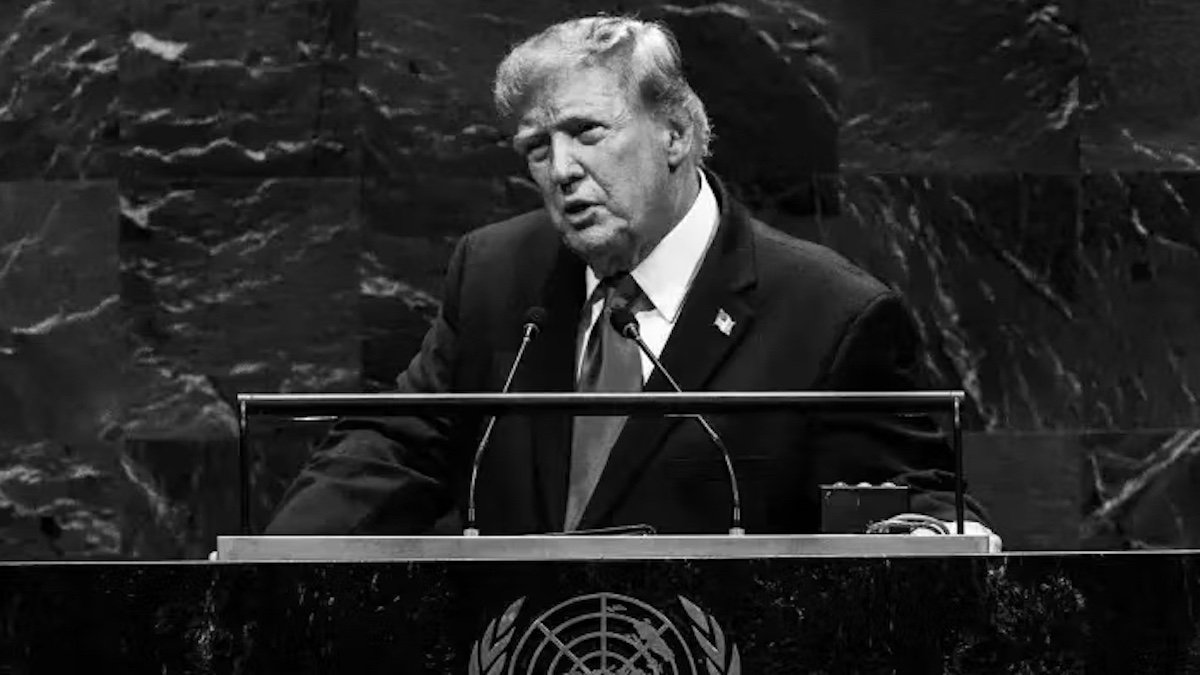
In a speech to the UN General Assembly, President Donald Trump framed the fate of Iran as a personal choice, saying he could negotiate a deal or "annihilate the Islamic Republic" and drive Iran "into hell with no chance of survival." He dismissed the midterm elections as irrelevant, giving "absolutely no credence" to voters. This is not the language of a leader bound by law or the Constitution; it is the language of a monarch.
The Founders explicitly rejected the British model of unchecked executive war powers. In Federalist 69, Alexander Hamilton assured Americans that the President's war authority would be far less than that of a king. James Madison wrote to Thomas Jefferson in 1798: "The constitution supposes, what the History of all Govts demonstrates, that the Ex. is the branch of power most interested in war, & most prone to it. It has accordingly with studied care vested the question of war in the Legislature."
Yet today, Congress has abdicated that responsibility. Republicans, terrified of Trump and beholden to AIPAC and the military-industrial complex, have refused to exercise their constitutional duty. Democrats, too, have often looked the other way when their own presidents launched wars. The result is a war with Iran that has no clear purpose, has caused mass suffering, and has cost tens of billions of dollars.
The human cost and strategic failure
The war has devastated Iran and the region. The closure of the Strait of Hormuz has sent global prices for oil, gas, and fertilizers soaring. American military bases across eight Middle Eastern countries have been hit. The much-vaunted AI battlefield has been exposed as a horror: on the first day of the war, a missile struck a girls' elementary school, killing more than 150 people, most of them girls aged seven to twelve. The military's own inquiry reportedly found that overreliance on artificial intelligence contributed to the targeting. Seven months later, there has been no apology, no compensation, and no accountability.
Trump's threat to annihilate a UN member state from the General Assembly podium violates Article 2(4) of the UN Charter, which prohibits even the threat of force. The world is aghast. This is not leadership; it is recklessness that endangers global stability.
Congress must act now
The Constitution is clear: Article I, Section 8 gives Congress, not the President, the sole power to declare war. That is not optional. Congress cannot play dead while the President takes the nation into an unauthorized conflict. The fiscal year ends on September 30, and every appropriations bill is an opportunity to prohibit funds for offensive operations against Iran.
A clear majority of Americans oppose this war, and opposition is growing. A few Republicans have broken ranks—last week, three more voted to end the war. Their colleagues should follow. The influence of military contractors and AIPAC must end; it is a dereliction of duty and a violation of the oath of office.
The right course is simple: cut off funding, stop the attacks, and bring American troops home. No agreement with Iran is needed to stop a war we started. Ending the war would restore sanity to energy markets and food supplies, and begin to repair America's standing in the world.
This is not just a domestic issue. The war has global implications, particularly for the Indo-Pacific, where allies and partners watch America's reliability. As Trump's second term accelerates a global shift away from US leadership, the region is taking note. The Strait of Hormuz has become a geopolitical void, and Congress stalls on war authorization even as the conflict deepens. The ordeal of the USS Abraham Lincoln is a reminder of the toll on service members.
Members of Congress, you have a job to do. Do it. Stop this war before it spirals further out of control.