For much of the post-Cold War era, the operating assumption in global politics was straightforward: American power, however imperfect, anchored the international system. Allies grumbled about Washington's unilateralism but stayed close, fearing the alternative—a world without a clear anchor—was riskier. That assumption is now being tested in real time, and the evidence from Donald Trump's second term suggests it may not survive.
Three developments illustrate the shift: a sweeping new round of US tariffs, a Pew Research Center survey showing China edging out the US in global favorability, and a European Union caught between American pressure and Chinese economic weight. Together, they point to more than routine diplomatic friction—they signal a fundamental realignment that may be difficult to reverse.
Tariff turbulence undermines trust
On July 24, the Trump administration imposed tariffs of 10% to 12.5% on goods from 60 trading partners, covering roughly 99% of all US imports. The administration framed the move as enforcement against countries that failed to adequately prohibit imports made with forced labor, using authority under Section 301 of the Trade Act of 1974. The new duties replaced a temporary 10% global tariff that had been in place since February, when the Supreme Court ruled Trump exceeded his authority by imposing tariffs unilaterally under a declared national emergency.
The specific legal justification matters less than the pattern. This is the second major tariff regime of Trump's second term, arriving within months of the highest court striking down the first. For trading partners from Canada to India to the European Union, the message is clear: the United States is no longer a reliable economic partner. A government that reissues sweeping trade barriers under a new legal theory each time the old one fails in court is not one whose commitments can be planned around.
Global opinion flips
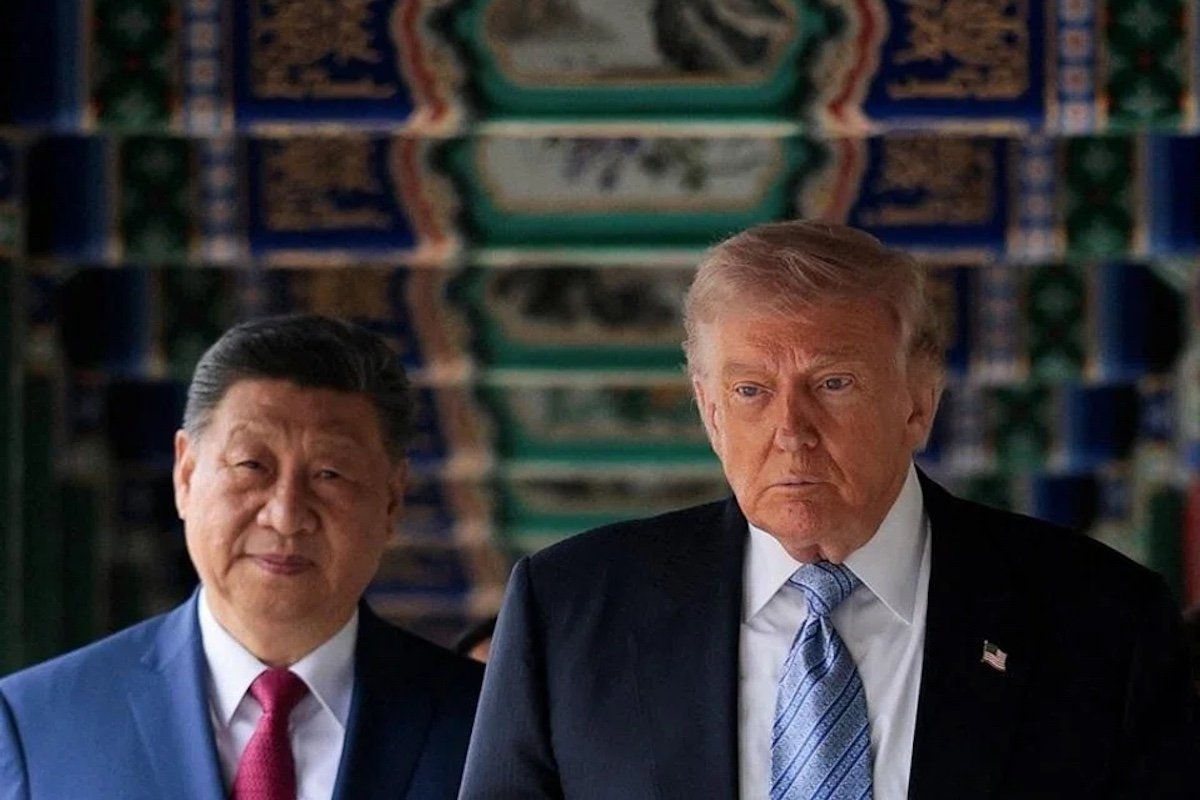
That unpredictability is showing up in global public opinion. A Pew Research Center report published July 15, 2026, based on surveys of more than 42,000 adults across 36 countries between February and May, found that people in most of those countries now view China more favorably than the United States. Confidence in Chinese President Xi Jinping has also overtaken confidence in Trump globally, according to the same report.
The finding's breadth is striking. This is not confined to the Global South or countries with longstanding grievances against Washington. Pew's data shows Canadians and Mexicans—the closest US neighbors—now view China more positively than the US. In Germany, Greece, Italy, the Netherlands, Spain, Sweden, and the United Kingdom, Xi outpolls Trump by double digits. A year ago, most surveyed countries still favored the US; that is no longer true.
As Council on Foreign Relations senior fellow Yanzhong Zhong puts it: “China now outranks the United States in global favorability for the first time in nearly two decades, but the real story isn't a Chinese soft-power surge—it's American decline. China's median favorability has barely moved over the past decade; the crossover occurred largely because US ratings collapsed.” Maria Repnikova adds, “China is passively gaining stature from America's soft-power retreat and now looks to many like the more accessible and reliable partner. Beijing has yet to turn that relative advantage into a decisive transfer of affection or a coherent alternative model.”
The Pew report also found that people in middle-income countries across Latin America, Africa, the Middle East, and Asia are now more likely to describe China as a reliable partner and less likely to see it as prone to foreign interference, compared with the US. That is a direct inversion of the roles the two powers have played in global public opinion for most of the post-Cold War era.
Seoul hedges its bets
Perhaps the clearest illustration among formal US allies is playing out in Seoul. Trump said on August 16 that he spoke with South Korean President Lee Jae-myung and asked if he would give the US “a little hand” with Iran. When Lee refused, Trump directed the Pentagon to “substantially reduce” joint military exercises, known as Ulchi Freedom Shield, which began August 17 and run until August 27.
Lee's progressive government has pursued what it calls “pragmatic diplomacy” and greater strategic autonomy, prioritizing national interest over rigid alignment with Washington. The shift has been pronounced enough that South Korea's conservative opposition accuses Lee's administration of drifting from the alliance, with American conservative commentators making similar arguments in a Wall Street Journal op-ed cited by both Seoul Economic Daily and Asia Times. Even a treaty ally with US troops still stationed on its soil is recalibrating how tightly to bind its foreign policy to Washington. This recalibration is happening under a government that came to power promising hard-nosed pragmatism rather than ideological alignment with either superpower—a telling sign of where the center of gravity in Korean politics has moved. For more on the economic pressures driving this, see Seoul's economic strain.
Europe's bind
South Korea is not alone. Nowhere is the tension more acute than in Europe, which finds itself squeezed from two directions. European policymakers are increasingly alarmed by Chinese industrial overcapacity, particularly in green technologies and electric vehicles, which threatens European manufacturers. At the same time, Washington's tariff policies and its questioning of NATO commitments have left European capitals unsure whether the US will remain a dependable security and economic partner.
The result is a Europe hedging its bets—deepening trade ties with Beijing where possible while maintaining defense links with Washington, but with growing skepticism about both. This is not a wholesale abandonment of the US, but it is a marked shift from the automatic alignment of previous decades.
The broader picture is clear: the post-Cold War order, anchored by American power and credibility, is unraveling. Trump's second term has accelerated the process, but the underlying forces—economic multipolarity, rising Chinese influence, and the erosion of trust in US commitments—are structural. Whether the shift is reversible depends on decisions in Washington, but the evidence suggests that many countries are already planning for a world with no single anchor. As the global fiscal strains and China's tech rise show, the landscape is changing in ways that will shape the Indo-Pacific and beyond for years to come.