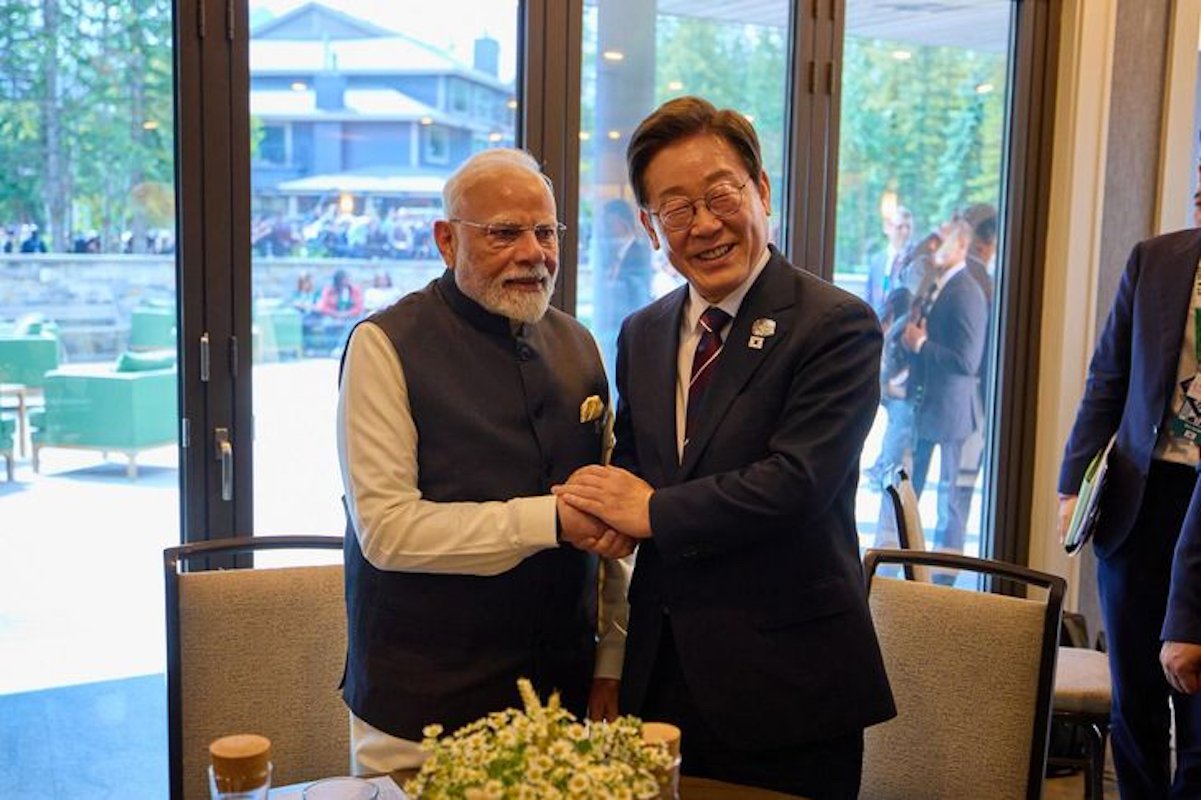
The upcoming state visit of South Korean President Lee Jae-myung to India represents far more than a diplomatic formality. It arrives at a pivotal juncture for both nations, as the regional order in the Indo-Pacific undergoes profound transformation. The frameworks that once facilitated predictable growth and security are weakening, compelling New Delhi and Seoul to reassess a partnership that has often prioritized commerce over cohesive strategy.
A Republic of Korea at a Strategic Crossroads
Seoul finds itself navigating intense internal debates over its foreign policy trajectory. One faction advocates for deeper alignment with traditional allies the United States and Japan, emphasizing shared democratic values and deterrence against North Korea. Another prioritizes economic pragmatism and sustained engagement with China, which accounts for roughly a quarter of South Korea's total trade. This divide has moved from theoretical discussion to actively shaping policy, creating a complex balancing act for the administration in Seoul.
This internal tension is exacerbated by external perceptions. Some analysts in Seoul point to perceived limitations of US military power in recent global crises, which, accurate or not, fuel arguments for a more autonomous defense and foreign policy. This sentiment accelerates calls for strategic self-reliance and partnership diversification, challenging the long-standing logic of near-exclusive dependence on Washington. The result is a structural paradox: a security posture growing more cautious even as economic interdependence with China remains deeply entrenched.
This evolving dynamic in Seoul has direct implications for the Indo-Pacific. As explored in a related analysis of the US-South Korea alliance, the foundational partnerships of the region are being stress-tested. Should Seoul's economic structures and security policy become more susceptible to Beijing's influence, the consequences would ripple far beyond the Korean Peninsula.
Strategic Stakes for India
For India, a robust and strategically aligned Republic of Korea is a significant asset. Bilateral trade has exceeded $27 billion, with ambitions to reach $50 billion. Major South Korean conglomerates like Samsung, Hyundai, and LG have invested over $10 billion in India, building manufacturing capacity and creating jobs. More fundamentally, Seoul is a critical node in the Indo-Pacific architecture, and its strategic choices directly impact New Delhi's vision for a free, open, and inclusive region.
The risks of inaction are clear. If Seoul is pulled deeper into China's economic orbit, it could weaken global efforts to diversify critical supply chains—a key priority for both India and its Quad partners. It would also diminish the effectiveness of emerging minilateral frameworks designed to build resilience among like-minded states. For India, the downstream effects could include increased strategic pressure along its eastern flank and a more constrained regional environment.
Moving Beyond Transactional Diplomacy
Historically, the India-South Korea partnership has been competent but constrained, often framed by transactional goals like trade agreements and investment facilitation rather than a unified strategic vision. This approach has led to three clear shortcomings.
First, it has underutilized significant areas of convergence, particularly in defense technology co-development, maritime security coordination, and building secure technology supply chains. Second, India remains a peripheral figure in mainstream South Korean strategic discourse, which is still dominated by the US-China dichotomy. Third, New Delhi has not consistently addressed Seoul's core anxieties, which include supply-chain security, disruptive export controls, the persistent threat from North Korea, and broader regional instability.
The challenge is not merely to increase the volume of engagement but to alter its quality. The partnership must evolve to jointly address systemic vulnerabilities. This means collaborating on resilient technology stacks, from semiconductors to clean energy, and coordinating naval postures to ensure sea lane security. The geopolitical context demands it, as seen in other theaters where alliances are being recalibrated, such as in the protracted stalemate shaping US-Iran-Israel tensions.
President Lee's visit is a strategic intervention. Its success will be measured not by the number of memoranda signed, but by whether it can establish a new framework for cooperation—one that acknowledges the severe pressures both nations face and moves deliberately to build long-term strategic autonomy and resilience. The alternative is to remain reactive in a region where the costs of passivity are rising sharply.