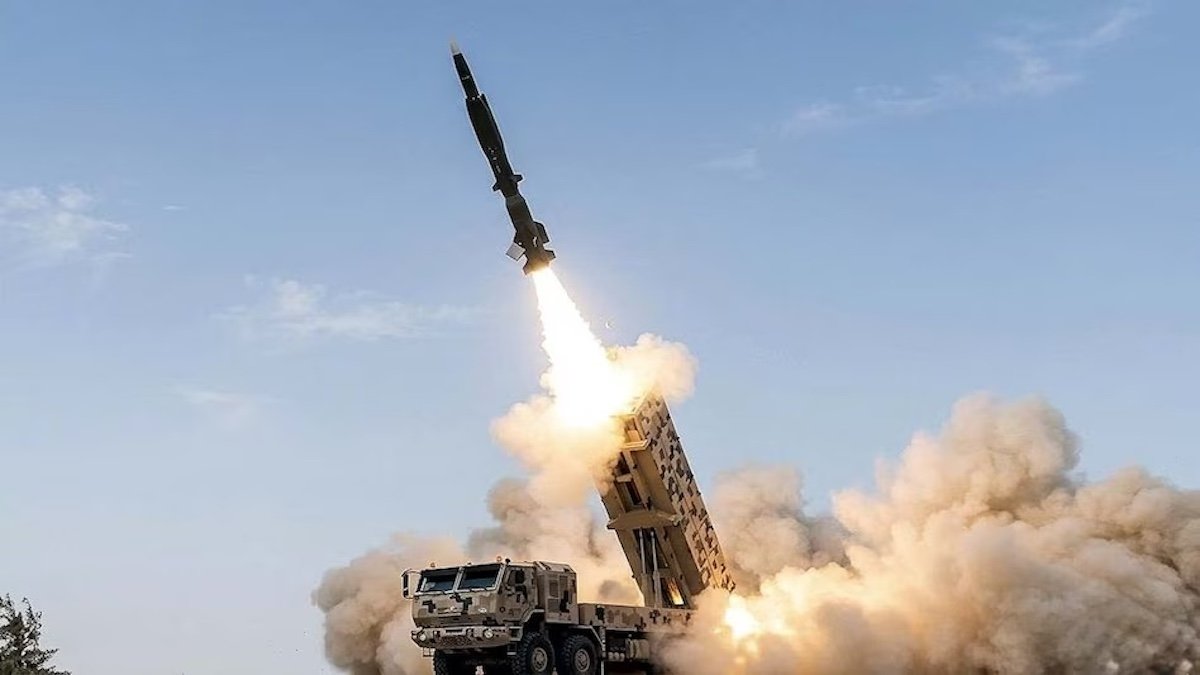
Pakistan's public display of the Fatah-3 supersonic cruise missile this month signals a potential shift in South Asian conventional deterrence and could open a new channel for Chinese missile exports to the Persian Gulf. The road-mobile, twin-canister system, unveiled by the Pakistan Army Rocket Force Command (ARFC), is widely believed to be a localized derivative of China's HD-1 missile, developed by Guangdong Hongda.
The Fatah-3 reportedly achieves speeds between Mach 2.5 and Mach 4, carries a warhead of 240 to 400 kilograms, and has a strike range of roughly 290 to 450 kilometers. Its supersonic speed and low-altitude flight profile—combining terrain-hugging and sea-skimming capabilities—compress interception timelines for air-defense systems, complicating radar tracking and layered responses against fixed infrastructure, naval targets, and mobile battlefield assets.
Challenging India's BrahMos Advantage
The missile directly challenges India's longstanding advantage in supersonic strike systems, anchored by the Russian-Indian BrahMos missile. According to Missile Threat, the HD-1 emphasizes affordability, lighter weight, and fuel efficiency through its solid-fuel ramjet, while the BrahMos prioritizes kinetic strike power, multi-platform deployment, stealth features, and advanced guidance systems with ranges of 300 to 500 kilometers. By fielding the Fatah-3, Pakistan narrows one of India's key conventional warfare advantages.
During the May 2025 skirmishes over Kashmir, India deployed the BrahMos to target Pakistan's Nur Khan Airbase, located roughly 1.6 kilometers from the headquarters of the Pakistan Strategic Plans Division (SPD), which oversees the country's nuclear arsenal. That strike demonstrated a potential Indian conventional counterforce capability against Pakistan's nuclear command-and-control infrastructure, exposing a gap that the Fatah-3 could help fill.
As Mandip Singh noted in a January 2026 report for the Center for Land Warfare Studies (CLAWS), Pakistan's Full Spectrum Deterrence (FSD) doctrine envisions using tactical nuclear weapons to skip the conventional stage of conflict. However, Singh points out that the ARFC adds a "pre-conventional conflict" phase—non-contact, deep, calibrated missile, rocket, and drone attacks—to offset India's conventional superiority while staying below the nuclear threshold. The Fatah-3, as a conventional counterforce asset, could enable Pakistan to threaten India's strategic deterrent without resorting to tactical nuclear weapons.
A Gateway to Gulf Markets
Beyond South Asia, the Fatah-3 could serve as a vehicle for China to expand its defense footprint in the Middle East. A South China Morning Post article this month argues that Pakistan's deployment of fighter aircraft to Saudi Arabia under the Strategic Mutual Defense Agreement (SMDA), signed in September 2025, gives Chinese-origin systems operational exposure under real crisis conditions without direct Chinese involvement. Reports indicate that one deployed aircraft may have been a JF-17 Block III, co-produced by Pakistan and China. Analysts say Pakistani operation of Chinese-linked systems could rebut Gulf concerns that such platforms are "unproven," potentially making Saudi Arabia more receptive to Chinese-equipped aircraft.
Reuters has reported that Pakistan and Saudi Arabia were discussing converting roughly US$2 billion in Saudi Arabian loans into JF-17 acquisitions, a move that would directly benefit Chinese defense exporters. Saudi Arabia could also consider the Fatah-3 for its ongoing missile buildup. Fabian Hinz, in a February 2025 article for the International Institute for Strategic Studies (IISS), notes that Riyadh has quietly expanded or modernized its ballistic missile force by constructing a suspected new underground missile base and upgrading Royal Saudi Strategic Missile Force (RSSMF) infrastructure since the late 2010s. Saudi Arabia first acquired Chinese DF-3 intermediate-range ballistic missiles in 1988 and later reportedly sought more accurate systems.
The Fatah-3's potential availability through Pakistan offers a politically palatable path for Gulf states to acquire Chinese-origin supersonic cruise missiles without direct purchases from Beijing. This arrangement aligns with Pakistan's role as a frontline broker for Chinese defense technology, a position that has deepened through joint ventures like the JF-17 and the Hangor-class submarines. For more on Pakistan's evolving role, see Pakistan's Diplomatic Pivot: How Islamabad Became an Indispensable Middle Power.
The Fatah-3's emergence also underscores the broader trend of China-Pakistan missile cooperation, which has implications for regional stability. As noted in China's J-35AE Export to Pakistan Could Destabilize Nuclear Balance with India, such transfers risk upsetting the conventional and nuclear balance in South Asia. Meanwhile, the missile's potential deployment in the Gulf could complicate existing deterrence dynamics, particularly given the region's reliance on US-provided air-defense systems.
In sum, the Fatah-3 represents more than a tactical upgrade for Pakistan. It is a strategic tool that could reshape conventional deterrence in South Asia and open a new front in Chinese defense exports to the Middle East, with implications for both regional security and the global arms trade.