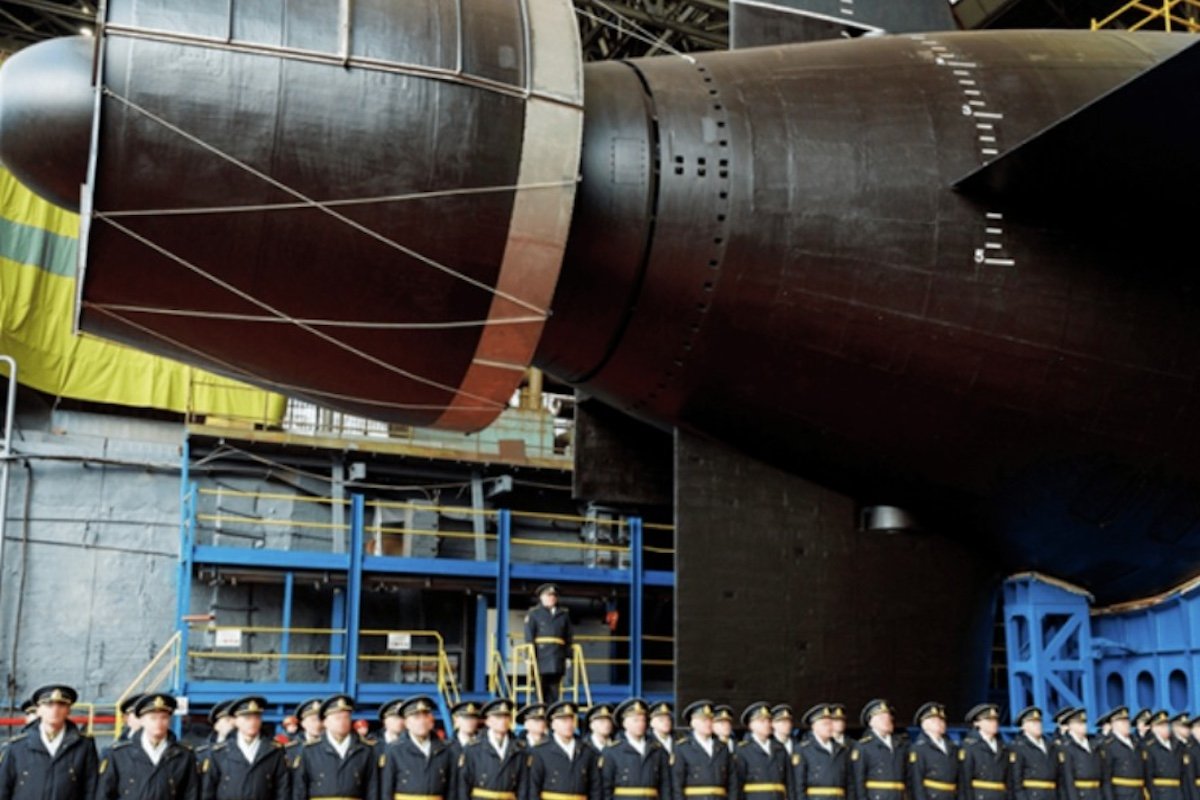
Russia's Khabarovsk submarine, the first purpose-built carrier for the Poseidon strategic nuclear drone, has begun initial factory sea trials, signaling a new phase in Moscow's undersea deterrence. The vessel departed Severodvinsk, a major shipbuilding hub, for its first voyage since construction began in 2014. Upon completion of testing, it is slated to join Russia's Pacific Fleet, extending its nuclear reach toward the US West Coast, Hawaii, and Japan.
The Khabarovsk is designed as a second-strike platform, equipped with six launchers for the 2M39 Poseidon—an autonomous, nuclear-powered torpedo capable of carrying a megaton-class warhead. With an operational depth of about one kilometer and speeds up to 200 kilometers per hour, the Poseidon can travel roughly 10,000 kilometers, using complex routing to evade conventional anti-torpedo defenses. Its intended targets include coastal military installations, critical ports, and carrier strike groups.
A new class of strategic asset
The Khabarovsk follows the Belgorod, a special mission submarine commissioned in July 2022 that can carry four Poseidon drones and also serves as a mothership for the Losharik spy submarine, designed to sever or tap undersea cables. The Khabarovsk appears more specialized as a Poseidon launch vehicle, with up to four additional units planned and a total of 30 Poseidon drones expected. This focus on heavy, high-yield systems comes as arms control norms weaken, particularly with the New START treaty expiring in February 2026.
These submarines are part of Russia's "superweapons" arsenal, which includes the Sarmat ICBM, the Avangard and Zircon hypersonic missiles, the Burevestnik nuclear-powered cruise missile, and the Kinzhal aero-ballistic missile. While Russia has used the Zircon and Kinzhal in combat against Ukraine, they have not broken the stalemate in the war. The Khabarovsk and Poseidon are now distinct strategic assets without effective arms control mechanisms, potentially serving as bargaining chips in future negotiations with the United States.
However, the Khabarovsk may be entering service at a time when traditional notions of sea-based nuclear deterrence are being challenged. Nuclear ballistic missile submarines (SSBNs) have long been seen as the ultimate guarantors of second-strike capability, but recent events in the Russia-Ukraine war question that assumption.
Ukraine's strikes challenge submarine invulnerability
In December 2025, Ukraine destroyed a Russian Kilo-class submarine at its homeport in Novorossiysk using a Sea Baby unmanned underwater vehicle (UUV) that slipped past base defenses. Earlier, in September 2023, Ukraine severely damaged the Kilo-class submarine Rostov-on-Don with Storm Shadow/SCALP cruise missiles while it was in drydock at Sevastopol; after repairs, Ukraine struck and sank it in August 2024. These incidents have prompted Russia to take countermeasures, including installing anti-drone cages on Kilo-class submarines in the Black Sea and keeping them submerged at port. At the Rybachiy Naval Base in Kamchatka, Russia has also installed anti-drone netting over docked SSBNs and deployed floating booms around submarine piers to block UUV attacks.
As those attacks show, SSBNs and special mission submarines such as the Khabarovsk and Belgorod may not be as invulnerable as previously thought. SSBNs can be "brittle" in the sense that if a submarine loses contact with higher command, is prevented from launching its nuclear payload, or is destroyed, it could result in the loss of a significant part of its operator's nuclear arsenal. That brittleness is not confined to SSBNs: concentrating multiple Poseidon weapons aboard a small number of Khabarovsk- and Belgorod-class submarines creates a comparable problem of force concentration.
Losing one Khabarovsk-class or Belgorod-class submarine and its entire Poseidon payload could seriously damage Russia's nuclear posture in the Pacific, forcing it to rely more on conventional nuclear delivery systems, such as ICBMs, which may be vulnerable to US missile defenses, including the Ground-Based Midcourse Defense (GMD) or the planned Golden Dome space-based system. While attacking a major nuclear power's strategic assets was previously seen as a red line inviting nuclear retaliation, Ukraine's audacious June 2025 Operation Spiderweb, which struck dozens of Russian aircraft—including several irreplaceable Tu-95 strategic bombers—may have served to call out Russia's nuclear bluff and set a perception-breaking precedent. Instead of nuclear retaliation, Russia responded with a barrage of 400 drones.
The Khabarovsk's deployment to the Pacific Fleet underscores Russia's intent to maintain a credible second-strike capability in a region where the United States is also facing carrier shortages that strain its own deterrence posture. Yet the lessons from Ukraine suggest that even the most advanced undersea systems are not immune to asymmetric threats, raising questions about the future of nuclear deterrence in an unstable world. As some analysts argue, the promise of nuclear deterrence may be increasingly fragile, and the Khabarovsk's arrival may not change that calculus.



