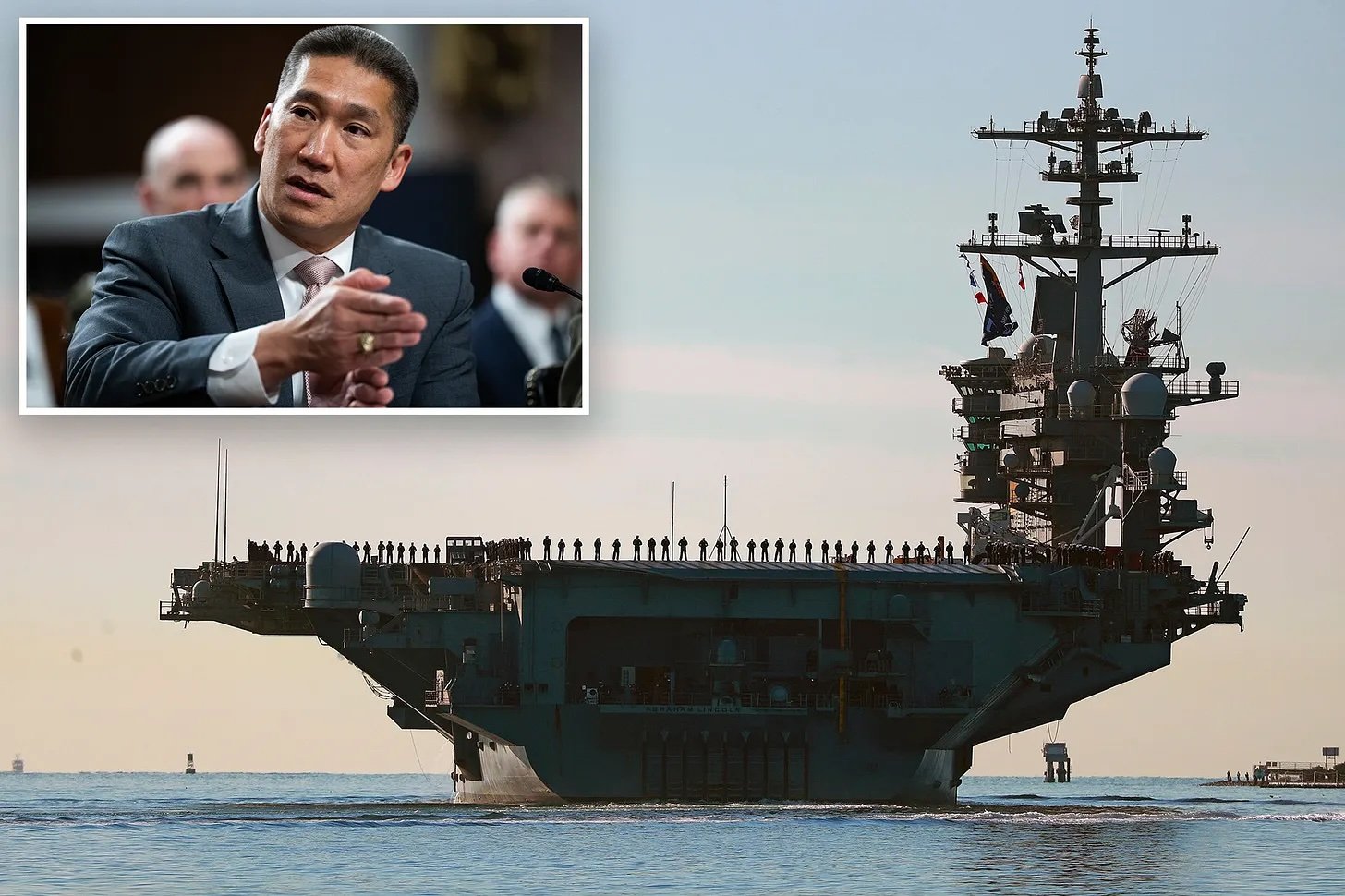
On August 6, 2026, a town hall at Naval Air Station North Island in San Diego brought together Acting Navy Secretary Hung Cao and more than 200 family members of the USS Abraham Lincoln's crew. The meeting came amid a flood of messages from sailors describing moldy showers, contaminated water, supply shortages, and poor food aboard the carrier. By then, the Lincoln had been deployed for 260 days—240 of them without a single port visit.
The extended deployment is not a sign of operational success but a symptom of a deeper problem: the US Navy has too few deployable aircraft carriers. Despite having 11 carriers in its fleet, most are in repair yards or their crews are in training, leaving only a handful ready for action. The Lincoln was kept on station because no replacement was available, and its return to port now leaves the Pacific—and much of the world—without a US carrier presence.
A Carrier Stretched to Its Limits
The Abraham Lincoln, a Nimitz-class nuclear-powered carrier commissioned in 1989, has long been a decorated ship. But the complaints from its crew are backed by evidence: deferred maintenance, irregular resupply, and deteriorating living conditions. The carrier serves as the flagship of Carrier Strike Group 3, with Carrier Air Wing 9 flying F/A-18E/F Super Hornets, F-35C Lightning IIs, EA-18G Growlers, and E-2 Hawkeyes, supported by MH-60R/S Seahawk helicopters. Destroyer Squadron 21, including the USS Spruance, USS Frank E. Petersen Jr., and USS O'Kane, provides layered air defense and strike capabilities.
The strike group's total personnel—between 6,500 and 7,500—includes 3,200 sailors running the carrier itself and 2,480 managing its aircraft. Unlike other ships in the group, carrier crews are not rotated. The Navy experimented with crew swaps in the 1960s and again with the Sea Swap program in the early 2000s, but both proved impractical. Submarines use the Blue/Gold crew system, but carriers do not.
Behind the carrier shortage lies a personnel crisis. The Navy is roughly 20,000 sailors short, with recruitment lagging and experienced crew leaving. Training is also behind, hampered by a lack of qualified instructors. These issues compound the carrier deficit, making it harder to maintain a credible forward presence.
Global Gaps and Regional Consequences
As of late August 2026, only three US carriers are at sea: the Abraham Lincoln, the George H.W. Bush, and the George Washington. The Lincoln is heading back to San Diego for maintenance, while the George Washington is en route to its homeport at Fleet Activities Yokosuka in Japan. That transition leaves the entire Pacific—and the Indo-Pacific more broadly—without a US carrier task force. There are no carriers in the Atlantic, Caribbean, or Mediterranean either.
This gap has direct implications for regional security. China has been developing anti-carrier missile strategies and expanding its own carrier fleet, including the Type 004 nuclear carrier. The US carrier deficit weakens deterrence in the Pacific, where allies like Japan and South Korea rely on American naval power as a counterweight to Chinese assertiveness. The delay of the USS Doris Miller further underscores the strain on carrier production.
The Navy is legally required to maintain 11 carriers. Most are Nimitz-class, with the USS Nimitz slated for retirement in 2027 and the USS Eisenhower in 2030 after 53 years of service. The newer Ford-class carriers, featuring electromagnetic catapults, are meant to replace them, but the lead ship, the USS Gerald R. Ford, is in port for major repairs following a 326-day deployment and a fire in its laundry spaces. Only two carriers are potentially ready for crisis activation.
The Lincoln's return is not just a homecoming—it is a stark reminder of the limits of American naval power. For the Indo-Pacific, where the US presence is a cornerstone of stability, the carrier gap is a strategic vulnerability that adversaries are watching closely.



