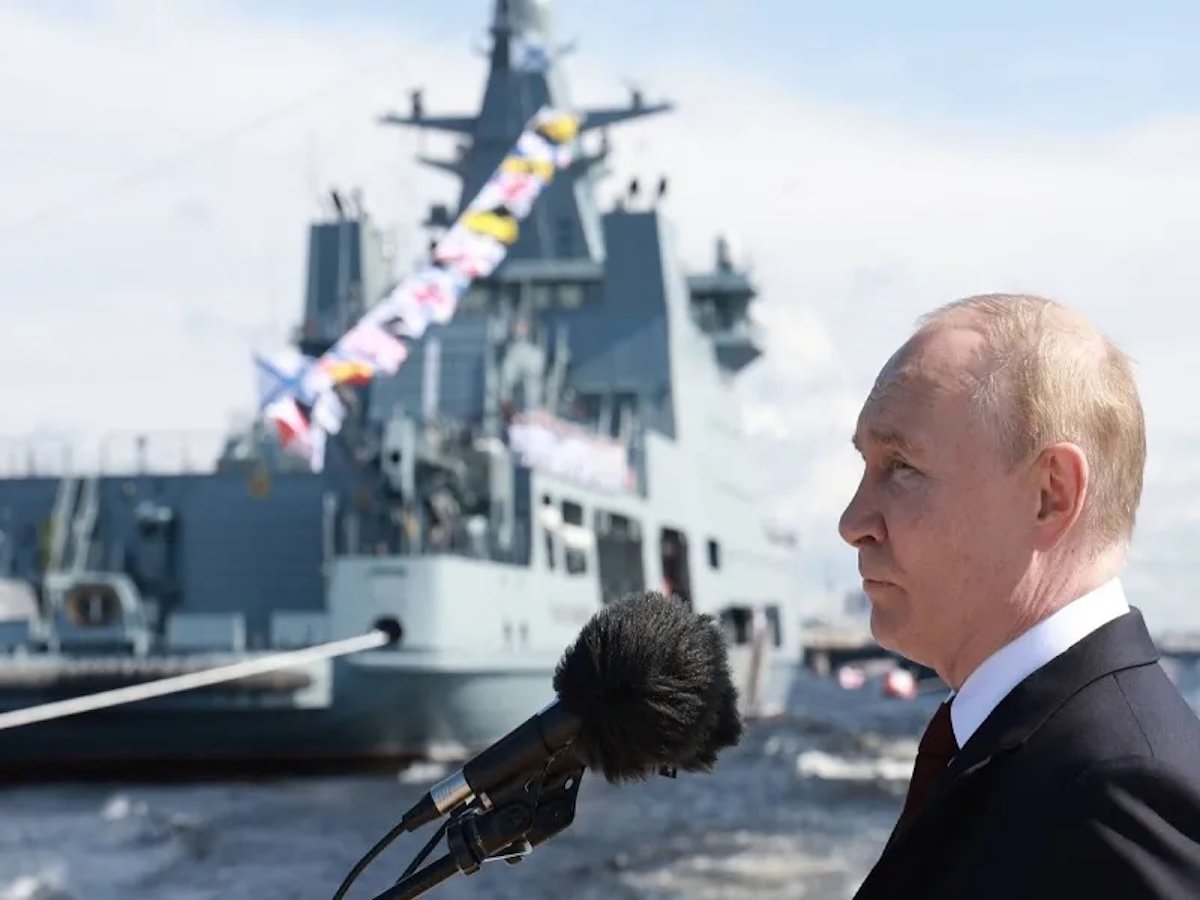
The Estonian Navy has ceased boarding vessels suspected of being part of Russia's "shadow fleet," citing a direct and increased threat of military confrontation in the Baltic Sea. Commander Ivo Vark told Reuters that the risk of escalation is now "just too high," a decision driven by a significant ramp-up in Russian naval patrols in the Gulf of Finland.
"The Russian military presence here in the Gulf of Finland has become much, much more evident," Vark stated, contrasting the tense Baltic situation with the Atlantic and North Sea, where he noted a minimal Russian presence and thus a greater likelihood of inspections. Reporters observing from an Estonian vessel last week witnessed a Russian Navy corvette stationed near a group of idle tankers waiting to load oil at a nearby Russian port.
Patrushev's Strategy and the Shadow Fleet's Routes
This show of force is the result of a directive from Nikolai Patrushev, the powerful Secretary of Russia's Security Council. In a mid-February interview, Patrushev outlined efforts to bolster naval patrols, a move now visibly impacting maritime security dynamics. The primary function of Russia's shadow fleet—older tankers operating outside Western insurance and finance channels—is to circumvent price caps and sanctions on Russian oil exports, with China and India being the dominant destinations.
The successful deterrence of Estonia suggests Russia could employ similar escort tactics to protect its oil shipments in other contested waterways. However, the Russian Navy lacks the capacity for one-to-one escorts for hundreds of vessels. A more plausible strategy would involve convoy-style protection for groups of tankers on their long voyages to Asian markets, practically circumnavigating Eurasia via the Suez Canal.
Potential Flashpoints and Western Calculations
This shift pushes potential enforcement action farther from Europe. Key chokepoints like the Suez Canal or the Bab el-Mandeb Strait near Yemen become more logical, though politically complex, interception sites. Any boarding operation in Egypt's territorial waters at the canal would require Cairo's approval. Similarly, action near Bab el-Mandeb could leverage US facilities in Djibouti or British bases in Cyprus for support.
Analysts doubt the United Kingdom would act unilaterally against Russian-escorted tankers, likely seeking explicit US approval and participation as a buffer against potential retaliation. The current US political climate, however, appears averse to such escalation. With former President Donald Trump signaling disinterest in confrontational moves, Washington may withhold authorization, leaving a enforcement vacuum. As a related analysis of regional standoffs notes, conflicts like the US-Iran-Israel conflict often settle into protracted stalemates under such conditions.
To eliminate any doubt about its resolve, Moscow could issue a public warning authorizing its navy to act against any force attempting to board escorted tankers. Faced with this, the US and its allies might opt for indirect pressure, such as facilitating Ukrainian drone attacks against the shadow fleet—a tactic already in use. Ukraine is suspected of operating drones from a base in Libya, having successfully struck two shadow fleet vessels, and could expand these efforts with Western support.
Asian Energy Security and the Geopolitical Ripple
The situation directly impacts energy flows to Asia. China and India have become the largest buyers of discounted Russian crude, and the security of these maritime deliveries is a growing concern for Moscow. The threat from Ukrainian drones presents a persistent challenge, one Russia may counter with improved anti-drone technology for its convoys.
Ultimately, Russia may seek to negotiate an end to these attacks as part of broader talks to conclude the Ukraine conflict, calculating that Washington holds sufficient influence over Kyiv to enforce such a ceasefire. Guaranteeing the safety of its energy exports, a vital source of revenue, remains a paramount strategic objective. This maritime struggle over oil sanctions enforcement is part of a wider recalibration of economic power, where, as explored in our coverage of the petroyuan's rise, geopolitical crises often accelerate shifts in global financial systems.
While the Russian Navy's presence has neutralized Baltic states like Estonia as immediate threats to its shadow fleet, it has merely relocated the arena of competition. The long sea lanes to Asia are now the critical zone where the enforcement of Western sanctions, the risk of military escalation, and the security of energy supplies for major economies like China and India will be tested.