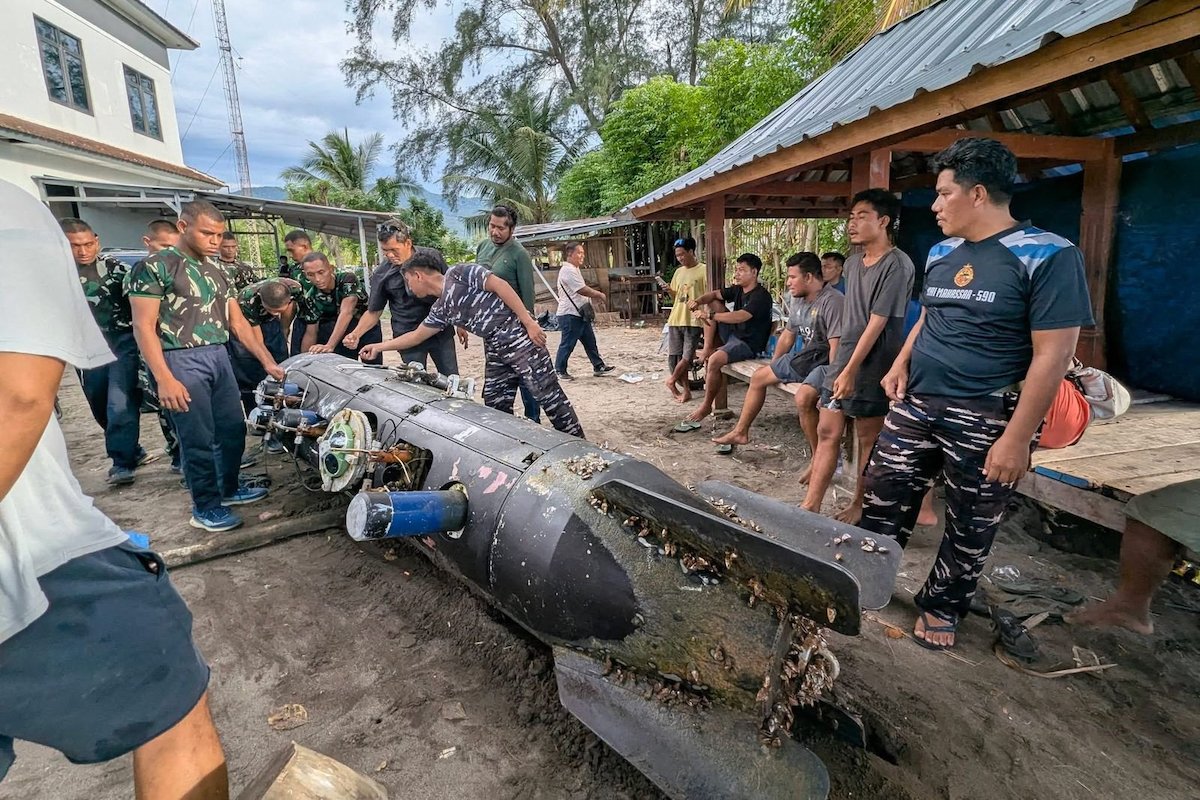
The recent retrieval of a suspected Chinese unmanned underwater vehicle (UUV) from the Lombok Strait represents a significant challenge to Indonesia's maritime sovereignty, not a minor technical incident. Found by a local fisherman within Archipelagic Sea Lane II (ALKI II), the device bore markings linking it to the China Shipbuilding Industry Corporation (CSIC), indicating unauthorized undersea activity in one of the nation's most vital waterways.
A Strategic Chokepoint Compromised
The Lombok Strait is far from peripheral water. It is a deep, strategic chokepoint connecting the Pacific and Indian Oceans, essential for global commerce and, critically, for submarine transit. Control over this corridor is fundamental to Indonesia's identity as an archipelagic state. Permitting foreign unmanned systems to operate there without consequence erodes that control in practice, regardless of legal claims on paper.
UUVs are designed for stealth and endurance, making them ideal tools for surveillance and deeply problematic when discovered in another nation's waters without consent. While capable of scientific research, they are equally adept at mapping seabeds, recording acoustic signatures of vessels, and supporting submarine operations. In contemporary naval strategy, such activity constitutes active intelligence gathering.
Indonesia's initial response—to investigate while avoiding escalation—is inadequate given the strategic stakes. Ambiguity primarily benefits the actor deploying the system, not the state whose waters are penetrated. Treating such intrusions as acceptable creates space for deniable operations and gradually normalizes a foreign presence beneath Indonesia's surface without oversight.
A Call for Clear Action and Investment
Jakarta must respond with clarity and assertiveness. First, it should publicly state that any unauthorized deployment of unmanned underwater systems within its archipelagic sea lanes violates its sovereign rights. The legal concept of transit passage does not encompass covert surveillance, a distinction that must be articulated without qualification.
Second, Indonesian officials should formally summon their Chinese counterparts for a detailed explanation. Diplomatic discomfort is justified when national security is implicated. If no credible answer is forthcoming, Jakarta should say so publicly. Silence should not be an acceptable response.
Third, and most urgently, Indonesia must prioritize undersea domain awareness. The fact that a fisherman, not a naval detection system, found the UUV exposes a critical capability gap. The nation is effectively blind below the surface, a strategic vulnerability that demands immediate investment in seabed sensors, acoustic monitoring networks, and anti-submarine capabilities. This is no longer optional but a pressing national security requirement.
Fourth, building this capacity necessitates deeper operational cooperation with capable regional partners such as Australia, Japan, and India. This is not about alignment in great power competition but pragmatic capacity-building. Without access to external expertise and technology, closing Indonesia's undersea surveillance gap will take longer than the strategic environment permits. This incident underscores the concerns raised by analysts about Indonesia's foreign policy drift amid rising US-China tensions.
Fifth, Indonesia should champion regional efforts to establish clear norms governing the use of unmanned underwater systems. The current absence of rules enables precisely this kind of ambiguous activity. If Jakarta does not help set new standards, it will be forced to operate under frameworks dictated by others.
The Underwater Front of Strategic Competition
Strategic competition in the Indo-Pacific is increasingly moving underwater—a domain defined by quiet operations that are harder to detect and easier to deny than surface activities. This makes it particularly dangerous for states that fail to adapt. Indonesia cannot afford to treat this UUV incident as an isolated curiosity. It is a direct probe of its control over the maritime domain.
History suggests that restraint without consequence is interpreted as permission. Past instances of unchallenged intrusions have often led to repeated incursions. Jakarta does not need to seek confrontation, but it must impose tangible costs—diplomatic, political, and strategic—on unauthorized activity in its waters. Sovereignty is not merely declared; it is enforced through consistent action.
The broader context includes China's development of advanced asymmetric capabilities, such as drone-launched mines that could complicate regional security. Meanwhile, the nation's economic policies, including industrial overcapacity that reshapes global trade, add another layer of complexity to regional dynamics. In this environment, undersea vigilance becomes paramount.
If Indonesia fails to act decisively, it risks losing more than visibility beneath the waves. It risks ceding control of a domain central to its security and prosperity. The Lombok Strait incident is a wake-up call that demands a coherent, sustained, and sovereign response.



