In 2019, the United States banned Chinese-made surveillance cameras from its military bases, targeting firms like Hangzhou Hikvision Digital Technology Co., Ltd. and Zhejiang Dahua Technology Co., Ltd. The move aimed to eliminate potential backdoors in systems used for security. Yet, a troubling pattern has emerged: the ban appears to have accelerated a shift toward drone-based espionage, with unmanned aerial systems (UAS) now buzzing sensitive sites such as Barksdale Air Force Base in Louisiana and RAF Lakenheath in the United Kingdom.
The timing is striking. The rise in drone incursions over US and allied bases closely tracks the 2019 prohibition. As fixed cameras were removed, China may have pivoted to mobile surveillance platforms, exploiting gaps in airspace defenses. This development underscores a broader challenge: Beijing's surveillance apparatus, built over two decades through its Safe City (Ping’an Chengshi) program, is not confined to fixed installations. It is a flexible ecosystem that adapts to countermeasures.
From Cameras to Drones: A Tactical Shift
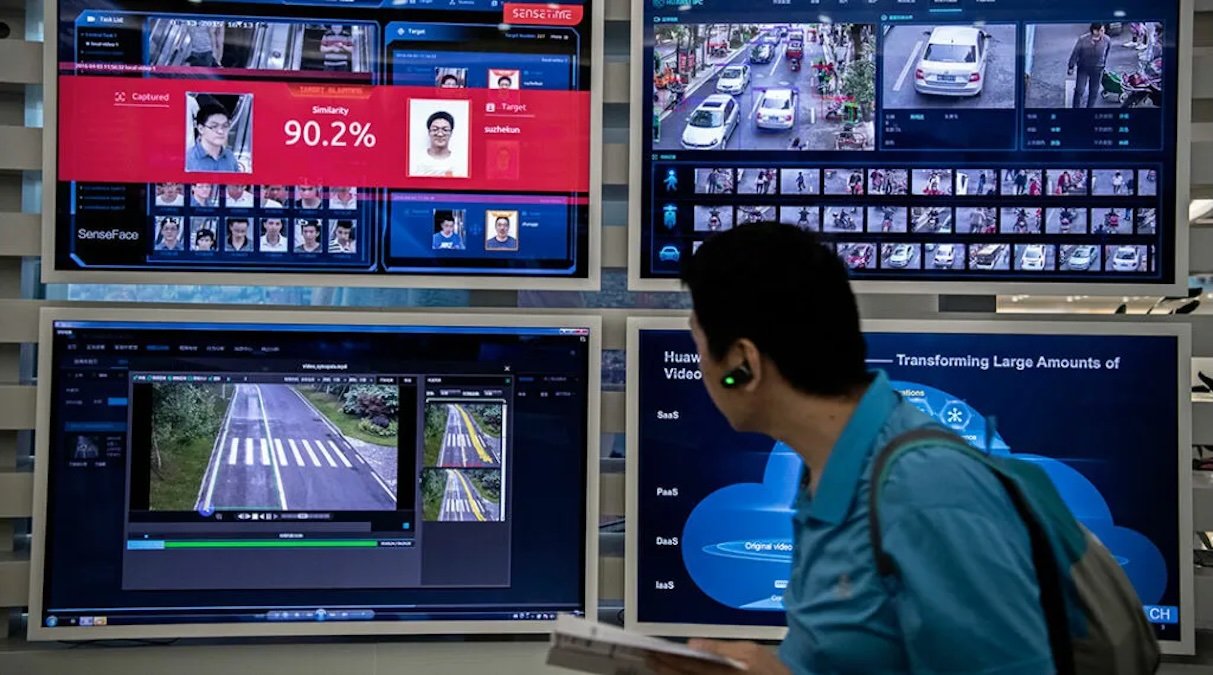
China's Safe City initiative, launched in 2003, has deployed millions of cameras, facial recognition systems, and AI-driven analytics across the country and abroad. In Africa, nations like Kenya, Uganda, and Ethiopia have adopted the system; in Southeast Asia, it operates in Pakistan, Laos, Myanmar, and the Philippines; and in Latin America, Brazil and Venezuela are clients. The Middle East has seen implementations in the UAE, Saudi Arabia, and Iran. These networks, while marketed for public safety, have been used for social and political control, turning cities into what critics call digital prisons.
The vulnerability of such systems was exposed in 2023, when the Wall Street Journal reported that US Cyber Command had pre-positioned malware in Hikvision and Dahua cameras across Caracas, Venezuela. This allowed American forces to track President Nicolás Maduro in real time, leading to his capture during Operation Absolute Resolve. Similarly, Israeli intelligence hacked Tehran's surveillance network, using AI to map the movements of bodyguards and drivers, culminating in the February 2026 strike that killed Supreme Leader Ali Khamenei. Both operations exploited the same backdoors that Washington had feared in its own bases.
Now, the drone threat is escalating. Persistent incursions over US bases, including RAF Lakenheath—home to the F-15E Strike Eagle and F-35A Lightning II—suggest a coordinated effort. These incidents mirror tactics seen in the Middle East, where low-cost drones have reshaped precision warfare. The shift from fixed cameras to drones offers China deniability and flexibility, complicating defensive responses.
The implications extend beyond the US. South Korea, Japan, and Australia, which host American forces, face similar risks. In Southeast Asia, nations like Vietnam and the Philippines, which have invested in Chinese surveillance technology, must now assess their exposure. The surge in drone incursions is not just a US problem; it is a regional security challenge that demands coordinated countermeasures.
China's camera giants remain central. Hikvision, listed on the Shenzhen Stock Exchange, is effectively state-controlled, with state-owned enterprises holding over half its shares. Dahua and Tiandy, another Chinese firm, have supplied high-end cameras to Iran's Islamic Revolutionary Guard Corps. In April 2025, reports emerged that China had arrested 300 Hikvision employees on espionage charges, though details remain murky. This internal purge suggests Beijing is aware of the dual-use nature of its technology.
For Asian policymakers, the lesson is clear: reliance on Chinese surveillance infrastructure carries strategic risks. As the US and its allies harden defenses against drones, they must also reconsider the digital supply chains that underpin their security. The ban on cameras may have closed one door, but the drone threat has opened another—one that flies over borders and defies easy solutions.