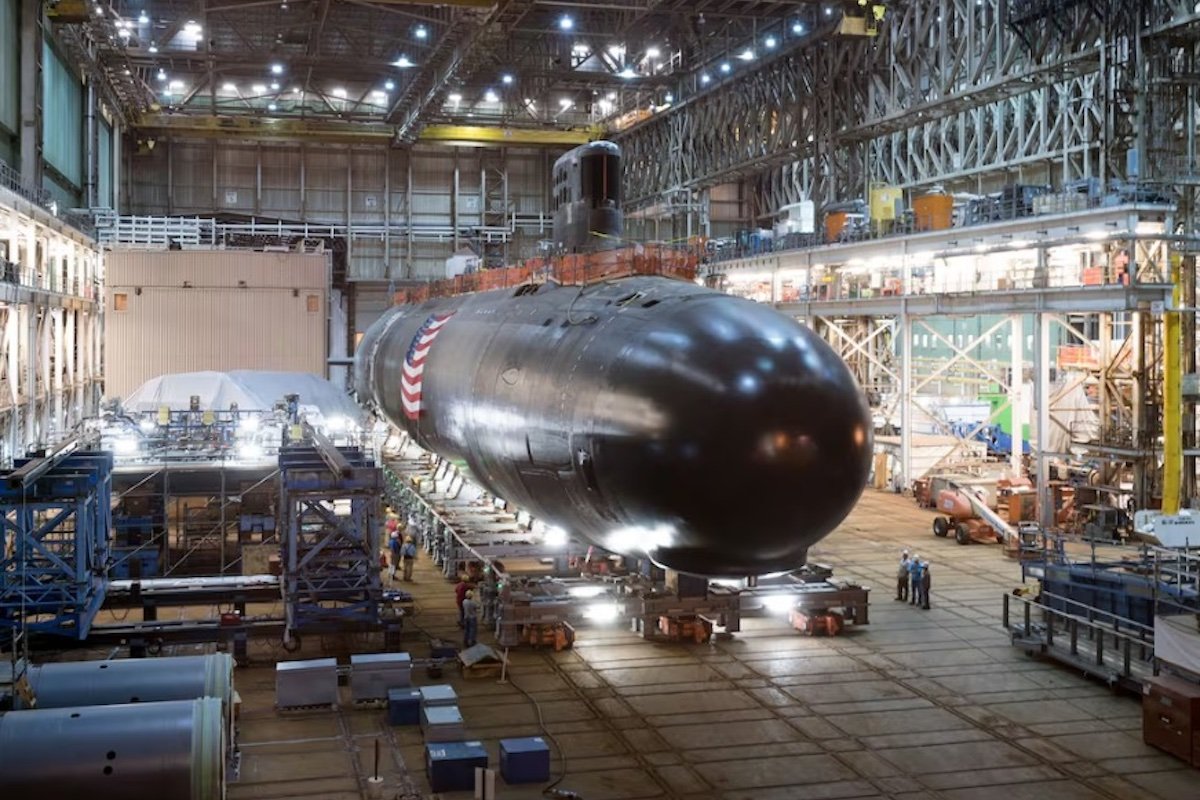
The United States Navy has begun preliminary steps toward building its next-generation nuclear-powered attack submarine, the SSN(X), but the program remains years away from delivery—and China is closing the undersea gap faster than anticipated.
In a recent sources-sought notice issued by the Naval Sea Systems Command (NAVSEA), the service is surveying domestic shipyards for their capacity to construct the SSN(X), a vessel designed to replace the aging Virginia-class fleet. The notice, reported by multiple outlets, asks prospective contractors for detailed technical and capital-expenditure data, covering everything from hull fabrication to nuclear reactor installation.
The assessment aims to establish a baseline for US industrial infrastructure, drydock availability, and specialized labor, as the Navy prepares an acquisition strategy for a program that targets initial construction around 2034. However, severe budget constraints have already deferred procurement to fiscal 2040, meaning the first SSN(X) is unlikely to enter service before the mid-2040s.
Given the stringent requirements—certified graving or floating drydocks and heavy gantry cranes—the pool of potential builders is effectively limited to General Dynamics Electric Boat and Huntington Ingalls Industries' Newport News Shipbuilding. Both are already stretched thin by existing submarine and aircraft carrier commitments.
Why the SSN(X) matters
The SSN(X) is envisioned as a larger, more capable combatant that merges the speed and payload of the Seawolf class, the stealth and sensors of the Virginia class, and the operational availability of the Columbia-class ballistic missile submarines. It is designed to conduct full-spectrum undersea warfare, with expanded torpedo rooms and the ability to coordinate autonomous systems.
The urgency stems from the inevitable retirement of the Virginia-class boats. Although improved construction methods have extended their service life to 33 years, the earliest hulls will begin retiring around 2037. To maintain planned force levels, the Navy must commission successors before then—a timeline that now looks optimistic.
Beyond replacing aging hulls, the US must keep pace with China's expanding undersea fleet. In a potential conflict over Taiwan, US submarines are among the few survivable assets that can penetrate China's anti-access/area denial (A2/AD) envelope within the First Island Chain, which stretches from Japan through Taiwan to the Philippines.
China's rapid progress
China's submarine force is growing both in numbers and sophistication. The Bohai Shipbuilding Heavy Industry Co. in Huludao has undergone major expansions since 2019, including a second construction hall, and has surpassed the US in total launches and combined tonnage between 2021 and 2025, according to a February 2026 report by the International Institute for Strategic Studies (IISS). Henry Boyd and Tom Waldwyn note that the yard has achieved a sustained "1+2" annual tempo, launching one Type-094 ballistic missile submarine and two Type-093B guided-missile submarines in both 2024 and 2025.
China's design cycle is also accelerating. The Type 09V (or 95) attack submarine was launched in February 2026, followed by an unconventional "sailless" submarine observed in June 2026. This rapid iteration is supported by a shipbuilding complex that can quickly move prototypes from design to water.
Acoustic stealth remains a key differentiator. US Virginia-class submarines are among the quietest ever built, using advanced nuclear propulsion, anechoic hull tiles, vibration-damping mounts, and pump-jet propulsors. As Natasha Bajema noted in a December 2024 Foreign Policy article, US submarines still hold a distinct stealth advantage over their Chinese counterparts, which remain relatively noisy.
But that gap may be narrowing. Russian technical assistance could prove decisive. According to an April 2025 report by Anton Oksentiuk in Ukrainian Prism, Russia expanded defense cooperation with China under a 2017 roadmap, extended through 2025 in 2021, which formalized joint development of naval and submarine technology. Russia's Yasen-class submarines are among the quietest in the world, with acoustic signatures comparable to US Virginia- and Seawolf-class boats. Whether Moscow would transfer such crown-jewel technologies remains debatable, but even without overt assistance, China's accelerated design iteration is eroding the US lead.
Vice Admiral Richard Seif, in March 2026 testimony before the US Congress, stressed that in undersea warfare, marginal improvements in quieting, endurance, or acoustic detection can decisively shift tactical outcomes. China's rapid rollout of new hulls underscores an aggressive design cycle that the US, with its constrained budget and industrial base, struggles to match.
The SSN(X) program is a critical pillar of US strategy in the Indo-Pacific, but its delayed arrival means the US Navy must rely on its existing Virginia-class fleet—and possibly on private-sector efforts to revive submarine production—to maintain deterrence in the coming decade. As China continues to close the undersea gap, the margin for error is shrinking.