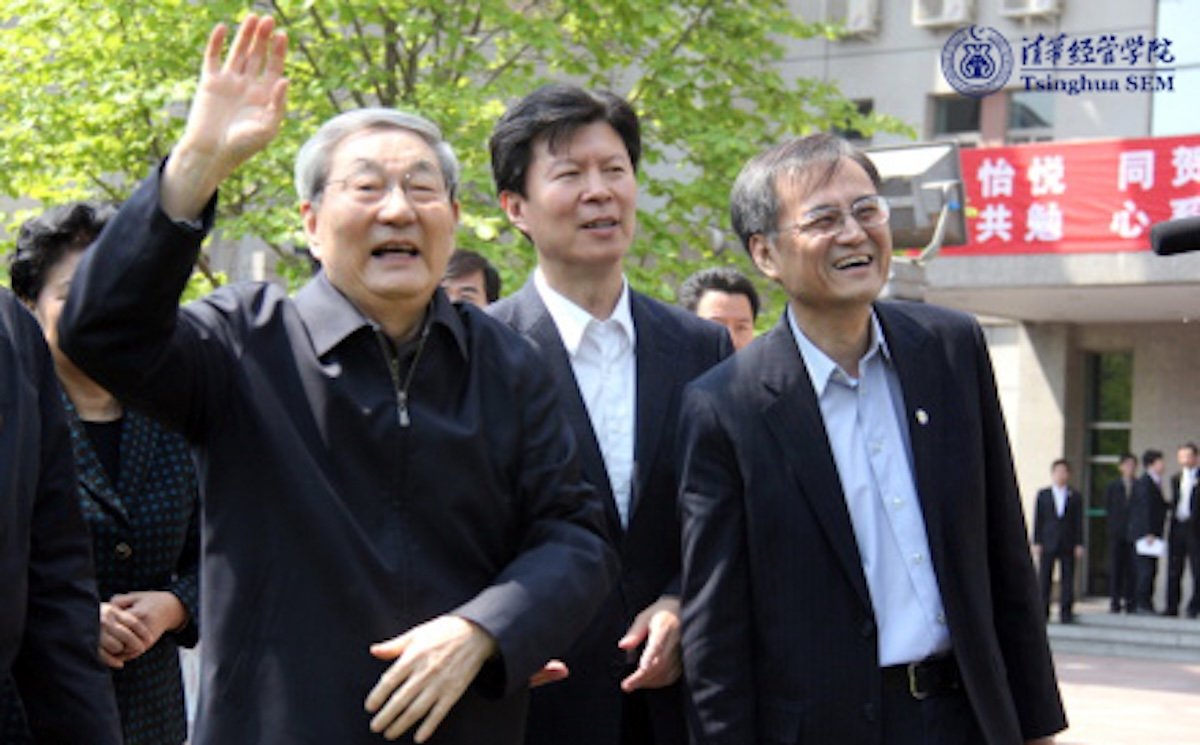
At 96, Zhu Rongji, China's former premier and the driving force behind its market reforms in the 1990s, remains alive but unrecognized by the Nobel Committee. The question is no longer whether China's economic rise merits a Nobel—it's whether the committee will act before it's too late.
British economist John Ross recently quipped that if the Royal Swedish Academy of Sciences were honest, the Nobel Prize in Economics would have been awarded to Chinese economists every year for the past four decades. Hyperbole? Perhaps. But the numbers are staggering: China's real GDP is 50 times larger than in 1978, when Deng Xiaoping launched the reform and opening-up policy. That growth, sustained over four decades for 1.4 billion people, has reshaped global supply chains, lifted hundreds of millions out of poverty, and redrawn the economic map of Asia. It dwarfs the achievements of Japan's post-war miracle or the rapid industrialization of South Korea, Taiwan, Singapore, and Hong Kong.
Yet the Nobel economics prize has instead honored models like Black-Scholes for option pricing—a tool that, while elegant, was not essential for options markets and whose laureates later oversaw the collapse of Long-Term Capital Management in 1998. Or the Gale-Shapley algorithm, whose primary real-world application has been matching medical residents to hospitals in the United States and Canada. These are not trivial contributions, but they pale in comparison to the transformation of the world's most populous nation.
Columbia University historian Adam Tooze has joined the chorus, arguing that the prize should go to Chinese policymakers because China's growth is the most profound economic story of our lifetime. The objection that the Nobel is for academic researchers, not practitioners, rings hollow. The prize has never been bound by rigid rules. The Swedish Academy awarded the 2024 Nobel Prize in Physics to Geoffrey Hinton and John Hopfield for work in artificial intelligence—a field far removed from traditional physics. And in 2016, Bob Dylan won the Nobel Prize in Literature. If the committee can stretch definitions for a singer-songwriter, it can stretch them for the architects of the greatest poverty alleviation program in history.
The Economics Prize: A Bastard Child of the Nobel Family
The economics prize is not among the original five established by Alfred Nobel in his 1896 will. It was created in 1969 by Sweden's central bank, Sveriges Riksbank, as a "Prize in Economic Science dedicated to the memory of Alfred Nobel." Since then, it has undergone 11 name changes, oscillating between "economic science" and "economic sciences" with no clear rationale. Members of the Nobel family have publicly opposed it, calling it a marketing ploy by economists to elevate their profession.
At the 1974 awards banquet, laureate Friedrich Hayek criticized the prize itself, warning that it confers "an authority which in economics no man ought to possess." He argued that in natural sciences, experts quickly correct overreach, but in economics, the influence is over laymen—politicians, journalists, and the public. In essence, he called it a bullshit award. The committee has since expanded the prize's scope to include political science, psychology, and sociology, further muddying its identity.
The Nobel Committee has a history of missing the mark. Mendeleev never won for the periodic table. Leo Tolstoy was overlooked for literature. Mahatma Gandhi was assassinated in 1948 before the committee could act; they offered a moment of silence instead. The living-laureate rule, intended to encourage aspirants, has left many deserving figures unrecognized. Zhu Rongji, now 96, is running out of time.
China's economic rise is not just a story of GDP numbers. It is a story of deliberate policy choices: the dismantling of collective farming, the opening to foreign investment, the creation of special economic zones in Shenzhen and Shanghai, and the painful restructuring of state-owned enterprises in the late 1990s. Zhu Rongji, as premier from 1998 to 2003, was the architect of many of these reforms. He slashed tariffs, joined the World Trade Organization in 2001, and forced state banks to clean up their balance sheets. His legacy is visible in every Chinese city skyline and in the living standards of hundreds of millions.
Critics may argue that China's model is not purely market-driven, that it relies on authoritarian governance and state intervention. But the Nobel Prize has never required ideological purity. It has honored economists from across the spectrum, from Friedrich Hayek to Amartya Sen. The question is whether the committee can recognize a contribution that is not a neat mathematical model but a lived reality.
As the Donroe Doctrine reshapes global trade dynamics, and as South Korea's AI boom masks underlying economic risks, the story of China's rise remains the defining economic narrative of our era. The Nobel Committee has a chance to correct a long-standing oversight. Zhu Rongji is 96. The clock is ticking.