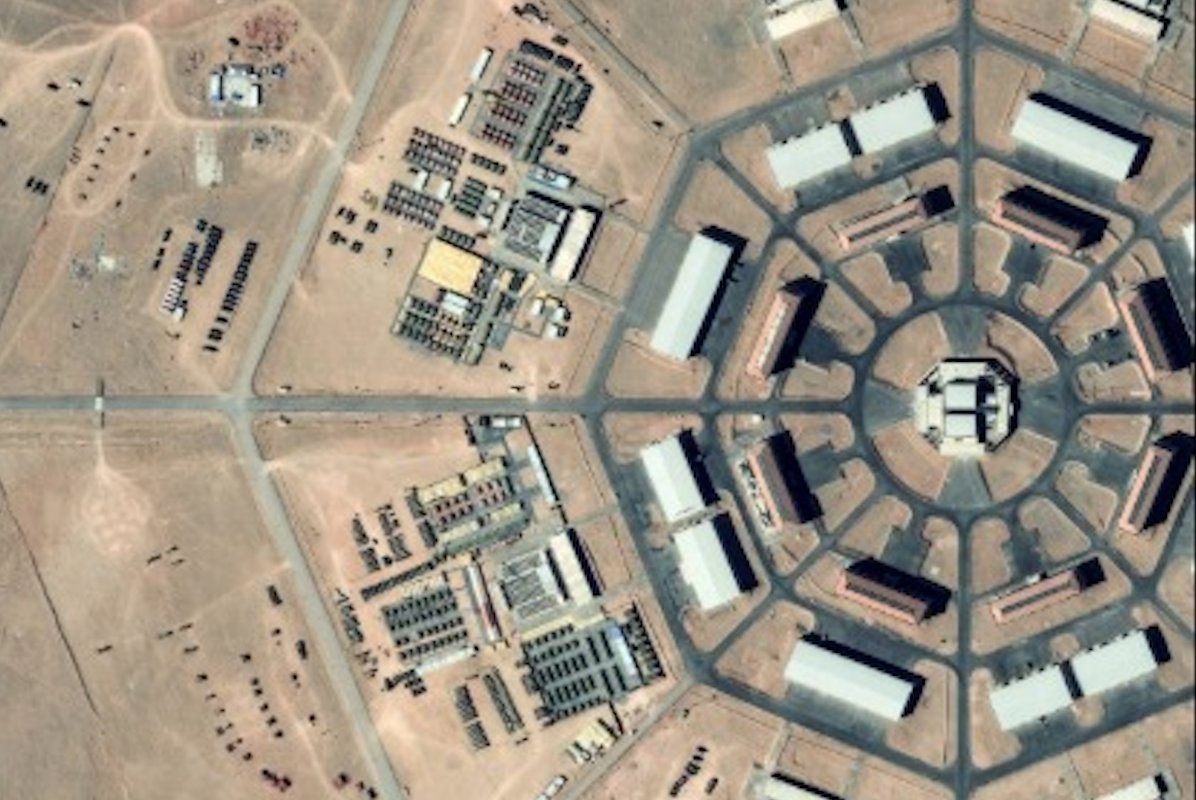
China is rapidly transforming its nuclear forces at a remote site in the Xinjiang desert near Hami, constructing a sprawling defensive network designed to withstand a preemptive strike and guarantee retaliation. The buildup, which includes over 80 concrete launch pads and two octagonal command centers, reflects Beijing's strategic shift from a historically vulnerable arsenal to a resilient deterrent—one that analysts say is explicitly calibrated to constrain US intervention in a Taiwan contingency.
According to recent reporting, the Hami complex features two major command, control, and communications hubs built over the past six years, linked by dirt roads and fiber-optic conduits to pads optimized for road-mobile intercontinental ballistic missile (ICBM) launchers, electronic warfare systems, and air-defense batteries. A third, less developed octagon serves as a target range for mock Western aircraft. This localized infrastructure approach sets China apart from traditional nuclear powers like the United States and Russia, which rely on silo isolation and sheer numbers.
Strategic Rationale: A Backstop for Taiwan Coercion
The expansion comes as China fields roughly 100 ICBMs across its primary silo fields, with the US Department of Defense estimating Beijing is on track to field 1,000 nuclear warheads by 2030. Sajjad Ahamed, writing in the Journal of Current Chinese Affairs in May 2026, argues that China is building a more survivable arsenal not for routine nuclear coercion but as a strategic “backstop” for conventional and gray-zone competition, particularly over Taiwan. A more resilient deterrent, he notes, could expand China’s options for nuclear signaling during a crisis.
Matthew Kroenig, in a September 2023 Atlantic Council report, suggests China could use its nuclear arsenal to signal the US and its allies not to interfere in a Taiwan conflict. Possible moves include an ICBM test, a nuclear test at Lop Nur, or more provocatively, detonating a weapon near Taiwan or a US base in the Pacific. Kroenig adds that China might use nuclear weapons against US and allied forces if it deems such action necessary to stave off conventional defeat or if the Chinese leadership feels threatened.
Ahamed contends that as China strengthens its second-strike capability through new silos, submarines, and mobile missiles, US leaders will face greater risks in any Taiwan crisis. This nuclear backstop, he says, limits US escalation options, reinforces mutual restraint at the nuclear level, and supports sustained Chinese pressure through military exercises, air incursions, and other coercive activities directed at Taiwan and US regional allies. For context, Taiwan's calm response to Trump-Xi deal-making highlights strategic confidence amid these tensions.
Vulnerability Concerns Drive Expansion
Despite the buildup, Chinese leaders increasingly fear that advances in US missile defenses, precision-strike weapons, and intelligence, surveillance, and reconnaissance (ISR) systems could locate and destroy China’s relatively small nuclear force before it can retaliate. Emily Gill, in an October 2025 article for the China Aerospace Studies Institute, notes that concerns about a potential US conventional or nuclear first strike have driven China to expand silo fields, deploy more road-mobile missiles, harden infrastructure, and improve concealment measures.
Data from the Stockholm International Peace Research Institute (SIPRI) show that as of January 2025, China has an estimated 600 nuclear warheads, compared with the US’s 5,177 and Russia’s 5,459. The Hami network appears tailored to address these vulnerabilities by dispersing launch assets and complicating efforts to locate and destroy Chinese nuclear forces.
The expansion is part of a broader nuclear buildup that the Institute for Defense Analyses (IDA) describes as unprecedented since the late Cold War. An October 2023 IDA report states that China is rapidly increasing both strategic and theater nuclear forces, developing a full nuclear triad, launch-on-warning capabilities, and low-yield nuclear options. It projects China could field more than 1,500 deployed warheads by 2035 and achieve rough quantitative parity with the US in deployed warheads by the mid-2030s.
From a US perspective, John Harvey argues in a May 2025 report for the Center for Global Security Research that counterforce capabilities remain important as China transitions to a large, silo-based ICBM force. He contends that the ability to hold at risk part of China’s arsenal strengthens deterrence and reassures allies that US extended deterrence remains credible. However, Dahlia Anne Goldfeld and other writers note in a November 2024 RAND report that China’s nuclear modernization increasingly constrains US counterforce options.
The Hami expansion underscores a broader regional dynamic: as China hardens its nuclear deterrent, it may feel emboldened to escalate pressure on Taiwan and its neighbors. This development also intersects with other strategic shifts, such as South Korea's nuclear submarine ambition, which reflects growing concerns about deterrence across the Indo-Pacific.