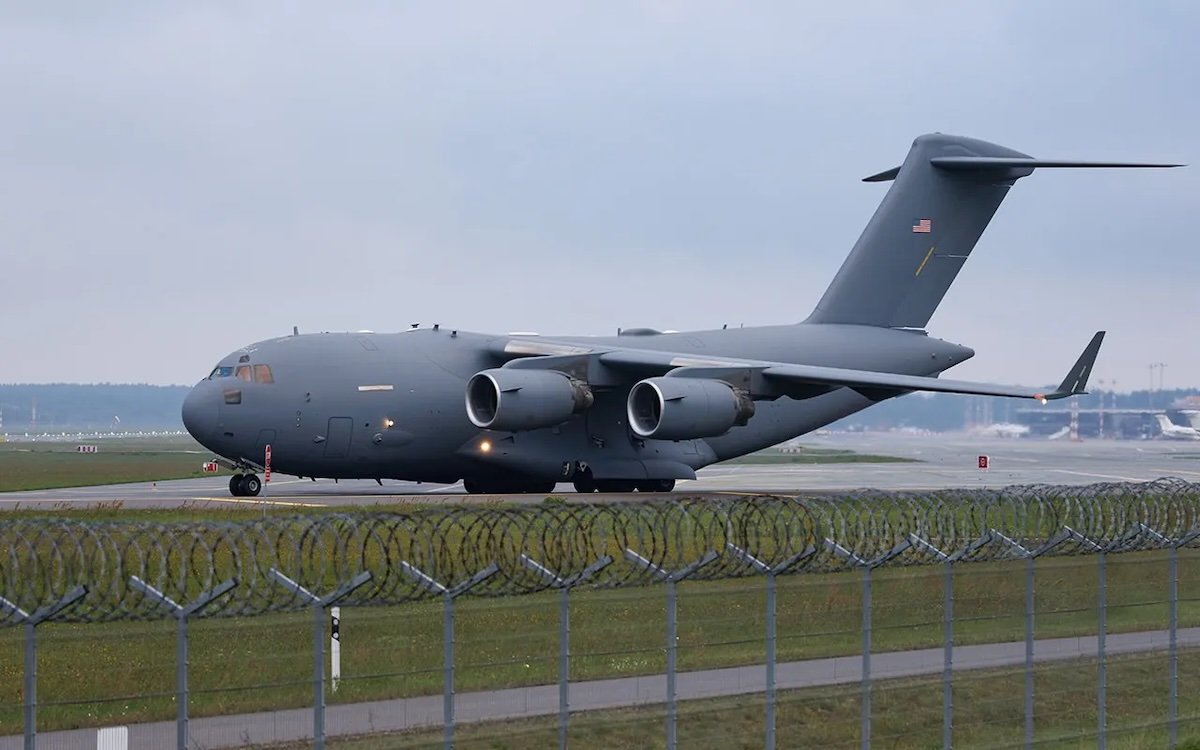
The unannounced visit of CIA Director John Ratcliffe to Moscow has deepened the mystery surrounding Washington's intentions toward Russia and Ukraine. Ratcliffe flew in a C-17 Globemaster, a heavy military transport aircraft, rather than a smaller VIP jet. The choice of such a conspicuous platform, equipped with secure communications to keep the director in constant contact with the White House, suggests a mission of high sensitivity and urgency, one that Washington wanted both visible and protected.
Across Europe, rumors are circulating that Russia may be planning attacks on NATO members, with Lithuania frequently cited. These rumors are not baseless; they come amid heightened Russian anger over British-supplied long-range drones and cruise missiles being used by Ukraine to strike targets inside Russia. The focus of concern is Kaliningrad, a Russian exclave on the Baltic Sea that is physically separated from the rest of Russia. Once known as Königsberg, it was awarded to the Soviet Union at the Potsdam Conference in 1945. During the Cold War, it was surrounded by communist Poland and Lithuania, both Warsaw Pact members. Today, those two countries are independent NATO members, deeply wary of Moscow.
Kaliningrad's strategic vulnerability is its reliance on the Suwalki corridor—a narrow land bridge between Poland and Lithuania that connects the exclave to Belarus and, ultimately, to Russia. Recent attempts by Warsaw and Vilnius to restrict traffic along this route have heightened tensions. While Kaliningrad can also be supplied by sea, Russia's position in the Baltic has weakened since Sweden and Finland joined NATO, ending their long-standing neutrality. The exclave's air defenses, including S-400 systems and Pantsir short-range missile systems, are formidable, but they are now facing an unprecedented NATO presence.
NATO's provocative maneuvers
In recent weeks, a concentration of specialized NATO aircraft has been operating in international airspace near Kaliningrad. The deployment included E-3 AWACS early warning planes, an American EA-37B Compass Call II electronic warfare aircraft, an ARTEMIS II reconnaissance platform, and fighter units from the United States, Norway, and Poland. The EA-37B is a powerful intelligence-gathering and electronic warfare asset, suggesting that NATO is preparing for a potential strike on Kaliningrad. The port of Baltiysk, Russia's main ice-free naval base on the Baltic, is a key strategic asset in the region.
In response, Russia's Baltic Fleet has conducted tactical air-defense exercises simulating enemy air raids on the Baltiysk naval base. These drills involved Su-30 multirole fighters, Mi-24 combat helicopters, and unmanned aerial vehicles acting as hostile elements. The base, situated on the Vistula Spit, hosts surface combatants, diesel-electric submarines, naval aviation, and coastal defense missile systems such as Bastion and Bal, designed to project power across the Baltic approaches and enforce anti-access/area-denial (A2/AD) coverage over neighboring NATO airspace.
The mutual military buildup has pushed tensions between NATO and Russia to levels not seen since the Cold War. While Washington has supported the operations around Kaliningrad, there is growing concern in the U.S. that actual fighting could break out, potentially drawing in Poland, Lithuania, or even NATO bases in Germany and the UK. There is no public evidence of imminent Russian aggression beyond the exercises, but preparations are underway, including the reported movement of nuclear weapons to Belarus. In late August, Belarusian President Alexander Lukashenko held meetings in Moscow with Russian Prime Minister Mikhail Mishustin and President Vladimir Putin, focusing on security coordination and strategic cooperation, as reported by the Kyiv Post.
Neither NATO, the U.S., nor Russia has reported any significant troop movements related to the Baltics or Eastern Europe. NATO claims Russia is preparing a major mobilization, but Moscow denies this, and even Ukraine's military intelligence (GUR) does not believe such a mobilization is imminent. Meanwhile, a series of provocations have been attributed to Russia, including attacks on manufacturing and supply facilities in Italy, Bulgaria, Estonia, and Slovakia, as well as a thwarted drone attack near Leipzig/Halle Airport in Germany. Disruptions of undersea cables in the Baltic Sea have also been blamed on Russia's "shadow fleet" of tankers and container ships.
Underlying the military activity is a growing sense that the Ukraine war is reaching a crisis point. Kyrylo Bogdanov, former head of Ukraine's GUR and now an advisor to President Volodymyr Zelensky, recently stated that Ukraine cannot afford not to mobilize at least 30,000 personnel per month just to maintain its current defensive capabilities. This implies that Ukraine is losing up to 30,000 frontline soldiers each month and cannot replace them. While Russian losses are also high, Moscow has a larger pool of active-duty soldiers, though there are reports of young Russians fleeing the country to avoid a broader mobilization. In Ukraine, young men cannot leave, and fewer are willing to fight, creating a severe manpower crisis.
The situation around Kaliningrad and the broader Ukraine conflict has significant implications for the Indo-Pacific. As the U.S. and its European allies focus on Russia, there is a risk that attention and resources are diverted from Asia, where China's assertiveness and North Korea's provocations continue. The CIA chief's Moscow trip may signal a shift in U.S. priorities, potentially affecting its commitments in the region. Meanwhile, reduced U.S.-South Korea drills have emboldened North Korea, which has been linked to Russia's war effort. The UK-Ukraine drone pact could have long-term security implications beyond Europe, as drone technology and tactics are being closely watched by militaries worldwide.
For now, the immediate crisis is in Europe, but the ripple effects are global. The standoff over Kaliningrad is a test of NATO's resolve and Russia's willingness to escalate. The outcome will shape the security architecture of Europe and influence the balance of power in the Indo-Pacific. As the world watches, the decisions made in the coming weeks could redefine the post-Cold War order.