Iranian Foreign Minister Abbas Araghchi accused the Trump administration's negotiating team on Sunday of derailing intensive talks in Islamabad, Pakistan, with maximalist demands just as the two sides were on the verge of a preliminary agreement to end the six-week conflict. The accusation, posted on social media, underscores the fragility of diplomatic efforts in a region already roiled by military strikes and economic pressure.
“In intensive talks at the highest level in 47 years, Iran engaged with US in good faith to end war,” Araghchi wrote. “But when just inches away from ‘Islamabad [Memorandum of Understanding],’ we encountered maximalism, shifting goalposts, and blockade. Zero lessons earned. Good will begets good will. Enmity begets enmity.”
The failed weekend talks represent the second time since February that US negotiators have been accused of sabotaging formal negotiations despite participants believing a deal was within reach. Oman’s foreign minister, who mediated previous talks, had said hours before the US and Israel started bombing Iran on February 28 that “we have already achieved quite a substantial progress in the direction of a deal.”
Maximalist Demands and Red Lines
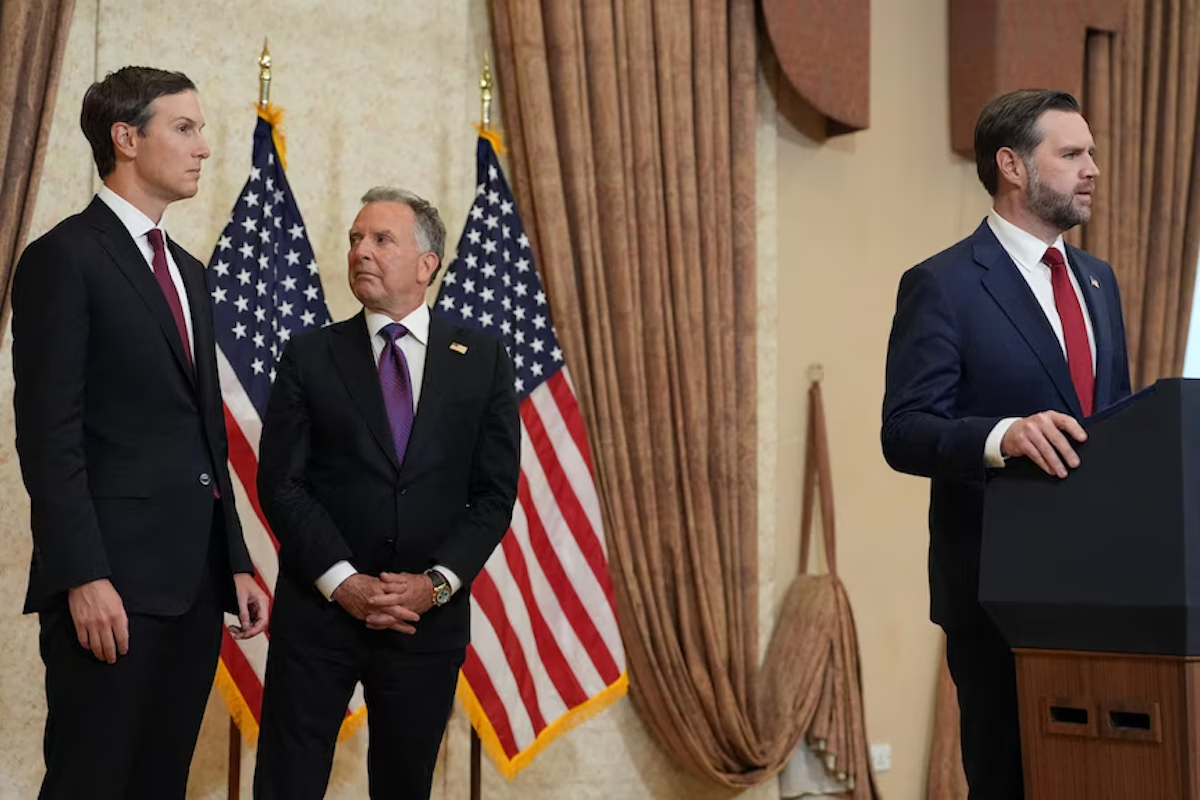
The US negotiating team, led by Vice President JD Vance and special envoys Steve Witkoff and Jared Kushner, reportedly set down numerous “red lines” during the Islamabad talks. These included demanding that Iran end all uranium enrichment—a right it holds under the Treaty on the Non-Proliferation of Nuclear Weapons—and dismantle its major nuclear energy facilities. Iran’s top negotiator, Parliament Speaker Mohammad Bagher Ghalibaf, wrote after the talks that “due to the experiences of the two previous wars, we have no trust in the opposing side.”
Vance told reporters on Sunday, “We just could not get to a situation where the Iranians were willing to accept our terms. I think that we were quite flexible.” President Donald Trump claimed on social media that “the meeting went well, most points were agreed to, but the only point that really mattered, NUCLEAR, was not.”
Following the collapse of the single-day talks, Trump announced a naval blockade on the Strait of Hormuz, a move critics describe as an illegal act of war that could plunge the two sides into deeper conflict. The Wall Street Journal reported that Trump and his advisers are considering resuming limited military strikes on Iran alongside the blockade, which the president said would begin at 10 am ET. The report noted that a full-scale bombing campaign is considered “less likely” by unnamed officials.
“It is concerning that Vance already suggests that the US has put forward a final and best offer, suggesting that the US is still trying to dictate terms rather than negotiate a better future,” said Ryan Costello, policy director at the National Iranian American Council. “We urge President Trump to walk back his blockade threat and for the US and Iran to reengage and consider implementing practical steps where there is agreement to lower tensions and build on this fragile pause to the war.”
US Representative Pramila Jayapal (D-Wash.) called the war on Iran “illegal,” “a war crime,” and “immoral,” and urged Congress to take action. “Impeachment, invoke the 25th Amendment, push for him to resign, whatever it is,” Jayapal told MS NOW. “This is so grave of a situation.”
The developments have significant implications for the Indo-Pacific region, particularly for energy markets and maritime security. The Strait of Hormuz is a critical chokepoint for oil shipments to Asian economies, including China, India, Japan, and South Korea. Any disruption could spike energy prices and destabilize supply chains across the region. Meanwhile, Iran is reportedly weighing a return to Islamabad peace talks amid US threats, as detailed in our earlier analysis, though the latest accusations may complicate any renewed engagement.
The blockade also raises the stakes ahead of the upcoming Trump-Xi summit, as discussed in this report, with Beijing likely to view the escalation as a threat to its energy security. In Japan, Prime Minister Takaichi's constitutional focus has raised economic concerns amid regional instability, as noted in our coverage, highlighting how the crisis reverberates beyond the immediate conflict zone.