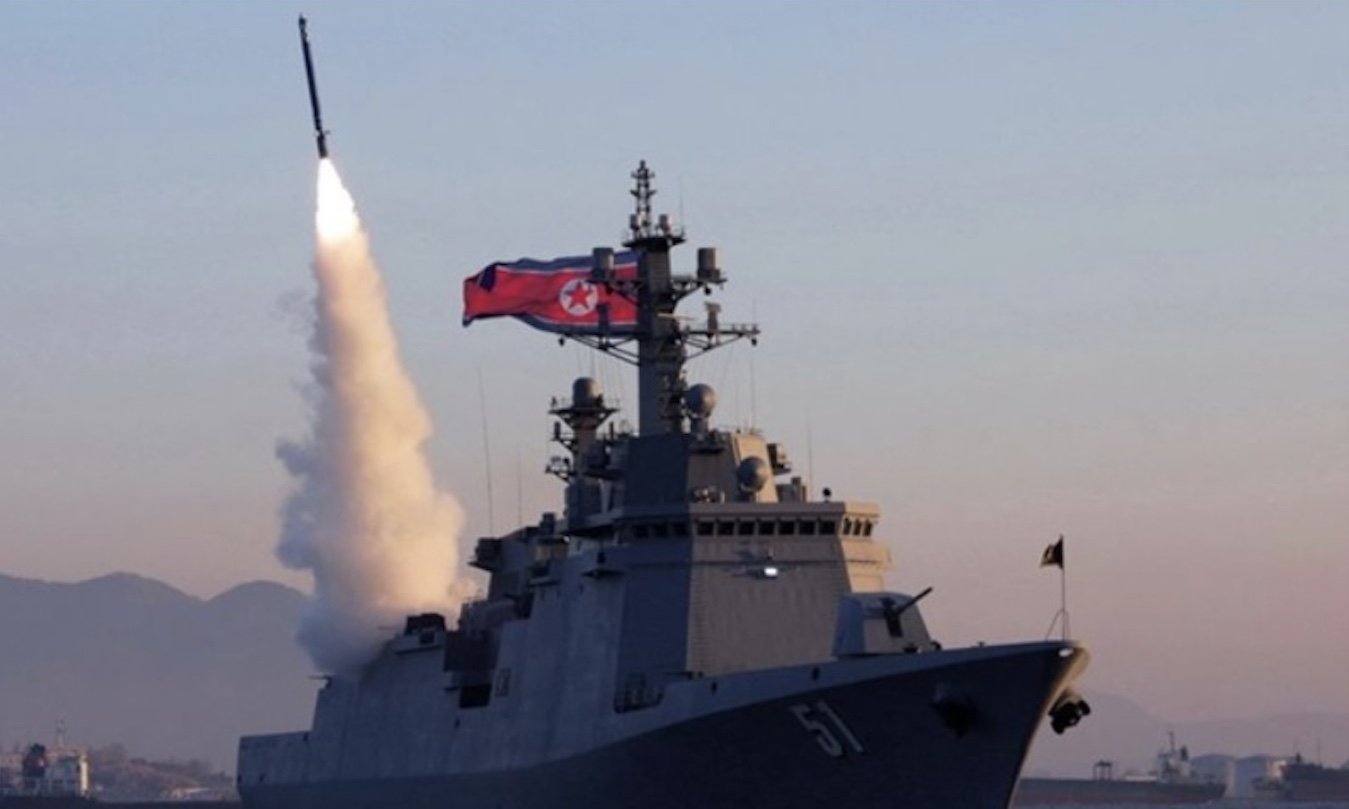
North Korea has conducted a significant series of missile tests from its newest and most advanced warship, marking a deliberate step toward deploying a more flexible and survivable nuclear deterrent at sea. The tests, personally overseen by Supreme Leader Kim Jong Un, involved firing strategic cruise missiles and anti-ship missiles from the 5,000-ton destroyer Choe Hyon during operational trials off the country's west coast.
A New Maritime Platform for Nuclear Signaling
The Korean Central News Agency (KCNA) stated the cruise missiles flew for over two hours and the anti-ship missiles for approximately thirty minutes before striking their targets with what it called "ultra-precision" accuracy. The primary goals were to evaluate the destroyer's integrated weapons command system and to enhance crew proficiency. Kim Jong Un reiterated that bolstering the country's nuclear capabilities remains an absolute priority, with KCNA explicitly describing the tested weapons as "strategic"—a term typically associated with nuclear delivery systems.
According to an April 2025 analysis by Joseph Bermudez Jr. and others for the Beyond Parallel project, the Choe Hyon is approximately 144 meters long and functions as a multi-mission destroyer. It is equipped with a substantial missile architecture, including 44 vertical launch cells for surface-to-air missiles and 30 larger cells for cruise or surface-to-surface missiles. Its armament also features close-in weapon systems, electronic warfare suites, a 127-millimeter gun, and a deck for helicopters or unmanned aerial vehicles. Analysts assess it can perform anti-air, anti-ship, anti-submarine, and anti-ballistic missile roles, with potential for hypersonic cruise and tactical ballistic missile strikes.
Evidence of Russian Technical Assistance
The ship's design and remarkably rapid construction—reportedly built in roughly 13 months—point to substantial foreign assistance. Naval analyst Mike Plunkett, in a June 2025 Wall Street Journal report, stated building such a vessel so quickly would be "impossible" without outside help, noting strong design similarities with Russia's Grigorovich-class frigates. The vessel also incorporates the Russian Pantsir-M air defense system. Plunkett suggested Kim Jong Un's visit to Russia in 2023 effectively served as a "sales pitch" for naval technology transfers, indicating deepening military cooperation between Pyongyang and Moscow as Russia's confrontations with the West continue.
This development occurs as other regional actors are modernizing their strategic postures. The integration of advanced platforms like the Choe Hyon parallels broader concerns about technological acceleration in military domains, such as the AI-driven risks emerging in South Asian militaries.
A Stopgap for an Immature Submarine Fleet
The Choe Hyon is viewed by security experts as an interim solution, compensating for the technical limitations of North Korea's submarine-based nuclear ambitions. While Pyongyang has showcased the Hero Kim Ok, a purported nuclear-powered submarine, the program faces profound challenges in reactor design, acoustic quieting, and long-term sustainment. The country's existing fleet of aging Romeo-class submarines is considered noisy, vulnerable, and likely confined to coastal bastion operations, offering limited credible second-strike capability.
"Taken together, Choe Hyon acts as a stopgap sea-based deterrent, buying time while North Korea’s submarine leg remains technically immature," the original analysis concluded. The destroyer provides a more immediate platform for nuclear signaling, crisis response, and potential sea-based strike operations against regional targets.
Command, Control, and Escalation Risks
The deployment of such a platform also highlights evolving tensions within North Korea's nuclear command and control (NC2) structure. The country's 2022 Law on Nuclear Forces asserts the "monolithic" command of Kim Jong Un but also contains provisions for an "automatic and immediate" nuclear strike if the national command system is endangered. This creates a tension between centralized personal authority and pre-planned automaticity.
An August 2022 report by the US Defense Threat Reduction Agency (DTRA) suggested North Korea may adopt a hybrid NC2 model. Under this framework, Kim would retain sole launch authority over strategic, long-range systems like intercontinental ballistic missiles (ICBMs), while limited delegation could be granted for the use of tactical nuclear weapons deployed with frontline units. This approach aims to improve survivability and responsiveness while avoiding the political risk of full devolution of authority.
In practice, this likely means Kim retains absolute control over weapons aimed at the US homeland, while the nuclear-capable cruise missiles aboard the Choe Hyon could be designated as theater assets. Their use might be governed under tightly controlled, potentially pre-authorized conditions for regional contingencies, aligning with a shift toward a regional nuclear warfighting doctrine.
Strategically, dispersing nuclear assets to sea aboard a surface combatant like the Choe Hyon may enhance survivability compared to fixed land-based sites. However, it introduces significant escalation risks, particularly because its cruise missiles could be armed with either conventional or nuclear warheads, creating ambiguity for adversaries during a crisis. This ambiguity complicates the decision-making calculus for the United States, South Korea, and Japan, and is part of a wider regional pattern where security dynamics are increasingly interlinked, much like the reassessments prompted by conflict in the Middle East.
The advancement of North Korea's sea-based deterrent underscores a persistent and adaptive challenge to regional security. It reflects Pyongyang's determined pursuit of a layered nuclear arsenal and demonstrates how its military partnerships, particularly with Russia, are yielding tangible capabilities that alter the strategic balance in Northeast Asia.