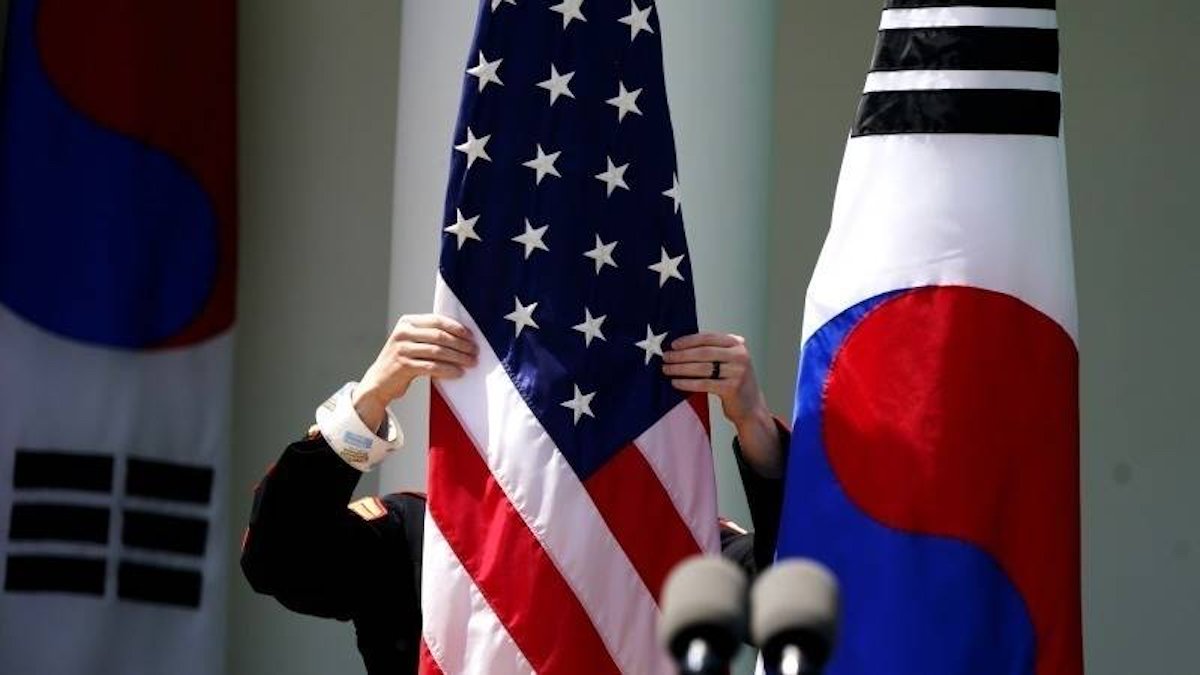
South Korea's lavish spending on Washington influence has not translated into the policy dividends Seoul might have expected. In July, Republicans on the House Judiciary Committee released an interim report accusing South Korea of “discriminatory attacks on American-owned businesses,” citing coercive investigations, burdensome regulations, and hefty fines aimed at disadvantaging US firms competing with Korean companies. The probe, launched in February over Seoul's handling of a data breach at Coupang, drew on internal documents and testimony from the US-listed e-commerce giant.
Seoul dismissed the report as one-sided, but South Korean lawmaker Lee Ki-heon pointed a finger at an unexpected culprit: the Ministry of Foreign Affairs. “Why has the Ministry of Foreign Affairs failed to build a human network in the US Congress?” he asked. “Despite investing so much money and time, it's incomprehensible that a 'human network' hasn't been established. Meeting only with [congressional] aides amid such a major incident is shameful.”
A decade of record spending
The numbers behind Lee's frustration are striking. According to investigative reporter Brody Mullins, South Korea's government and affiliated entities spent $363 million on lobbying and influence in Washington over the past decade, based on OpenSecrets' tally of Foreign Agents Registration Act (FARA) filings. In 2024 alone, Seoul spent nearly $38 million, and at least $11.8 million in the first half of 2026, placing it consistently among the top ten FARA spenders—alongside Saudi Arabia and China, whose economy is roughly ten times Korea's size.
Government entities accounted for nearly two-thirds of the total, more than $236 million. From January 2021 through June 2026, the Korea Trade-Investment Promotion Agency spent an estimated $85 million, the Korea Tourism Organization $33.1 million, and the Korea Institute for International Economic Policy $15.4 million. The Korean Embassy itself clocked another $10 million, according to US Justice Department records.
On the corporate side, familiar names dominate. Samsung spent $6.98 million on lobbying in 2024, nearly double its 2021 total, while SK Group spent $5.59 million and Hyundai Motor Group $3.28 million, per Senate filings. These companies lobby through US subsidiaries under the Lobbying Disclosure Act rather than FARA.
Heavy hitters on the payroll
Mullins counts 29 Washington firms and more than 180 registered foreign agents working for Seoul between 2021 and 2025. The embassy's principal lobbyist is Thomas Sung-Hoon Kim, who has represented Korea since 2004 through his firm, Thomas Capitol Partners, for about $500,000 a year. Other firms on Seoul's payroll include Brownstein Hyatt Farber Schreck, BGR Group, Akin Gump, Mercury Public Affairs, Squire Patton Boggs, Qorvis, and DGA Group. Brownstein's Korea team has included former Democratic Senators Mark Pryor and Mark Begich.
Mercury holds particular sway in Trumpworld: White House Chief of Staff Susie Wiles co-chaired its Florida and Washington offices before joining the administration. Shortly after Trump's 2024 victory, the Korean Embassy signed a $240,000-a-year contract with the firm.
Access, but little influence
That money buys access, if not always results. FARA filings show that from January 3, 2025, a Mercury lobbyist spoke weekly with National Security Council chief of staff Brian McCormack on Korea's behalf, continuing until McCormack left the White House in July. In the second half of 2025, however, Mercury reported only two contacts for Korea—one with a Homeland Security official and one with a White House aide—while collecting a $120,000 retainer.
On Capitol Hill, Kim's political donations have been strategic. In the six months ending November 2025, he made 48 donations to members of Congress and their PACs, totaling over $500 per recipient. Mullins found that every congressional office receiving such donations also had staff contacted on Korea's behalf in the same period.
Seoul's lobbyists also work the big stages. At the 2024 presidential conventions, they secured credentials for then-Ambassador Cho Hyun-dong at both parties' gatherings. In Chicago, Brownstein used money and party connections to get him into a luxury suite, a skybox, and onto the convention floor. They arranged meetings with senior members of the Senate Judiciary, Senate Foreign Relations, and House Armed Services committees, as well as with the House's second-ranking Democrat and a senior appropriator to discuss the defense authorization bill.
Among the most active lobbyists is Ed Royce, former chairman of the House Foreign Affairs Committee, who joined Brownstein in 2020 and registered as a foreign agent for Korea the next year. Since March 2023, FARA records document more than 1,700 contacts by Royce with lawmakers, aides, and officials on Seoul's behalf.
Yet despite this extensive network, South Korea's influence in Washington appears limited. The House report and the lack of visible policy wins suggest that money alone cannot overcome the perception of unfair trade practices. As Seoul continues its economic success story, its diplomatic strategy may need a rethink—especially as tensions on the Korean Peninsula edge toward a new crisis. The contrast with other regional players is telling: while India-Philippines defense ties quietly bolster US deterrence in the South China Sea, Seoul's lobbying machine seems to be buying access without securing influence.