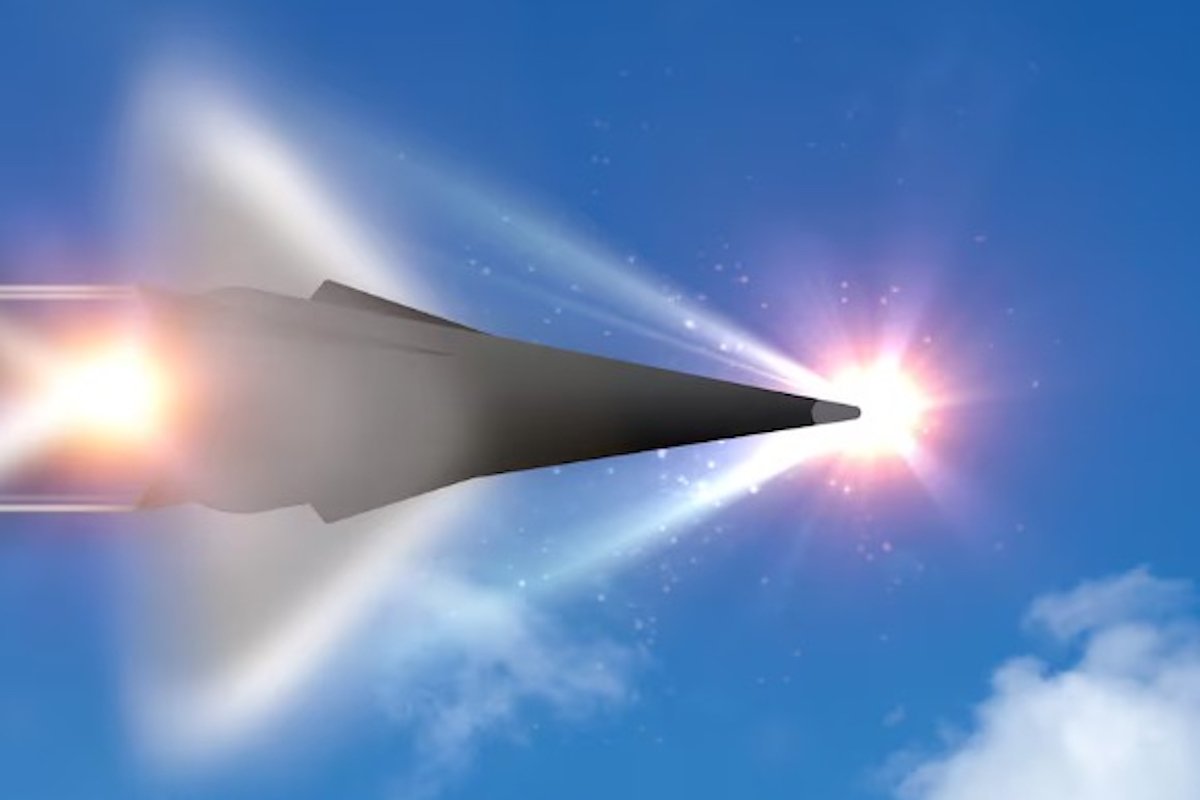
The United States is pushing ahead with plans for a new generation of hypersonic cruise missiles, betting that speed and maneuverability will restore its edge in long-range strike. But turning that ambition into a reliable wartime capability is proving harder than the physics alone, and the effort carries strategic risks that extend well beyond the Pacific.
This month, the Defense Advanced Research Projects Agency (DARPA) issued a request for information for a Next-Generation Hypersonic Cruise Missile demonstrator. According to the solicitation, the goal is a scramjet-powered weapon capable of flying above Mach 5 over distances ranging from 460 to 3,700 kilometers, with reduced radar and thermal signatures and agile midcourse maneuverability. The agency is calling for an affordable design that can be carried by fighter jets, bombers, or launched from surface platforms, and it is urging non-traditional defense contractors to submit ideas by October 2026.
The push comes as the US military grapples with the limits of its current arsenal. Legacy subsonic cruise missiles like the Tomahawk, long a staple of American power projection, may no longer be effective against a near-peer adversary such as China, which fields a dense, layered air defense network across the Indo-Pacific. Combat experience in Ukraine has also raised doubts about subsonic missiles: Major General Vadym Skibitskyi, deputy chief of Ukraine's Defense Intelligence, told RBC-Ukraine that when interceptor missiles are available, Ukraine has a 100% intercept rate against Russia's Kalibr cruise missile, the functional equivalent of the Tomahawk. Russia, he noted, is now shifting Kalibr stocks to reserve and ramping up production of harder-to-intercept ballistic missiles.
Cost and production hurdles
Yet the US hypersonic program has been plagued by cost overruns and testing failures. A July 2026 Government Accountability Office (GAO) report, cited by SOFREP's Guy McCardle, found that the Navy's Conventional Prompt Strike (CPS) missile costs about $67 million per round, with production running at less than half its target rate. The Army's Long-Range Hypersonic Weapon (LRHW) faced similar setbacks: four attempted test flights in 2023 and 2024 were disrupted by launcher defects, launch-sequence failures, and missile production-quality issues, delaying fielding by 18 months and increasing the initial battery cost by $150 million.
McCardle argues that while the US has mastered the physics of hypersonic flight, high unit costs and sluggish manufacturing prevent it from generating affordable combat mass. Commanders, he says, are left with weapons too costly to expend and replace in a sustained conflict. This is a critical gap, especially as China and Russia continue to field their own hypersonic arsenals.
Nuclear ambiguity and escalation risks
At the strategic level, the US hypersonic push may also blur the line between conventional and nuclear weapons. An August 2025 Congressional Research Service (CRS) report notes that US hypersonic weapons are currently conventionally armed, but warns that adversaries may be unable to distinguish conventional from nuclear-armed systems. A strike could be misread as a decapitating attack, potentially triggering unintended nuclear retaliation. This ambiguity is particularly dangerous in a crisis with China, where early warning systems and decision-making timelines are compressed.
Some analysts, like Xiaodon Liang, argue in a March 2026 Arms Control article that the US should pursue separate, clearly distinguishable systems to avoid this risk. But the current trajectory suggests a different path: integrating hypersonic technology into the nuclear arsenal could become more likely as the military seeks to maintain deterrence credibility. The false promise of nuclear deterrence in an unstable world is a lesson that Washington and Beijing would do well to remember.
For Asia, the stakes are high. Japan is already shifting toward counterstrike capability with its own long-range missile tests, while North Korea's missile exports to Russia are reshaping regional security dynamics. The US hypersonic drive, if it succeeds, could reassure allies like Tokyo and Seoul, but it also risks accelerating an arms race that no one can win.
The challenge for Washington is not just building a faster missile. It is building one that is affordable, reliable, and—above all—does not increase the risk of nuclear war. As the Pentagon races to close the gap with China, it must ensure that its new weapons do not become a source of instability in the very region they are meant to protect.