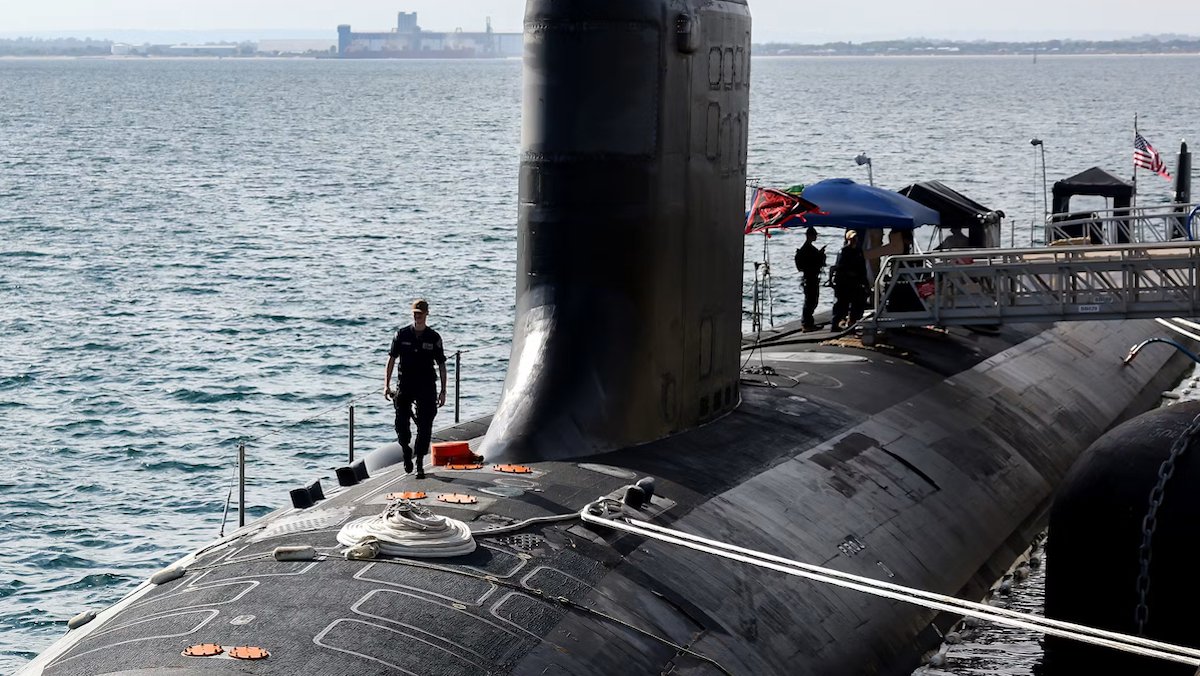
Australia's decision to acquire three used Virginia-class submarines from the United States, rather than a mix of new and used boats, has reignited debate over the AUKUS defense pact. The shift, announced recently, is a pragmatic response to a looming capability gap: Australia's Collins-class submarines, which entered service between 1996 and 2003, are aging faster than replacements can be built.
As a former Navy officer specializing in anti-submarine warfare, I often field questions about AUKUS. Here's what the latest deal actually means for Australia and the Indo-Pacific.
Why Used Submarines?
Australia's Collins-class boats are undergoing multi-year life extensions, but they won't last indefinitely. Decades of delays and underfunding have left the Royal Australian Navy without a viable replacement timeline. Under AUKUS, Australia plans to co-design and build nuclear-powered submarines domestically, but that process won't deliver boats until the 2040s at the earliest.
The purchase of three Virginia-class submarines—scheduled for delivery in 2032, 2035, and 2038—provides a stopgap. Think of it as a "crawl, walk, run" approach: the Virginias are the walk phase before Australia builds its own SSN-AUKUS submarines. Acquiring boats already in US service reduces risk, avoids the complexities of introducing a new submarine class, and eliminates the need for initial certification trials.
Critics have questioned whether Australia is getting less capable submarines. The third boat will be an older Block IV version, meaning its sensors may be slightly less advanced. But all three remain among the world's most capable attack submarines, carrying over 20 torpedoes and 12 Tomahawk land-attack missiles. Claims that Australia is losing missile capacity because the submarines lack the Virginia Payload Module are misleading: the boat Australia was originally slated to receive in 2038 was never intended to have that module. In a conflict, Australia would primarily use these submarines for anti-submarine and anti-ship roles, not land attack. The US has also made clear it is not willing to provide that extra capability.
The main trade-off is service life. A new Virginia-class submarine typically has a 33-year lifespan. The Australian Submarine Agency told Senate estimates that each boat will have more than 20 years of life remaining upon delivery. Claims of only eight years are unfounded: the Block IV submarines Australia will receive only began entering US service in 2020.
The Cost Question
The often-cited figure of AU$368 billion (US$255.3 billion) for AUKUS covers costs through 2055, including infrastructure, workforce, maintenance, the purchase of Virginia-class submarines, and building Australia's own boats. Of that, about AU$244 billion is projected cost, with AU$122.9 billion as a 50% contingency—money set aside for risks and cost growth. Most defense projects carry only 5-10% contingency. The Department of Defence's 2026 Integrated Investment Program estimates nuclear-powered submarines will cost between AU$71 billion and AU$96 billion over the next decade, representing about 8-11% of projected defense spending of AU$887 billion.
This is a massive investment, but it reflects the strategic imperative of maintaining a credible submarine capability in the Indo-Pacific, especially as China expands its naval presence. For context, South Korea's own nuclear submarine ambitions face similar budgetary challenges.
Can the US Deliver?
The most legitimate concern is whether the US submarine industrial base can produce enough boats for both its own needs and Australia's. After the Cold War, US production rates fell. Since 2011, the goal has been two submarines per year, but from 2016 to 2019, the average was just 1.9. The Covid-19 pandemic and the shift to building the larger Block V Virginia-class have further strained production. In May, Chief of Naval Operations Admiral Daryl Caudle told Congress he expects Virginia-class production to reach two boats per year around 2032. He previously noted that a rate of 2.3 per year is needed to meet the US Navy's 2054 goal, including the sale of three boats to Australia. Currently, the US builds about 1.3 per year.
These industrial challenges are real, but the US has not indicated it will cancel the sale. The AUKUS partners are investing billions to expand the submarine industrial base, and Australia has already established a submarine base near Perth, embedded personnel in US and UK programs, and secured US congressional approval for the transfers.
AUKUS is undeniably risky—it is the most complex defense project in Australian history. But much has been achieved in less than five years. The decision to buy used submarines is a calculated step to bridge a critical gap while building long-term capability. For the Indo-Pacific, the stakes are high: a credible Australian submarine force is a key deterrent in a region where China's naval modernization is accelerating.