The battlefield today is being reshaped by drones, a technology that has upended assumptions about air power and force projection. From Ukraine to the Middle East, unmanned aerial vehicles have proven their worth, challenging traditional military hierarchies and forcing even the most advanced armed forces to adapt. Yet this is not the first time a technological leap has transformed warfare. The ancient Near East offers two striking precedents: the chariot and the composite bow.
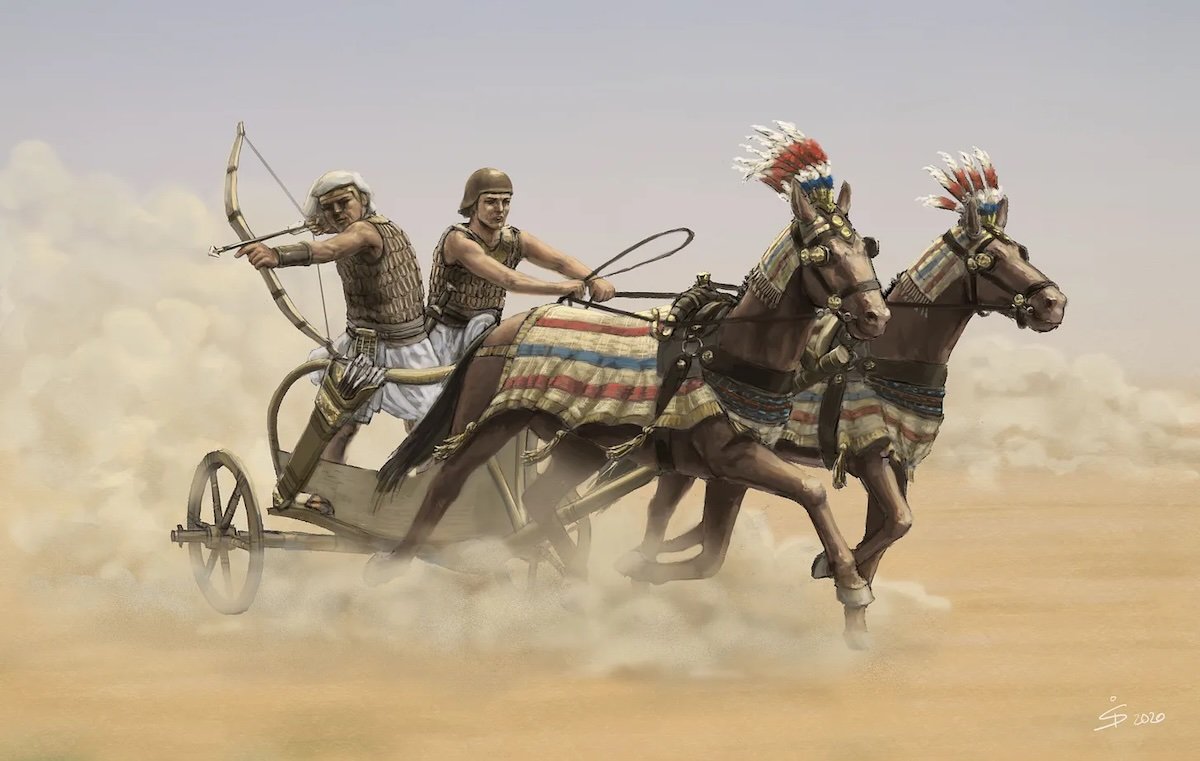
The chariot, perfected over centuries, became a dominant weapon for more than a millennium. Its design evolved to provide a stable platform for archers and spearmen, allowing forces to outflank infantry formations and break enemy lines. A typical chariot carried a driver, a melee fighter, and an archer, creating a mobile killing machine that could disrupt even well-organized armies. The chariot’s longevity underscores how a single innovation can define an era of conflict.
The Composite Bow: An Ancient Precision Weapon
The bow and arrow, known for over 10,000 years, had inherent flaws: breakage, string failure, and limited range. The composite bow, made from wood, horn, sinew, and fish bladder glue, addressed these issues. The fish bladder, processed into a durable adhesive, allowed the bow to withstand greater torsion and deliver arrows with enough force to penetrate armor up to three inches thick. This innovation gave chariot archers a decisive edge, as seen when the Hyksos used composite bows and chariots to overwhelm Egyptian forces.
The production of composite bows was a slow, labor-intensive process, often requiring a year of work by skilled artisans and slave labor. This suggests that the societies that mastered this technology were hierarchically organized and capable of sustained industrial effort—a parallel to modern defense industries. Today, fish bladder-derived isinglass is used in wound treatment, showing how ancient materials find new military applications.
The Bronze Age, which ended around 1200 BCE, relied on copper-tin alloys for weapons and armor. The collapse of trade networks that supplied these metals led to a shift in power, much as the rise of drones is altering the cost calculus of modern warfare. For example, the US military faces a costly dilemma as cheap Iranian drones challenge million-dollar missile defenses. Similarly, China has converted retired J-6 fighters into low-cost drones for potential contingencies in the Taiwan Strait, echoing the ancient principle of repurposing technology for asymmetric advantage.
In Asia, the drone revolution is reshaping strategies from Seoul to Jakarta. South Korea's potential role in the Quad highlights how drone capabilities factor into regional security alignments. Meanwhile, Japan's strategic ambiguity reflects the tension between pacifist rhetoric and the need to counter drone threats. The lesson from history is clear: military revolutions are rarely sudden; they build on incremental innovations that, when combined with organizational change, can upend the status quo.
As drones become cheaper and more accessible, the gap between great powers and smaller states narrows. The chariot and composite bow remind us that technology alone is not enough—it must be integrated into doctrine, training, and logistics. For Asia, where defense budgets are rising and territorial disputes simmer, understanding these ancient revolutions offers a framework for navigating the drone age.