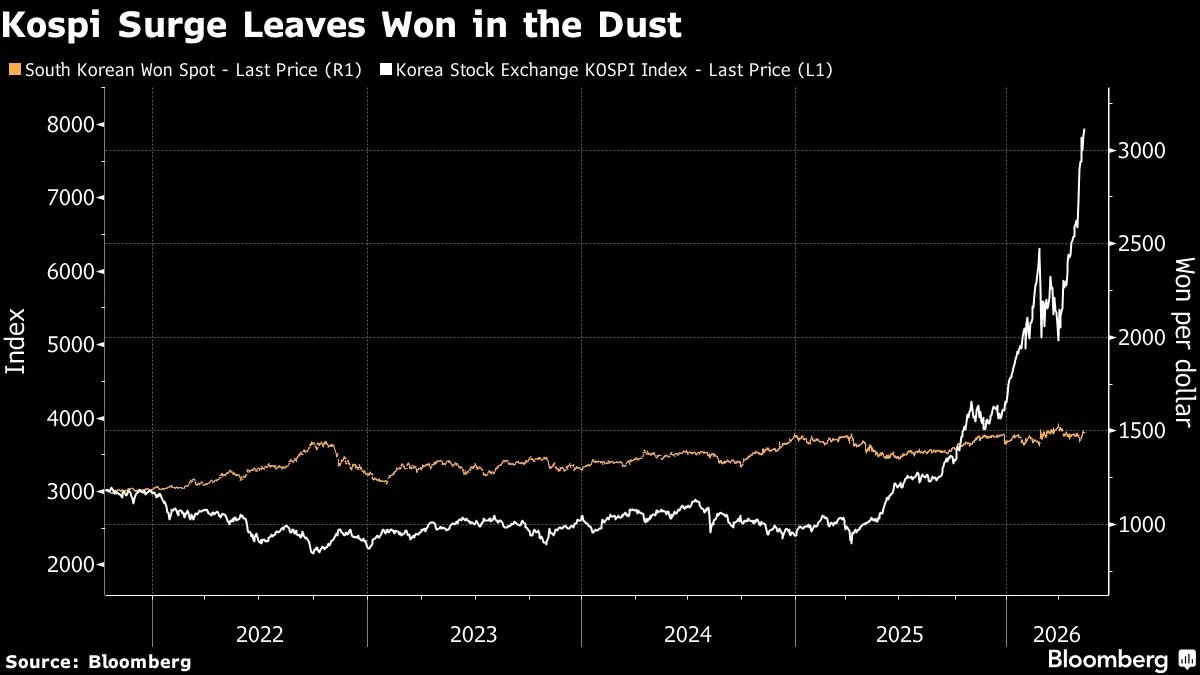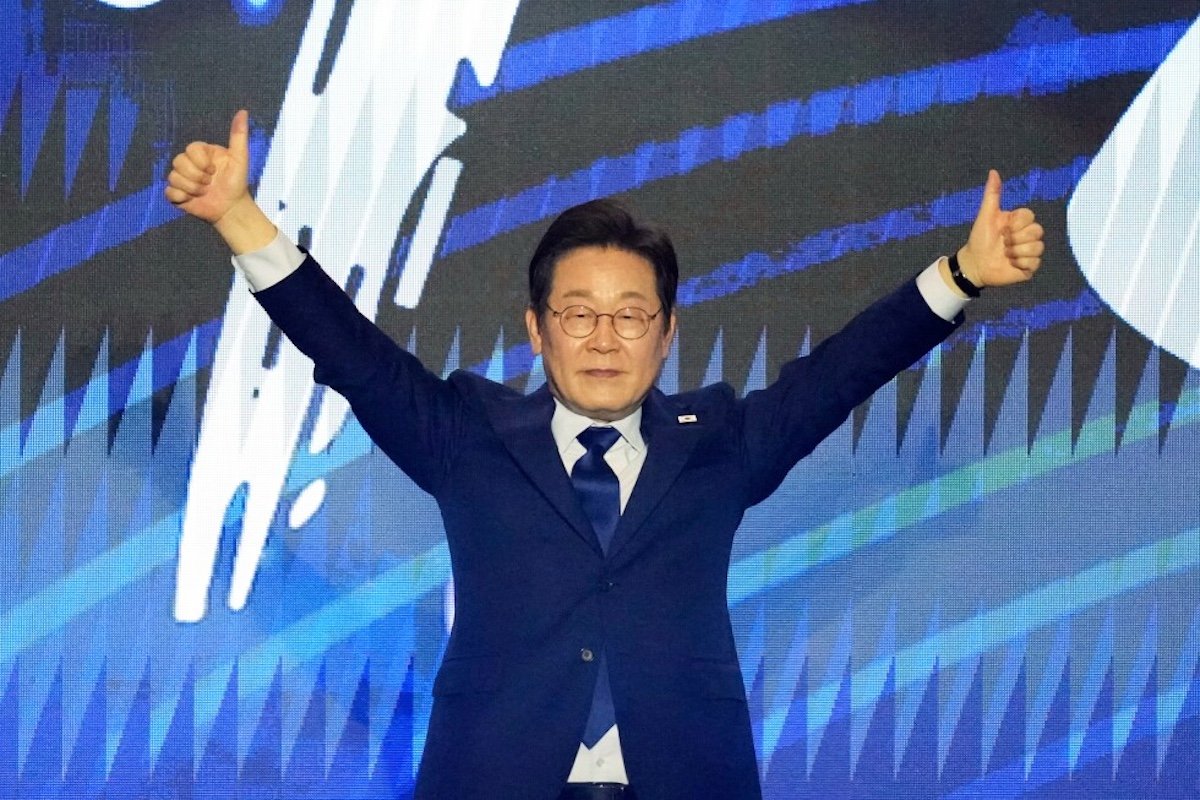
By one measure, President Lee Jae-myung’s first eight months in office have been a resounding success: the benchmark Kospi index has more than doubled. Before his election in June, Lee campaigned on a promise to push the index to 5,000—a target many dismissed as fanciful. At the time, the Kospi languished below 2,500. Lee pledged to reach that level within his five-year term. Thanks to a global surge in artificial intelligence stocks, he hit the mark in just over five months.
The rally has been fueled by heavy buying of semiconductor and AI-related shares, particularly Samsung Electronics and SK Hynix, which together account for a large share of the index’s weight. Foreign investors have poured capital into Seoul, betting on South Korea’s role as a key supplier of memory chips and high-bandwidth memory for AI data centers. The result: a Kospi that now trades above 5,000, a level that seemed improbable just a year ago.
Yet beneath the surface, the rally has done little to address the structural weaknesses that have long plagued South Korea’s financial markets. The so-called “Korea discount”—the tendency for Korean stocks to trade at lower valuations than their global peers due to weak corporate governance, opaque chaebol structures, and low dividend payouts—remains stubbornly in place. As Seoul leverages the Iran conflict to push financial reforms, the government has yet to deliver on promises to overhaul the system.
Reform promises, limited action
Lee Jae-myung’s campaign platform included ambitious pledges to reform the chaebol, improve shareholder protections, and reduce the influence of family-run conglomerates. But since taking office, concrete legislative steps have been slow. A proposed “Corporate Governance Improvement Act” remains stalled in the National Assembly, facing opposition from business lobbies and some lawmakers who argue that tighter rules could hurt competitiveness.
“The market is celebrating a cyclical boom, not a structural transformation,” said Kim Soo-kyung, an analyst at Seoul-based Daishin Securities. “Without real reform, the Kospi’s gains could prove fragile if the AI cycle turns.” Indeed, the rally has been narrowly concentrated: the top five stocks now account for more than 40% of the index’s market capitalization, raising concerns about overconcentration and vulnerability to sector shocks.
The government has taken some steps. In October, the Financial Services Commission announced measures to encourage companies to improve dividend policies and share buybacks. But critics note that these are voluntary guidelines, not binding rules. Meanwhile, the chaebol—led by Samsung, Hyundai, and LG—continue to operate with complex cross-shareholding structures that insulate controlling families from shareholder pressure.
Global context and regional comparisons
South Korea’s AI-driven rally mirrors trends in other markets, but the underlying challenges are distinct. In Japan, the Tokyo Stock Exchange has pushed for corporate governance reforms that have boosted valuations, while in China, regulators have tightened oversight of listed companies. South Korea, by contrast, has moved more cautiously. South Korea's AI boom masks deep structural vulnerabilities, including a heavy reliance on a few export sectors and a demographic crisis that threatens long-term growth.
Lee’s administration has also focused on foreign policy, including a recent visit to India aimed at deepening strategic ties. Lee Jae-myung's India visit tests a strategic partnership at a crossroads, as both nations seek to diversify supply chains and reduce dependence on China. But on the domestic economic front, the clock is ticking.
“The president has a strong mandate, but he needs to use it,” said Park Jae-won, a professor of economics at Korea University. “If he lets the AI boom do the heavy lifting, the next downturn could be brutal.” For now, the Kospi’s ascent provides a welcome political cushion. But the underlying question remains: is Lee’s government building a sustainable foundation, or just riding a wave?