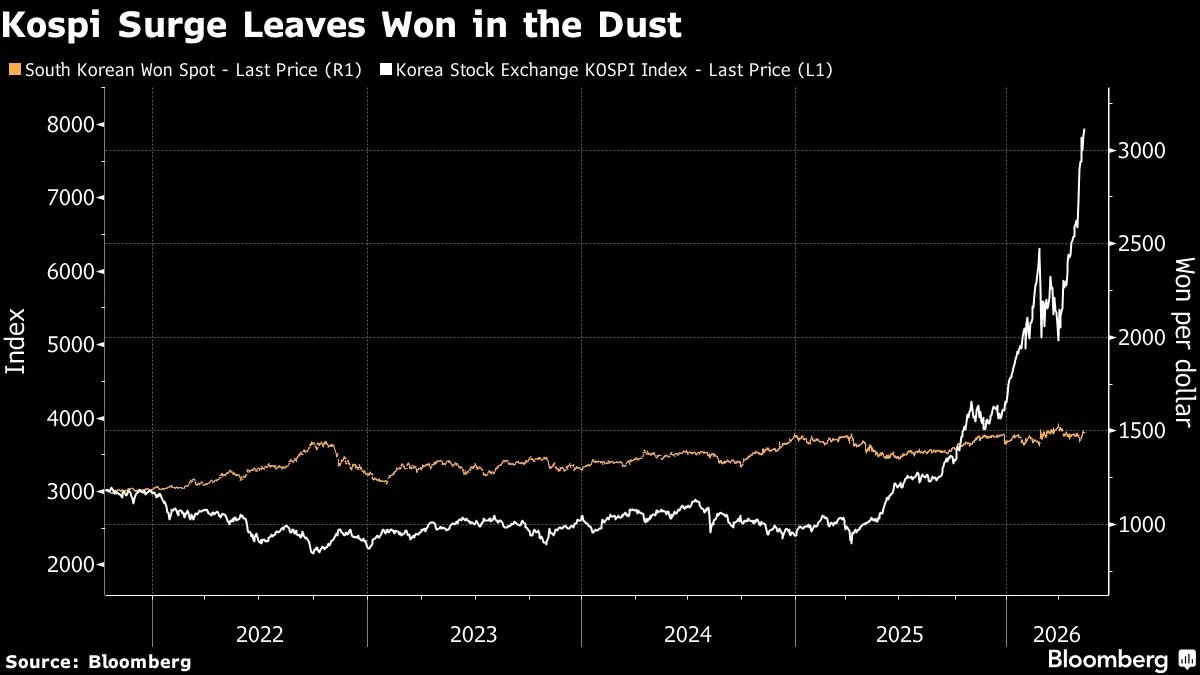
South Korean President Lee Jae-myung is seizing the geopolitical upheaval from the Iran conflict to push through long-stalled financial reforms, aiming to finally lift the persistent discount that weighs on the country's stock market. Speaking at a March 18 meeting in Seoul dedicated to building a capital market that is “strong in crisis and trusted by the people,” Lee explicitly invoked the principle of using emergencies to enact necessary but disruptive changes.
“At times like this, resolving the necessary measures and reform tasks is the way to prepare for a new start,” Lee said, channeling the spirit of Nobel laureate Milton Friedman. In his 1962 book Capitalism and Freedom, Friedman argued that crises create a unique window for governments to implement reforms that would otherwise face stiff resistance—when everyone is off balance, change becomes possible.
What Is the 'Korea Discount'?
The so-called Korea discount refers to the tendency for South Korean stocks to trade at lower price-to-earnings ratios compared to peers in developed markets, even when fundamentals are similar. Analysts attribute this to structural issues: weak shareholder protections, opaque corporate governance, low dividend payouts, and a chaebol-dominated economy where family-run conglomerates often prioritize insider interests over minority investors. For years, successive governments have pledged to address these problems, but meaningful progress has been limited.
Lee’s administration now sees the Iran war—which has roiled global energy markets and heightened uncertainty across the Indo-Pacific—as a catalyst. By framing reforms as a crisis response, Seoul hopes to overcome entrenched opposition from business lobbies and political factions. The strategy is not without precedent: Japan under Prime Minister Fumio Kishida similarly used the pandemic to push through corporate governance changes, and India under Narendra Modi leveraged the 2020 border standoff with China to accelerate economic self-reliance measures.
Key elements of the reform package include mandatory stewardship codes for institutional investors, stricter disclosure rules for conglomerates, and tax incentives for companies that boost dividends or buy back shares. The government is also considering measures to streamline the delisting process and improve the rights of minority shareholders. If successful, these changes could narrow the valuation gap with markets like Tokyo and Singapore, potentially unlocking billions of dollars in foreign investment.
However, skepticism remains. Critics point out that similar reform drives under previous presidents—including Moon Jae-in and Yoon Suk-yeol—yielded mixed results. The chaebol, which dominate sectors from semiconductors to shipbuilding, have historically resisted governance overhauls. Moreover, the current crisis environment could also distract from other pressing issues, such as South Korea's AI boom masking deep structural vulnerabilities and the evolving cost and reciprocity tensions in the US alliance.
Lee’s approach also carries geopolitical risks. The Iran conflict has already drawn in regional players, and North Korea has been adopting tactics from the Iran and Ukraine wars for its own combat playbook. Any miscalculation could escalate tensions on the Korean Peninsula, undermining the very stability that financial reforms depend on.
For now, Seoul is betting that the crisis will provide the necessary cover to push through changes that have eluded previous administrations. Whether the gamble pays off will depend on execution, political will, and the trajectory of the Iran conflict itself. As Lee’s team works to build a capital market that can weather future shocks, the rest of Asia will be watching closely—not least because a successful reform in South Korea could serve as a model for other markets grappling with similar governance challenges.