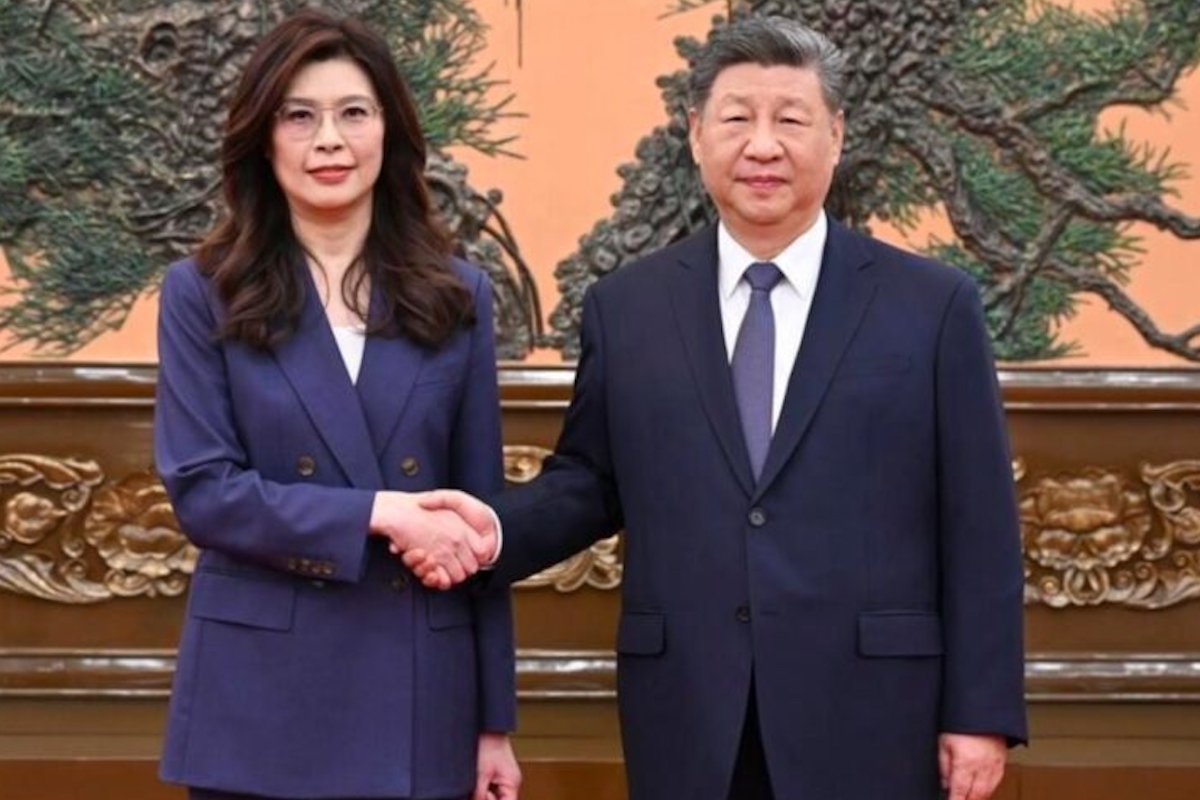
The recent meeting between Kuomintang (KMT) Chairwoman Cheng Li-wun and Chinese President Xi Jinping represents a significant diplomatic opening, the first of its kind in ten years. The visit, which included Beijing's announcement of ten economic and cultural incentives for Taiwan, suggests a potential thaw in cross-strait relations driven not by a sudden surge in pro-unification sentiment, but by a profound reassessment of geopolitical realities.
A Strategic Pivot Driven by American Ambiguity
Analysts observe that Taipei's overture is a direct response to perceived shifts in Washington's strategic posture. Under the Trump administration, the US has increasingly prioritized economic and technological competition with China, such as through tariffs and semiconductor restrictions, while appearing to deprioritize traditional security alliances. This was starkly illustrated by the redeployment of critical military assets, like the Terminal High Altitude Area Defense (THAAD) system from South Korea and the USS Tripoli from Japan, to the Middle East during recent conflicts.
These moves have amplified security anxieties in capitals like Tokyo, Seoul, and Taipei. The visible limitations of American extended deterrence during Iranian attacks on Gulf allies have further eroded confidence. Taiwanese policymakers are increasingly wary of finding themselves in a position analogous to Ukraine—heavily armed but strategically isolated—should a crisis erupt. The substantial US arms packages approved in late 2024 and 2025, while bolstering Taiwan's defenses, are seen by some as deepening the rift with Beijing without providing a clear strategic umbrella.
Previous American actions, such as former House Speaker Nancy Pelosi's 2022 visit to Taipei, are viewed as having deliberately aggravated tensions, leaving Taiwan to manage the consequences. The cumulative effect is a growing belief that Washington's commitments may be conditional and that the island's security cannot be taken for granted.
The KMT's Calculated Accommodation
The KMT's engagement with Beijing marks a notable evolution for a party that has long championed a separate Taiwanese identity. Chairwoman Cheng's trip signals a pragmatic shift toward "adaptive realism," where calculated accommodation is prioritized over US-backed confrontation. This is more than simple hedging; it reflects a reassessment of regional alignments where de-escalation with China becomes a strategic necessity.
Beijing's announced incentives—resuming tourist flows from Shanghai and Fujian, allowing Taiwanese TV dramas on the mainland, and facilitating food exports—are designed to foster economic interdependence. This approach aligns with a broader pattern of China's economic influence reshaping regional dynamics, pressuring neighbors to navigate between US and Chinese interests.
The strategic recalculations in Taipei occur within a wider Indo-Pacific context of states adjusting to great power competition. Similar balancing acts are evident in Indonesia's foreign policy deliberations and were a subtext during South Korean opposition leader Lee Jae-myung's recent visit to India. The reliability of American security guarantees is a recurring question across the region.
Furthermore, China's growing diplomatic leverage in other theaters, such as its pivotal role in Middle Eastern diplomacy, complements its pressure on Taiwan. Concurrently, Beijing continues to develop asymmetric military capabilities, including advanced systems that could complicate any potential US intervention in a Taiwan scenario.
The trajectory suggests Taiwan's drift toward pragmatic engagement with Beijing is likely to persist as long as American strategic indifference is perceived to continue. Should the KMT return to power, this could lead to a sustained period of reduced cross-strait tensions. However, this recalibration also carries risks, potentially altering the delicate status quo that has maintained peace for decades. The visit underscores a fundamental truth: in the high-stakes arena of Indo-Pacific security, allies are watching Washington's actions closely, and their strategic choices are evolving in response.