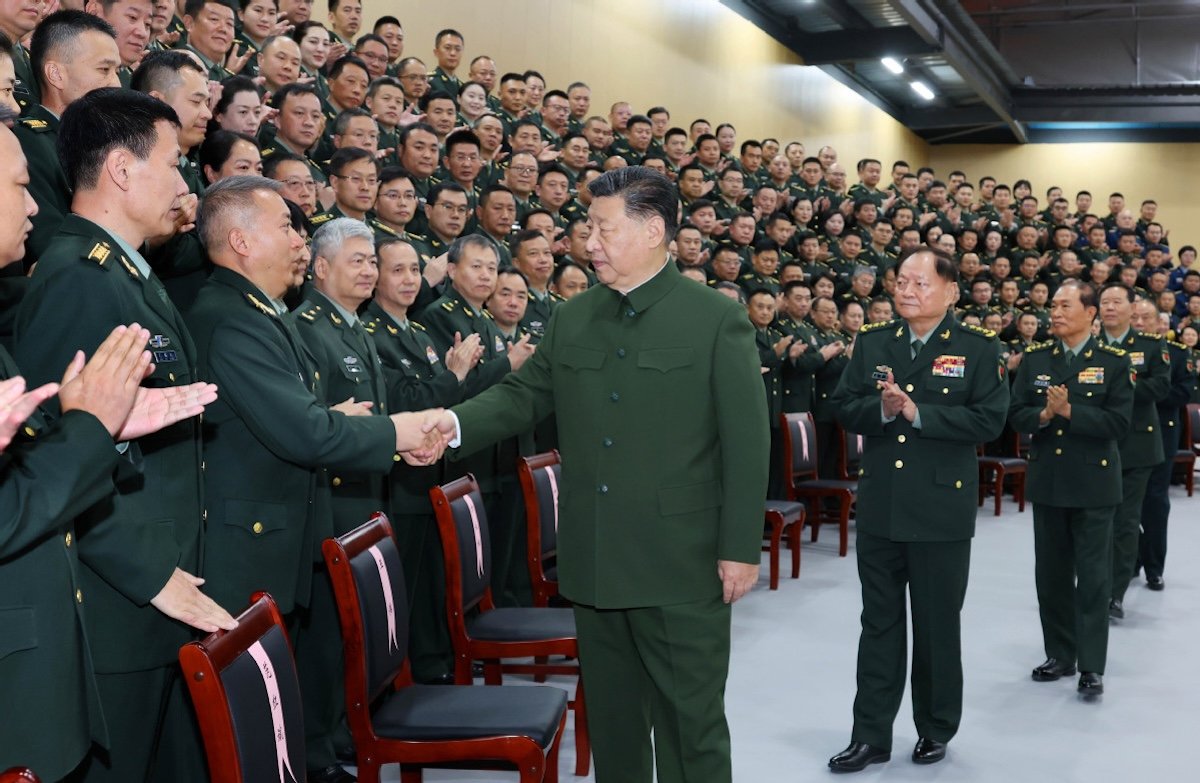
In late January, Chinese leader Xi Jinping ordered the arrest of two four-star generals from the People's Liberation Army (PLA), General Zhang Youxia and General Liu Zhenli, on charges of corruption. This purge, the most significant since Xi's anti-corruption campaign began in 2012, has left the Central Military Commission (CMC) with only two members: Xi himself and General Zhang Shengmin. Western analysts often frame such moves as signs of paranoia or fragmentation within the Chinese Communist Party (CCP), but a deeper understanding requires examining the concept of 'Chinese characteristics'—the unique civil-military relations that define the PLA as a party-army.
The Roots of the Purge: Combat Readiness and Taiwan
The timing of this purge is closely linked to Xi's strategic goals, particularly his directive for the PLA to achieve full combat readiness for a potential Taiwan operation by 2027. This deadline aligns with the 21st CCP Congress, where Xi is expected to secure a fourth term as president. However, General Zhang Youxia, a veteran with war-fighting experience, reportedly questioned the feasibility of this timeline, citing gaps in joint operations, training, and doctrine. This conflict over readiness principles was exacerbated by the US military's Operation Absolute Resolve in Venezuela, which demonstrated a capability gap that Zhang and others argued the PLA could not bridge quickly.
Xi's vision for a world-class military by 2049 requires the PLA to abandon historical privileges and adopt modern strategies. The 2016 reforms restructured the PLA from a defense-oriented, army-centric force into one capable of joint offensives, but resistance from senior generals like Zhang Youxia has persisted. Zhang, a 'princeling' with ties to Xi since childhood, had previously moderated Xi's anti-corruption campaign, advocating for a decentralized collective responsibility system that undermined the Chairman Responsibility System Xi implemented to consolidate personal control over the military.
Chinese Characteristics: Party Over Army
The PLA's formal name—People's Liberation Army—belies its true nature as the armed wing of the CCP, not the Chinese state. This 'party-army' concept means that a general's position within the CCP hierarchy takes precedence over military rank. Xi has reinforced this by serving as CMC chairman, a role that grants him absolute authority over military decisions, strategic planning, and personnel. Zhang Youxia's resistance to this system, including his attempts to moderate the anti-corruption campaign, challenged Xi's vision of absolute party leadership.
This purge is not merely about corruption but about enforcing 'Chinese characteristics' in the PLA. Xi's approach contrasts with Western models where the military serves the state. Instead, he insists that the PLA must embody 'people's democracy' under CCP control, a principle that has been central to Chinese governance since Mao Zedong. The recent arrests signal that Xi will not tolerate any deviation from this path, especially as he prepares for a potential Taiwan conflict.
Implications for the Indo-Pacific
The purge has broader implications for regional security. Xi's focus on Taiwan by 2027 has already prompted shifts in Indo-Pacific defense postures, as seen in Japan's combat role in Balikatan exercises and cost asymmetry reshaping defense strategies. The PLA's internal turmoil could affect its ability to project power, but Xi's consolidation of control may also lead to a more unified and aggressive military stance.
Meanwhile, China's technological and economic influence continues to expand, with Chinese tech firms testing in Gulf states and Chinese-linked tankers testing US blockades. These developments highlight the interconnected nature of Asia's security landscape, where internal CCP dynamics can have ripple effects across the Indo-Pacific.
As Xi pushes forward with his reforms, the PLA's evolution under 'Chinese characteristics' will remain a critical factor in regional stability. The purge of Zhang Youxia and Liu Zhenli is a stark reminder that loyalty to the party, not military expertise, is the ultimate currency in Xi's China.