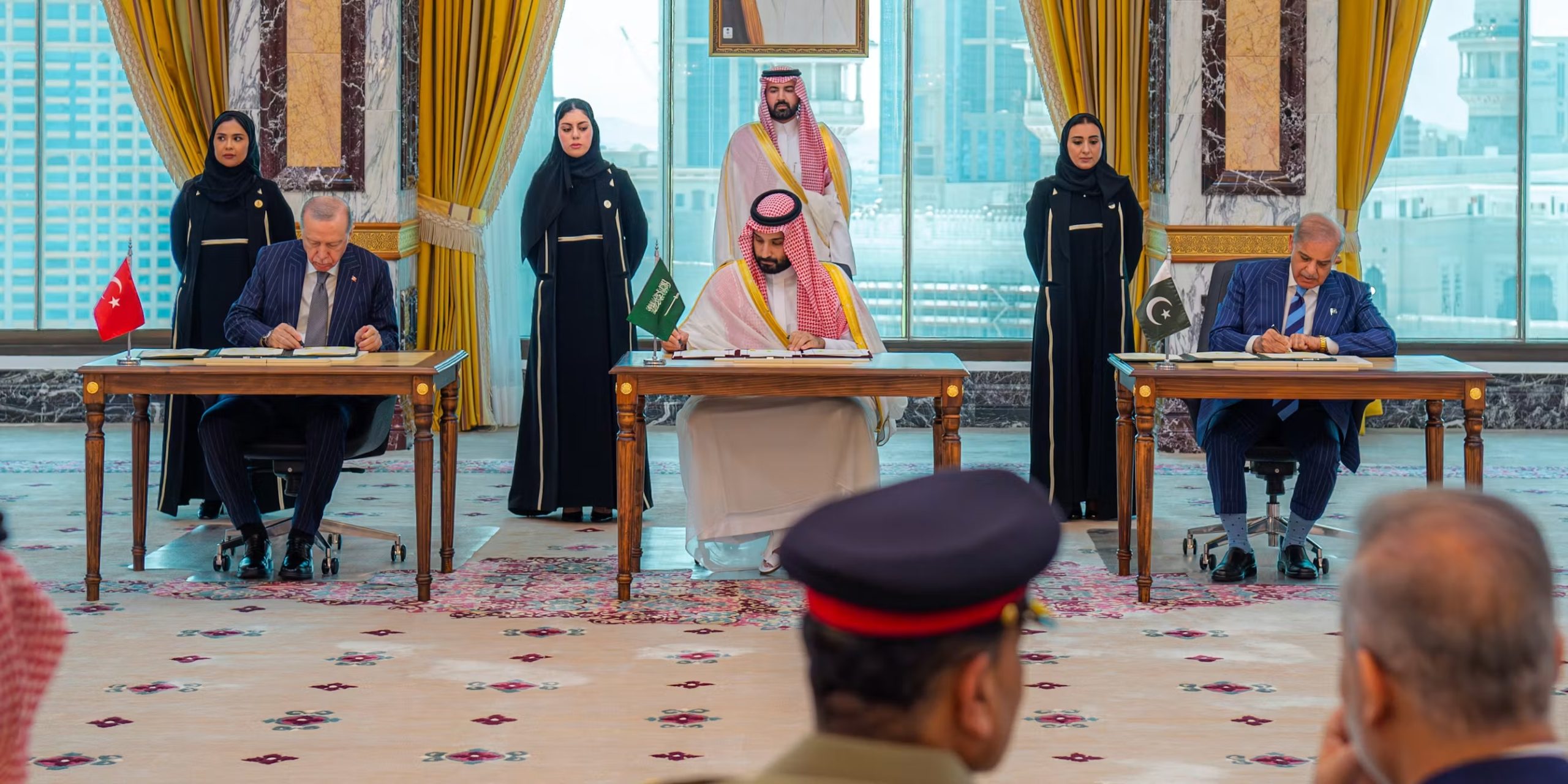
In a move that has drawn comparisons to NATO's Article 5, Saudi Arabia, Turkey, and Pakistan have signed the Mecca Joint Defense Pact, a collective defense arrangement linking the Middle East with South Asia. The pact's core promise—that an armed attack on one is an attack on all—has prompted talk of a new 'NATO of the East.' Yet a closer look reveals that this agreement is more about strategic insurance than a fully-fledged military alliance.
Complementary Strengths, Divergent Interests
The trio brings together distinct capabilities: Saudi Arabia's financial heft and energy leverage, Turkey's NATO-grade military and growing defense industry, and Pakistan's large army and nuclear arsenal. For Riyadh, the pact protects its Vision 2030 infrastructure from regional instability. Ankara sees a chance to expand defense exports and assert autonomy beyond NATO. Islamabad gains diplomatic relevance and potential investment, while maintaining its ties with Beijing.
These are not new relationships. Pakistan and Saudi Arabia signed a strategic defense agreement in September 2025, and Turkey-Pakistan military cooperation has deepened in training and electronics. Saudi-Turkish ties have also warmed after years of friction. The pact formalizes existing bonds rather than creating them from scratch.
Why Now? The Erosion of US Guarantees
The timing reflects declining confidence in the US-led security order. The war initiated by the US and Israel on Iran has exposed Gulf states to missile and drone attacks, despite their efforts to stay out. Saudi Arabia has been drawn into a conflict it did not choose, prompting a search for alternative security partners. Turkey, a NATO member, is building partnerships beyond the alliance, while Pakistan seeks to balance its US and China relationships.
This does not mean abandoning Washington. Turkey remains in NATO, and both Saudi Arabia and Pakistan retain important US ties. Instead, the pact adds a layer of protection should American commitments prove conditional or slow in a crisis.
The Nuclear Question
Pakistan's nuclear weapons give the pact weight, but they do not automatically extend a nuclear umbrella over Riyadh or Ankara. Extended deterrence requires detailed arrangements—consultation procedures, command structures, and clear conditions for use—none of which have been publicly announced. The signatories call the pact defensive, not nuclear, but this ambiguity risks miscalculation by rivals rather than a credible deterrent.
Obstacles to a True Alliance
Collective defense is credible only when members share threat perceptions and are willing to bear costs for each other. That is far from assured. Turkey must balance its NATO obligations and its complex ties with Iran and Russia. Pakistan wants to avoid being dragged into Middle Eastern wars while managing tensions with India and its western border. Saudi Arabia may seek protection without accepting all the institutional commitments.
As US deterrence fades, the pact could evolve into a more robust alliance, but that depends on resolving these deep questions. For now, it is a political statement with military undertones, not a new NATO. The reshaping of regional security is real, but its direction remains uncertain.
The pact also intersects with broader shifts in the Indo-Pacific. Pakistan's diplomatic wins now face the test of real investment, and its strategic gamble at Gwadar port is still fast closing. Meanwhile, the Iran-Iraq-Pakistan axis of sympathy adds another layer to Southwest Asia's security landscape.
In the end, the Mecca pact is a hedge, not a transformation. Whether it matures into a credible military alliance or remains symbolic will depend on how these three governments navigate their conflicting interests and the evolving regional order.